The Art of the Perfect Picnic: A Practical Guide with History
There is something almost conspiratorial about a picnic. You gather your provisions, pack your basket, find your patch of grass, and for a few hours you opt out of the ordinary arrangements of eating — the table, the chair, the roof overhead — in favour of something older and more pleasurable. The food tastes better outside. The wine is colder. The conversation is easier. The afternoon stretches. This is not an accident. It is the result of centuries of refinement in the art of eating outdoors, and it is worth understanding how we got here.

A Brief History of the Picnic
The word “picnic” entered English from the French pique-nique, which appeared in the late seventeenth century to describe a fashionable form of communal dining in which each guest contributed a dish or a bottle. It was, in its origins, an indoor affair — a kind of potluck supper among the French bourgeoisie — and it had nothing necessarily to do with grass or fresh air. The outdoor dimension came later, as the Romantic movement of the late eighteenth and early nineteenth centuries transformed the natural landscape from a place of danger and inconvenience into a place of beauty and spiritual refreshment.
By the 1820s and 1830s, the picnic had become a fashionable outdoor entertainment among the English upper and middle classes, celebrated in novels, depicted in watercolours, and organised with considerable logistical ambition. The great Victorian picnic baskets — fitted with compartments for plates, glasses, cutlery, and condiment jars, packed into wicker cases with leather straps — were engineering achievements as much as domestic objects. They were designed to make the outdoors as comfortable as the dining room, and they succeeded.
The picnic's most famous artistic moment came in 1863, when Édouard Manet exhibited Le Déjeuner sur l'herbe at the Salon des Refusés in Paris. The painting — which showed two clothed men lunching on the grass with a nude woman, the remains of a picnic scattered in the foreground — caused a scandal that had more to do with its frank modernity than with its subject matter. But it also fixed the picnic in the cultural imagination as a symbol of leisure, freedom, and the pleasures of the open air. The Impressionists who followed Manet — Monet, Renoir, Berthe Morisot — returned to the outdoor meal again and again, drawn by the light, the informality, and the sense of life lived at its most pleasurable.
The red and white gingham tablecloth — now so inseparable from the idea of the picnic that it has become a kind of shorthand for the whole ritual — became widespread in the mid-twentieth century, when gingham fabric was cheap, cheerful, and easy to wash. It is a democratic detail, available to everyone, and it has outlasted every fashion to become one of the most recognisable patterns in domestic life.
The Basket
A good picnic begins with a good basket. The classic wicker picnic basket — rectangular, with a hinged lid or two flaps, fitted with leather or canvas straps — has been the standard form since the Victorian era, and it remains the best option for a reason: wicker is light, strong, breathable, and beautiful. It keeps food at a stable temperature better than most synthetic alternatives, and it looks right on a patch of grass in a way that a cool box never quite does.
The fitted picnic basket — with compartments for plates, glasses, cutlery, and a cutting board — is the most practical option for a full spread. If you are travelling light, a simple wicker basket lined with a cloth and packed with a separate cool bag for anything that needs to stay cold is perfectly adequate. The essential items are: a cutting board (wooden, for bread and cheese), a good knife (a folding knife or a dedicated picnic knife with a wooden handle), a corkscrew, plates (ceramic or enamel, not plastic), cloth napkins, and glasses (real glass, if you can manage it — wine tastes better from glass).
A vacuum flask is worth including even in summer: hot coffee at the end of a picnic, when the afternoon has cooled and the wine is finished, is one of the small perfections of outdoor dining. A roll-up picnic blanket with a waterproof backing is essential; the ground is always damper than it looks.
The Food
The best picnic food shares certain qualities: it travels well, it can be eaten without much fuss, it improves with time rather than deteriorating, and it is generous enough to be shared. The great picnic traditions of Europe — the French pique-nique, the English hamper, the Italian scampagnata — all converge on the same basic formula: bread, cheese, cured meat, fresh fruit, and wine.
Bread should be good and substantial — a sourdough, a baguette, a country loaf. Sliced sandwich bread is convenient but lacks the structural integrity needed for outdoor eating. Bring more than you think you need.
Cheese is the heart of the picnic spread. A hard cheese — a good cheddar, a Comté, a Manchego — travels well and slices cleanly. A soft cheese — a brie, a camembert, a fresh chèvre — adds richness and pairs beautifully with fruit. Bring crackers as well as bread, and a small pot of good butter.
Charcuterie — salame, prosciutto, bresaola, a country pâté — adds depth and protein. A tin of pâté de foie with a good mustard is one of the most satisfying picnic provisions imaginable. Slice the salame at home and pack it between sheets of parchment.
Fresh fruit is essential: grapes, figs, pears, and apples all travel well and provide the sweetness and freshness that balance the richness of cheese and charcuterie. Strawberries are the classic English picnic fruit, but they bruise easily — pack them on top.
Something sweet to finish: a piece of dark chocolate, a few shortbread biscuits, a small tart if you are ambitious. The picnic dessert should be simple and portable.
The Wine
The picnic wine should be chosen for the occasion rather than for the cellar. It should be good — a picnic is not the place for bad wine — but it should not be so precious that you worry about the temperature or the glassware. A light red — a Beaujolais, a young Pinot Noir, a Barbera — can be served slightly cool and pairs well with charcuterie and cheese. A dry rosé is the classic summer picnic wine: versatile, refreshing, and beautiful in the glass. A crisp white — a Sauvignon Blanc, a Vermentino, an Albarino — works well with lighter food.
Keep the wine cool in a vacuum-insulated bottle or a small cool bag. Bring a proper corkscrew — the kind with a foil cutter and a double-hinged lever — and real glasses if you can manage the logistics. Wine from a plastic cup is a diminished experience.
The Place
The right location is as important as the right food. Look for shade in summer — a tree, a hedge, the shadow of a wall — and shelter from the wind. A slight elevation gives a view and keeps the ground drier. A park, a riverbank, a hillside, a beach at low tide, a meadow in the late afternoon: the picnic is adaptable to almost any landscape, and part of its pleasure is the act of choosing and claiming your particular patch of the world for a few hours.
Arrive early enough to settle in before you eat. Lay the blanket, unpack the basket, open the wine. Let the afternoon begin at its own pace. The picnic is not a meal to be rushed.

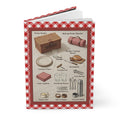
Our Picnic Journal celebrates the art of the outdoor table with two vintage-style illustrated guides — the essential picnic kit on the front cover, the perfect picnic spread on the back — on a classic red and white gingham background.
References
Bell, D., & Valentine, G. (1997). Consuming Geographies: We Are Where We Eat. Routledge.
Collingham, L. (2011). Curry: A Tale of Cooks and Conquerors. Oxford University Press.
Davison, J. (2014). Picnic: A History. AltaMira Press.
Robinson, J. (2015). The Oxford Companion to Wine. Oxford University Press.
Tannahill, R. (1988). Food in History. Crown Publishers.