The Owl in Victorian Culture: From Ancient Wisdom to Art Nouveau
The owl knows something. This has been the conviction of human beings across cultures and centuries — that the owl, with its forward-facing eyes and its silent flight and its habit of watching from the darkness, possesses a knowledge that daylight creatures cannot access. The ancient Greeks gave the owl to Athena, goddess of wisdom, and placed it on their coins. The Romans read omens in its call. Medieval Europeans feared it as a creature of ill omen, a companion of witches and a herald of death. The Victorians, characteristically, turned it into a parlour song.

The Ancient Owl
The association between the owl and wisdom is older than recorded history, but its most influential expression in Western culture is the Greek one. The Little Owl — Athena noctua, named for the goddess — was the sacred bird of Athena, the goddess of wisdom, craft, and strategic warfare, and it appeared on the silver tetradrachm of Athens, one of the most widely circulated coins of the ancient world. The image of the owl on the Athenian coin — facing forward, one eye visible, the other in shadow — is one of the most recognisable symbols of antiquity, and it established the owl as the emblem of wisdom, learning, and the city that considered itself the intellectual centre of the Greek world.
The Romans inherited the Greek association between the owl and wisdom, but they also developed a darker tradition. The strix — a screech owl or owl-like creature of Roman mythology — was a creature of ill omen, associated with witchcraft, blood-drinking, and the transformation of women into birds of prey. The call of an owl at night was an omen of death: Julius Caesar, Augustus, and Agrippa were all said to have been warned of their deaths by the call of an owl. This double tradition — the owl as wisdom and the owl as omen — persisted through the medieval period and into the early modern era, when the owl's association with darkness and the supernatural made it a standard companion of witches in popular imagination.
The Scientific Owl
The eighteenth and nineteenth centuries brought a new way of looking at the owl: the scientific one. The great tradition of natural history illustration — from Mark Catesby's Natural History of Carolina, Florida and the Bahama Islands (1729–1747) to Alexander Wilson's American Ornithology (1808–1814) to John James Audubon's Birds of America (1827–1838) — documented the owls of North America with a precision and beauty that transformed them from creatures of myth and superstition into subjects of scientific study and aesthetic admiration.
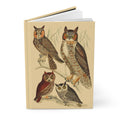
Alexander Wilson (1766–1813), the Scottish-born poet and weaver who emigrated to America in 1794 and became the father of American ornithology, was the first to document the owls of North America systematically. His hand-coloured engravings of the Great Horned Owl (Bubo virginianus), the Eastern Screech Owl (Megascops asio), and the Long-eared Owl (Asio otus) in American Ornithology (1808) are works of extraordinary precision and beauty — each owl captured with the individuality and vitality that distinguished Wilson's work from the more schematic illustrations of his predecessors. Wilson's owls look back at you. They have presence, character, and the unmistakable quality of creatures observed with devotion and rendered with love.
The scientific tradition did not diminish the owl's symbolic power — it enriched it. The more precisely the owl was observed and documented, the more remarkable it became: the asymmetrical ears that allowed it to locate prey by sound alone, the facial disc that functioned as a parabolic reflector for sound, the silent flight achieved through the comb-like serrations on the leading edge of the primary feathers, the ability to rotate the head through 270 degrees. The owl, examined scientifically, turned out to be even more extraordinary than mythology had suggested.
The Victorian Owl
The Victorians loved the owl with a particular intensity. It fitted perfectly into the Victorian sensibility: it was associated with learning and wisdom (the owl of Minerva, the owl of the university, the owl of the library); it was a creature of the night, which the Victorians found both frightening and romantic; and it was, in the hands of the natural history illustrators who flourished in the nineteenth century, genuinely beautiful. Victorian homes were full of owl imagery — on wallpaper, on ceramics, on embroidery, on bookplates, on the covers of the sheet music that was played in every middle-class parlour.
The parlour song was one of the defining cultural forms of the Victorian era. Before the gramophone and the radio, domestic music-making was the primary form of home entertainment for the middle classes, and the parlour piano was as essential a piece of furniture as the dining table. Sheet music publishers produced thousands of songs for the domestic market, and the covers of these songs — illustrated with chromolithographic prints of increasing sophistication — were themselves a form of popular art, collected and displayed as much as played.
H.W. Petrie's Owls Serenade (1894) is a characteristic example of the genre at its most charming. The song itself — a gentle, melodic piece in the parlour tradition — is less important than its cover: an Art Nouveau illustration of an owl perched on a branch, rendered with the sinuous lines, decorative elegance, and romantic atmosphere that defined the Art Nouveau aesthetic at its most appealing. The owl looks out from the cover with an expression that manages to be simultaneously wise, mysterious, and slightly amused — the perfect Victorian owl, at home in the parlour as much as in the forest.
Art Nouveau and the Night Bird
Art Nouveau — the decorative style that flourished in Europe and America between approximately 1890 and 1910 — was drawn to the natural world with a particular intensity, and the owl was one of its favourite subjects. The style's characteristic vocabulary of sinuous curves, organic forms, and decorative elegance was perfectly suited to the owl: the rounded body, the circular facial disc, the sweeping wings, the branch or vine on which it perched could all be rendered in the flowing lines that Art Nouveau made its own.
Owl imagery appeared throughout the Art Nouveau period — in the jewellery of René Lalique, in the ceramics of the Royal Doulton Lambeth studio, in the illustrations of Théophile Steinlen and Eugène Grasset, in the bookplates and ex libris designs that were a minor art form of the period. The owl's association with books and learning made it a natural subject for bookplate design, and hundreds of Art Nouveau bookplates featuring owls were produced in the 1890s and 1900s — small, exquisite works of graphic art that united the owl's symbolic associations with the decorative possibilities of the style.
The Owl Today
The owl has never lost its hold on the human imagination. It remains one of the most popular subjects in natural history illustration, wildlife photography, and decorative art — a creature that combines genuine biological extraordinariness with a symbolic richness accumulated over three thousand years of human attention. The forward-facing eyes that give it its uncanny, almost human gaze; the silent flight that makes it a creature of pure surprise; the call that carries across the dark — these qualities have made the owl a permanent resident of the human imagination, as at home in the mythology of ancient Athens as in the parlour songs of Victorian America.
To look at Alexander Wilson's Great Horned Owl, rendered with scientific precision in 1808, and then at H.W. Petrie's Art Nouveau owl, rendered with decorative elegance in 1894, is to see the same creature through two different but equally devoted kinds of attention — the naturalist's and the artist's, the scientific and the romantic, the daylight and the dark. Both are true. The owl contains them all.

Our Owls Serenade Journal unites Wilson's 1808 owl engravings from American Ornithology with Petrie's 1894 Art Nouveau sheet music cover — a dialogue across nine decades between natural history and Victorian popular culture, united by the enduring allure of the owl.
References
Armstrong, E. A. (1958). The Folklore of Birds. Collins.
Fordham, D. (2012). Alexander Wilson: The Scot Who Founded American Ornithology. Harvard University Press.
Houlihan, P. F. (1986). The Birds of Ancient Egypt. Aris & Phillips.
Mackay, C. (1841). Extraordinary Popular Delusions and the Madness of Crowds. Richard Bentley.
Swainson, W. (1836). On the Natural History and Classification of Birds. Longman.