The Fish That Built the North: Atlantic Salmon, Cod, and the Nordic Fishing Tradition
The history of Scandinavia is, in large part, a history of fish. Before the great Viking voyages, before the Hanseatic League, before the industrial age transformed the Nordic economies, the fish of the North Sea, the Baltic, and the Atlantic rivers were the foundation on which northern European civilization was built. Two species above all others defined this relationship: the Atlantic salmon and the Atlantic cod.
The Salmon and the River
The Atlantic salmon — Salmo salar, the leaper — is one of the most remarkable animals in the natural world. Born in the cold, clear rivers of Scandinavia, it migrates to the open Atlantic, travels thousands of kilometres, and returns — years later, to the exact river of its birth — to spawn. The precision of this navigation, accomplished without maps or instruments, across thousands of kilometres of open ocean, remains only partially understood.
For the peoples of Scandinavia, the salmon was not merely a food source but a cultural symbol. In Norse mythology, the salmon was associated with wisdom — the story of Fionn mac Cumhaill and the Salmon of Knowledge has its parallels in Scandinavian tradition. The great salmon rivers of Sweden and Norway — the Mörrum, the Ätran, the Gaula — were fished by royalty and commoners alike, and the rights to fish them were among the most valuable properties a landowner could hold.
By the 19th century, the Atlantic salmon had become the quarry of the sport fisherman as well as the commercial fisher. The fly-fishing tradition that developed in Britain and Scandinavia in the Victorian era transformed salmon fishing into an art form, with its own literature, its own equipment, its own aesthetic. The salmon fly — an elaborate construction of feathers, silk, and tinsel — became one of the most beautiful objects produced by the craft tradition of the 19th century.
The Cod and the Sea
If the salmon defined the rivers of Scandinavia, the Atlantic cod — Gadus morhua — defined its seas. The cod is not a glamorous fish. It lacks the salmon’s mythological associations and the trout’s sporting reputation. But for a thousand years, it was the most economically important fish in the North Atlantic, and its history is inseparable from the history of northern Europe.
The great cod fisheries of the North Sea and the Norwegian coast sustained the fishing communities of Scandinavia, Britain, and Iceland for centuries. Dried and salted, cod could be preserved for months and transported across Europe — it was the protein that fed medieval Europe through the winter, the commodity that drove the great fishing fleets of the Hanseatic League, the resource that brought European fishermen to the Grand Banks of Newfoundland decades before Columbus reached the Caribbean.
The Norwegian stockfish tradition — cod dried on wooden racks in the cold Arctic air of the Lofoten Islands — produced a product that could last for years without refrigeration and was traded as far as West Africa and the Caribbean. The word “bacalao” — salt cod — appears in the cuisines of Portugal, Spain, Italy, and Brazil, a testament to the reach of the Nordic fishing tradition.
Richter’s Fiskar: Science in the Classroom
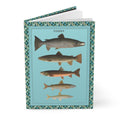
In 1939, Max Richter published his Fiskar series — Swedish school wall charts (skolplansch) produced by Norstedt & Söner, with chromolithography by Bengtsson. The charts were designed to bring the fish of Scandinavian waters into the classroom: to give Swedish students the visual vocabulary to identify and understand the species that had shaped their culture and economy for centuries.
Fiskar VI documented the salmonids — Atlantic salmon, sea trout, and their relatives. Fiskar III documented the gadoids — Atlantic cod, haddock, and the cold-water species of the North Sea and Baltic. Together, they constituted a visual encyclopedia of Nordic fish, rendered with the chromolithographic precision that was the highest standard of scientific illustration in the interwar period.
The skolplansch tradition of which Richter’s charts were a part had deep roots in Swedish educational culture. Wall charts had been used in Swedish classrooms since the mid-19th century, and the best of them — produced by publishers like Norstedt & Söner — combined scientific accuracy with the visual quality of fine art printing. Richter’s Fiskar series represented the tradition at its peak: scientifically rigorous, visually beautiful, and pedagogically effective.
What Remains
The Atlantic salmon and the Atlantic cod are no longer the abundant resources they once were. Overfishing, habitat destruction, and climate change have reduced both populations to fractions of their historical levels. The great salmon rivers of Scandinavia are carefully managed; the cod fisheries of the North Sea and Grand Banks have been subject to moratoriums and strict quotas. The relationship between the Nordic peoples and their fish has been transformed, from one of abundance to one of careful stewardship.
What remains is the record — in the skolplansch of Max Richter, in the fishing logs of generations of anglers, in the recipes and traditions of communities that built their lives around the fish of the northern waters. The chromolithographic plates of Fiskar III and Fiskar VI are documents of a relationship between people and fish that is still being negotiated, still being written.

Our Max Richter Fish Posters Journal carries Fiskar III and VI — the Atlantic salmon, cod, and the cold-water species of Scandinavian waters, documented by Richter with the chromolithographic precision of Swedish natural history education at its finest.
References
- Kurlansky, Mark. Cod: A Biography of the Fish That Changed the World. Walker & Company, 1997.
- Prosek, James. Trout: An Illustrated History. Knopf, 1996.
- Roberts, Callum. The Unnatural History of the Sea. Island Press, 2007.
- Richter, Max. Fiskar III & VI. Norstedt & Söner, Stockholm, 1939.