The Flower Painters of Amsterdam: Nicolas Robert, the Dutch Golden Age, and the Nederlandsch Bloemwerk of 1794
Share
In 1794, as revolutionary France was convulsing Europe and the Dutch Republic was entering its final years, a publisher named J.B. Elwe in Amsterdam produced something quietly extraordinary: a 54-plate collection of hand-coloured copperplate engravings celebrating the flowers of the Dutch Golden Age. He called it Nederlandsch Bloemwerk — Dutch Flower Arrangements — and credited it to a “company of scholars.”
It was, in its way, an act of cultural preservation: a last great flowering of the Dutch botanical publishing tradition, produced at the very moment when the world that had created it was about to disappear.
Nicolas Robert and the French Flower Painting Tradition
Among the sources that Elwe’s scholars drew upon was Nicolas Robert (1614–1685) — the greatest flower painter of 17th-century France, and one of the most important botanical illustrators in the history of European art.
Robert had begun his career painting flowers for Gaston d’Orléans, the brother of Louis XIII, whose garden at Blois was one of the finest in France. When Gaston died in 1660, Robert entered the service of Louis XIV, becoming the official peintre ordinaire pour la miniature — the king’s miniature painter — and spending the rest of his life documenting the plants of the royal gardens at Versailles and the Jardin du Roi in Paris.
His Variae ac multiformum species — a collection of flower paintings produced for the king — established the standard for botanical illustration in France for a generation. The precision of his observation, the delicacy of his colour, and the elegance of his composition made his work the model that every subsequent botanical illustrator in Europe aspired to match.
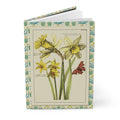
Plate XXVII of the Nederlandsch Bloemwerk — the plate that appears on the front cover of this journal — is based on Robert’s work. It documents three Narcissus varieties: Narcissus maximus pallidus (the pale large narcissus), Pseudonarcissus hispanicus (the Spanish daffodil), and Narcissus d’Argiers. A Comma butterfly rests among the stems — a detail that connects botanical study with entomological observation in the tradition of the great Dutch natural history illustrators, from Maria Sibylla Merian to Jan van Kessel.
The Dutch Botanical Publishing Tradition
The Nederlandsch Bloemwerk was the product of a publishing tradition that had made Amsterdam the centre of the European botanical world for more than a century. From the great herbals of the 16th century to the flower books of the 17th, Dutch publishers had understood that botanical illustration was not merely a scientific tool but an art form — and that the flowers of the Dutch Golden Age, cultivated with extraordinary skill and traded across the world, deserved the most beautiful portraits that the engraver’s art could produce.
By 1794, that tradition was coming to an end. The Dutch Republic was in decline, the great botanical publishing houses were closing, and the world of hand-coloured copperplate engraving was about to be transformed by the new technologies of the 19th century. The Nederlandsch Bloemwerk was, in a sense, a farewell — a last, magnificent celebration of everything that Dutch botanical publishing had achieved.
The back cover plate — by H.L. Myling after P.T. van Brussel — captures this spirit perfectly. The Cornflower (Centaurea cyanus), the Autumn Crocus (Colchicum), and the Saffron Crocus (Crocus sativus) are documented with the same loving precision that had characterised Dutch botanical illustration since the days of Clusius and de Bry. A caterpillar and a bee provide ecological context. The result is simultaneously a botanical reference, an entomological study, and a work of art — which is, perhaps, the best description of the entire Nederlandsch Bloemwerk tradition.