The Father of European Ornithology: Johann Friedrich Naumann and the Art of Knowing a Bird
In the history of natural history, there are figures who classify and figures who see. Johann Friedrich Naumann (1780–1857) was, above all, a man who saw. Born into a family of farmers and amateur naturalists in Ziebigk, Saxony, Naumann spent his entire life within a few kilometers of his birthplace — and yet, from that fixed point, he produced the most comprehensive and scientifically rigorous account of European birds that the nineteenth century would know. His Naturgeschichte der Vögel Deutschlands — the Natural History of the Birds of Germany — ran to thirteen volumes, published between 1820 and 1844, and remained the standard reference for European ornithology for decades after his death.
What distinguished Naumann from his predecessors was not merely the breadth of his knowledge but the quality of his attention. He did not describe birds from museum skins or second-hand accounts; he observed them alive, in the field, across every season of the year. He noted their calls, their courtship displays, their feeding habits, their migrations. He was, in the fullest sense, a field ornithologist — a category that barely existed before him.
II. The Problem of Knowing a Bird
To understand what Naumann achieved, it is necessary to understand how difficult it was, in the early nineteenth century, to know a bird. The problem was not merely taxonomic — though taxonomy was genuinely difficult, with species boundaries contested and synonyms proliferating across the literature of half a dozen countries. The deeper problem was visual. A bird is not a static object. It moves, it changes plumage with age and season, it looks entirely different in flight than at rest. The male and female of the same species may be so different in coloration that they were long classified as separate species. The juvenile plumage may bear no resemblance to the adult.
The illustrated natural history was the primary tool for addressing this problem. A good plate could show what words could not: the precise shade of a bullfinch’s rose-pink breast, the crossed tips of a crossbill’s bill, the subtle streaking of a linnet’s plumage in winter. But good plates were expensive, and the history of ornithological illustration is littered with works whose artistic ambitions outran their scientific accuracy — birds posed in theatrical attitudes, plumages rendered from memory or imagination, species confused with one another.
III. Anschauungsunterricht — Learning by Looking
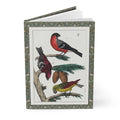
The 1841 work reproduced in this journal — Naturgeschichte der Vögel in Bildern (Natural History of Birds in Images), produced in collaboration with the naturalist and philosopher Gotthilf Heinrich von Schubert — was conceived with a specific pedagogical purpose. The German educational tradition of the period placed great emphasis on Anschauungsunterricht — literally, “instruction through looking” — the idea that knowledge of the natural world should be grounded in direct visual experience rather than abstract description.
Von Schubert, who had written widely on natural philosophy and the spiritual dimensions of the natural world, brought to the collaboration a conviction that the study of birds was not merely a scientific exercise but a moral and aesthetic one — that to look carefully at a crossbill hanging upside down from a pine cone, or a hawfinch cracking a cherry stone with its enormous bill, was to encounter something of the order and beauty of creation. The plates of Naturgeschichte der Vögel in Bildern were designed to be used in schools and family homes, bringing the living forest into spaces where the birds themselves could not go.
IV. The Hand-Coloured Copper Engraving
The plates were produced by hand-coloured copper engraving — the dominant technique of scientific illustration in the first half of the nineteenth century, and one that demanded an extraordinary collaboration between the naturalist, the draughtsman, the engraver, and the colorist.
The process began with Naumann’s own drawings and field notes — observations accumulated over decades of watching birds in the forests and fields of Saxony. These were translated into finished drawings by a trained draughtsman, then transferred to polished copper plates by a professional engraver working with a steel burin. The engraved plates were printed in black and white; the color was added afterward, by hand, sheet by sheet, by colorists working from a painted model. The quality of the coloring varied — as it always did with hand-coloring — but the best examples achieve a warmth and precision that no mechanical color process of the period could match.
The choice of copper engraving over the newer technique of lithography was deliberate. Lithography was faster and cheaper, but it produced softer, less precise lines. For a work designed to teach the identification of birds — where the precise shape of a bill, the exact pattern of a wing bar, the subtle gradation of a breast color could be the difference between one species and another — the hard, clear lines of copper engraving were essential.
V. The Finch Family and the Ingenuity of Bills
The two plates reproduced in this journal focus on the family Fringillidae — the finches — a group that fascinated nineteenth-century naturalists precisely because of the extraordinary diversity of their bills. Where most birds have bills adapted to a general diet, the finches have evolved bills of remarkable specialization: the crossbill’s uniquely crossed tips, designed to pry seeds from the scales of pine cones; the hawfinch’s massive, powerful bill, capable of exerting enough pressure to crack a cherry stone; the bullfinch’s short, rounded bill, adapted for stripping buds and soft seeds; the linnet’s fine, pointed bill for small seeds in open ground.
This diversity was not lost on Naumann. His plates are arranged not merely for aesthetic effect but to make scientific arguments: the crossbill is shown hanging upside down from a pine cone, in the acrobatic posture it adopts when feeding — a detail that no artist working from a museum skin could have captured. The hawfinch is shown interacting with cherries, its bill positioned to demonstrate the crushing action that gives it access to the stone within. These are not portraits; they are demonstrations.
VI. The Forest as Classroom
The world that Naumann’s plates evoke is the European forest of the early nineteenth century — a world of pine and oak, of hedgerow and garden, of the quiet sounds of birds going about their lives in the margins of human settlement. The crossbill in the pine, the bullfinch in the orchard, the greenfinch in the garden, the linnet in the hedgerow — these were birds that every European child of the period would have known by sight and sound, birds that were part of the texture of daily life in a way that is harder to imagine in an age of urban sprawl and habitat loss.
Naumann’s great achievement was to make this familiar world strange again — to show that the birds of the garden and the hedgerow were objects of genuine scientific complexity, worthy of the same careful attention that naturalists devoted to the exotic fauna of distant continents. In doing so, he helped to create the tradition of European field ornithology that would eventually produce, in the twentieth century, the modern birdwatcher.
VII. A Science of Patience
Naumann worked slowly, carefully, and without haste. He published his first ornithological work in 1795, when he was fifteen years old, and continued publishing until the year of his death in 1857. His Naturgeschichte der Vögel Deutschlands took more than twenty years to complete. He revised, corrected, and expanded his observations continuously, returning to the same species year after year as new information became available.
This patience — this willingness to spend a lifetime looking at the same birds in the same fields — is what gives his work its authority. The crossbill hanging upside down from the pine cone is not a generalization; it is a specific observation, made on a specific day, in a specific forest in Saxony, by a man who had been watching crossbills for decades.
VIII. Legacy
Naumann’s influence on European ornithology was profound and lasting. His Naturgeschichte der Vögel Deutschlands was the model for every subsequent national avifauna in Europe; his insistence on field observation as the foundation of ornithological knowledge shaped the discipline for generations. When the great ornithologists of the late nineteenth and early twentieth centuries — Hartert, Dresser, Vaurie — built their systematic works, they built on foundations that Naumann had laid.
The 1841 Naturgeschichte der Vögel in Bildern, with its hand-coloured plates designed for schools and families, represents a different but equally important aspect of his legacy: the conviction that the knowledge of birds should not be confined to specialists, but should be available to anyone willing to look carefully at the world around them.
Naumann’s crossbill hanging from its pine cone, his bullfinch in the orchard, his hawfinch at the cherry — hand-coloured copper engravings from 1841, now on the covers of a hardcover journal. A small homage to a man who spent a lifetime learning to see.

👉 Naumann Songbird Journal — Naturgeschichte der Vögel 1841
References
- Naumann, J.F. & von Schubert, G.H. (1841). Naturgeschichte der Vögel in Bildern. Stuttgart.
- Naumann, J.F. (1820–1844). Naturgeschichte der Vögel Deutschlands. Leipzig.
- Stresemann, E. (1975). Ornithology from Aristotle to the Present. Harvard University Press.
- Birkhead, T. (2008). The Wisdom of Birds: An Illustrated History of Ornithology. Bloomsbury.
- Newton, I. (1972). Finches. Collins New Naturalist Library.
- Collar, N. et al. (2010). Illustrated Checklist of the Birds of the World. Lynx Edicions.