The Garden He Painted: Monet’s Giverny, the Japanese Bridge, and the Series of 1899–1900
In 1883, Claude Monet rented a house in the village of Giverny, in the Seine valley between Paris and Rouen. He was forty-two years old, increasingly celebrated, and increasingly restless. The house came with a modest orchard and kitchen garden. Within a decade, he had transformed both into one of the most deliberate and ambitious artistic projects of his life.

The flower garden — the Clos Normand — came first: symmetrical beds of irises, nasturtiums, roses, and poppies, designed to bloom in sequence from early spring through late autumn, providing Monet with an ever-changing subject at his doorstep. But it was the water garden, created after 1893 on a plot of land he purchased across the road, that would define the final thirty years of his painting life.
A Garden Designed to Be Painted
The water garden was not a found landscape. It was engineered. Monet diverted a branch of the Epte river to fill an irregularly shaped pond, planted the banks with weeping willows, bamboo, Japanese peonies, and wisteria, and introduced exotic water lilies — Nymphaea varieties sourced from specialist nurseries in Paris and abroad. Local authorities initially objected, fearing the foreign plants would poison the water supply. Monet persisted.
The Japanese bridge was installed around 1895: a simple wooden arch, painted green, inspired by the ukiyo-e prints Monet had collected since the 1870s. His collection, still visible today in the dining room at Giverny, included works by Hiroshige, Hokusai, and Utamaro — artists who had taught him to see landscape as pattern, reflection, and atmosphere rather than as fixed, perspectival space. The bridge was not merely decorative. It was compositional: a fixed architectural element around which light, water, and vegetation could be observed changing across seasons and hours.
Eighteen Canvases, One Summer
In the summer of 1899, Monet began painting the bridge systematically. He worked from a boat and from the banks, returning to the same viewpoints at different times of day, in different weather, under different light. By the end of 1900, he had completed eighteen canvases — a series in the strict sense, each painting a variation on a shared motif rather than an independent composition.
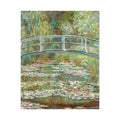
The four works in this collection represent the range of that achievement. The harmonie verte (Musée d’Orsay, 1899) captures the pond at midday in high summer, the bridge almost submerged in dense green vegetation. The harmonie rose (Musée d’Orsay, 1900) shifts the palette entirely: willows and blossoms reflected in mauve and pink, the water surface transformed into something closer to silk than liquid. The National Gallery canvas (1899) is perhaps the most legible of the series — vibrant, almost joyful, the bridge clearly defined against the lush garden. The Princeton canvas (1899) is the most atmospheric: the bridge recedes into the upper register of the composition, the vegetation pressing in from all sides, the water below dense with lilies.
Together, they document not a place but a sustained act of attention — eighteen attempts to capture what Monet called l’instantanéité: the instantaneous quality of light on water, the moment before it changes.
After the Bridge
The 1899–1900 series was exhibited at Durand-Ruel’s gallery in Paris in 1900 to immediate critical and commercial success. But Monet was already moving beyond the bridge. In the years that followed, he eliminated it from his compositions entirely, focusing instead on the water surface alone — the lily pads, the reflections of sky and cloud, the dissolution of any fixed horizon. The result was the Grandes Décorations, the monumental water lily panels now installed permanently in the Orangerie in Paris, completed in the final years of his life and donated to the French state on the day the Armistice was signed, 11 November 1918.
The bridge paintings of 1899–1900 stand, then, at a threshold: the last moment in Monet’s work where the garden still has edges, where the composition still has a centre, where the world beyond the water is still visible. What came after was something else entirely.

Our Monet Water Lily Bridge Puzzle Collection brings four of these eighteen canvases into your hands — each size a different harmony, each piece a fragment of Giverny reassembled.
References
- Tucker, Paul Hayes. Monet in the 90s: The Series Paintings. Museum of Fine Arts, Boston, 1989.
- Wildenstein, Daniel. Monet: Catalogue Raisonné. Taschen/Wildenstein Institute, 1996.
- Joyes, Claire. Monet at Giverny. Mathews Miller Dunbar, 1975.
- House, John. Monet: Nature into Art. Yale University Press, 1986.