The Hypocrite, the Miser, and the Gentleman: Molière’s Characters and Why They Never Left
Jean-Baptiste Poquelin was born in Paris in 1622, the son of an upholsterer to the royal court. He died on stage in 1673, playing the role of a hypochondriac in his own play — Le Malade imaginaire — collapsing during the fourth performance and expiring a few hours later. Between those two dates, he wrote thirty-one plays, managed a theatre company, survived censorship, bankruptcy, and the enmity of the Church, and created a gallery of characters that have not left the stage since.
We call them by their names as though they were people we know. Tartuffe. Harpagon. Monsieur Jourdain. Alceste. Scapin. They are not people, of course — they are types, distillations, exaggerations. But Molière’s genius was to make the exaggeration feel like recognition. His audiences laughed because they saw their neighbours. Sometimes, uncomfortably, they saw themselves.
The Hypocrite
Tartuffe, the false devout of Le Tartuffe ou l’Imposteur (1664), was so dangerous that Louis XIV initially banned the play after its first performance at Versailles — not because it mocked religion, but because it mocked religious hypocrisy too accurately. The Church objected. The play was suppressed for five years. When it finally reached the public stage in 1669, it was an immediate sensation.
Tartuffe works because hypocrisy is not a historical vice. The gap between professed virtue and actual behaviour — in politics, in religion, in social life — is as legible today as it was in 1664. Molière understood that the most dangerous hypocrites are not the obvious ones, but those who have half-convinced themselves.
The Miser
Harpagon, the protagonist of L’Avare (1668), is perhaps Molière’s most psychologically acute creation. His love of money has displaced every other attachment — to his children, to his servants, to the woman he wishes to marry. When his strongbox is stolen, his anguish is indistinguishable from grief. The comedy is uncomfortable precisely because it is not entirely comic: Harpagon is a man who has chosen an abstraction over life, and the play shows us the consequences with merciless clarity.
The Gentleman
Monsieur Jourdain, the bourgeois of Le Bourgeois Gentilhomme (1670), wants to be an aristocrat. He hires teachers of music, dancing, fencing, and philosophy. He learns, to his astonishment, that he has been speaking prose all his life. He is ridiculous — and entirely sympathetic. The desire to be something other than what one is, to acquire the markers of a class one was not born into, is not a 17th-century problem. Molière knew this. The play was commissioned by Louis XIV as court entertainment; the king laughed. So did everyone else, for different reasons.
The Faces of 1868
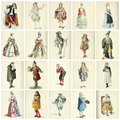
In 1868, two centuries after Molière’s death, the Paris publisher Hachette commissioned a lavish illustrated edition of the complete works. Maurice Sand — son of the novelist George Sand, and a serious student of theatrical tradition — designed the character portraits. Geoffroy executed them. Wolf and Manceau engraved them. The result was twenty-one hand-colored illustrations that gave these characters their most enduring visual form: full-length, in period costume, each one a portrait of a type rather than an individual.
They are not illustrations of specific productions. They are something more interesting: interpretations of what these characters essentially are — the costume, the posture, the expression that makes Tartuffe recognisably Tartuffe, Harpagon recognisably Harpagon, across any production, any century, any stage.
The twenty-one illustrations from this 1868 edition are available as a digital download — high-resolution archival images for personal use, instant delivery.
References
- Molière. Œuvres complètes, illustrated by Maurice Sand and Geoffroy. Hachette, Paris, 1868.
- Cairncross, John. Molière: Bourgeois Gentleman. Nijhoff, 1963.
- Gossman, Lionel. Men and Masks: A Study of Molière. Johns Hopkins University Press, 1963.
- Scott, Virginia. Molière: A Theatrical Life. Cambridge University Press, 2000.