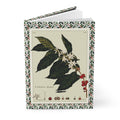
The Plant That Changed the World: J. Miller, John Ellis, and the Botanical Illustration of Coffee, 1774–1840
There are perhaps a dozen plants that have genuinely changed the course of human history — plants whose cultivation and trade have shaped economies, driven exploration, fuelled wars, and altered the daily rhythms of life for hundreds of millions of people. Coffee is one of them. From its origins in the highlands of Ethiopia, through its cultivation in Yemen and its spread across the Ottoman Empire, to its arrival in Europe in the seventeenth century and its subsequent global expansion, the story of Coffea arabica is inseparable from the story of modernity itself. And the botanical illustrators who documented this plant — who drew its flowers and fruits, its leaves and seeds, its processing methods and its commercial forms — were not merely recording a botanical specimen. They were documenting one of the most consequential plants in human history.

Two illustrations, separated by sixty-six years, appear on the covers of our journal. The first, by J. Miller, was engraved in 1774 for one of the great botanical publications of the Enlightenment — a precise, elegant rendering of Coffea arabica that captured the plant at the height of European scientific curiosity about the natural world. The second, by John Ellis, appeared in 1840 in his Historical Account of Coffee — a lithograph that documented not just the plant but its commercial significance, its processing methods, and its place in the global economy of the early nineteenth century. Together, they tell the story of how European science understood coffee — and how that understanding changed over the course of a century.
J. Miller and the Botanical Illustration of the Enlightenment
The botanical illustrator known as J. Miller — almost certainly John Sebastian Miller (1715–1792), a German-born engraver who worked in London and produced illustrations for some of the most important botanical publications of the eighteenth century — worked in a tradition of scientific illustration that had reached its fullest development in the Enlightenment. The great botanical publications of the period — among them Philip Miller’s Gardeners Dictionary, John Hill’s Vegetable System, and the publications of the Royal Botanic Gardens at Kew — combined authoritative botanical text with illustrations of exceptional quality, designed to allow the reader to identify and understand the plants described.
The Enlightenment botanical illustration had a characteristic aesthetic: precise, elegant, and systematic. The plant was shown in its characteristic form, with details of flower, fruit, seed, and leaf rendered with sufficient accuracy to allow identification, but arranged with a compositional care that made the image satisfying to look at quite apart from its informational content. The engraving technique — which used fine lines incised into a copper plate to build up tone and texture — was ideally suited to this aesthetic: it allowed the illustrator to render the delicate venation of a leaf, the subtle surface texture of a coffee berry, the precise geometry of a flower with a fineness that no other printing technique of the period could match.
Miller’s 1774 engraving of Coffea arabica is a masterwork of this tradition. The plant is shown in its characteristic form — the glossy, dark green leaves, the clusters of white flowers, the developing and ripe coffee berries — with a precision that reflects both careful observation and deep botanical knowledge. The details — the cross-section of the berry showing the two seeds within, the enlarged views of the flower and its parts — are rendered with the systematic thoroughness that characterised the best Enlightenment botanical illustration. It is an image that tells you everything you need to know about the coffee plant as a botanical specimen.
John Ellis and the Economic Botany of Coffee
By the time John Ellis published his Historical Account of Coffee in 1840, the world had changed considerably. The coffee trade, which had been a luxury commerce in the seventeenth and early eighteenth centuries, had become one of the great global commodity trades of the nineteenth century. Coffee plantations had spread from Yemen and Ethiopia to Java, Ceylon, the Caribbean, and Brazil; the coffee house, which had been a novelty in seventeenth-century London, had become a fixture of urban life across Europe and the Americas; and the annual consumption of coffee had grown from a few thousand tons to hundreds of thousands.
Ellis’s Historical Account of Coffee reflected this changed context. Where Miller’s 1774 engraving had been primarily a botanical document — an image designed to allow the identification and classification of the plant — Ellis’s 1840 lithograph was as much an economic and historical document as a botanical one. It showed not just the plant but its commercial significance: the processing methods by which the coffee cherry was transformed into the green bean that was traded on the world’s commodity markets, the different varieties and grades of coffee that the trade recognised, the geographical range of coffee cultivation across the tropical world.
The lithographic technique that Ellis used — which had been developed in the early nineteenth century and had largely replaced engraving as the dominant illustration technique by the 1840s — gave his image a different aesthetic quality from Miller’s engraving. Where the engraving used fine lines to build up tone and texture, the lithograph used areas of tone applied directly to the stone, producing an image with a softer, more painterly quality. The result was an illustration that was, in some ways, less precise than Miller’s engraving but more atmospheric — an image that conveyed the sensory richness of the coffee plant as well as its botanical structure.
Coffee and the Age of Enlightenment
The coffee house played a remarkable role in the intellectual life of the Enlightenment. In London, Paris, Vienna, and Amsterdam, the coffee house was the place where ideas were exchanged, newspapers were read, business was conducted, and the public sphere — in Habermas’s sense of a space of rational discourse open to all — was constituted. The great intellectual movements of the eighteenth century — the Scottish Enlightenment, the French philosophes, the English radical tradition — were all, in part, coffee house phenomena: movements that depended on the informal exchange of ideas in spaces where men of different backgrounds and occupations could meet and talk.
The botanical illustration of coffee — of which Miller’s 1774 engraving is a prime example — was part of this broader Enlightenment culture of curiosity and classification. The Enlightenment naturalists who documented the coffee plant were not merely satisfying scientific curiosity: they were participating in a broader project of understanding and ordering the natural world, of bringing the products of distant lands within the framework of European scientific knowledge. To illustrate the coffee plant was to claim it for science — to transform it from an exotic curiosity into a known and classified specimen, available for study and comparison.
From Berry to Cup: The Science of Coffee Processing
One of the most distinctive features of Ellis’s 1840 illustration is its attention to the processing of coffee — the sequence of operations by which the coffee cherry is transformed into the green bean that is roasted and ground to make the beverage. This attention to processing reflects the economic botany perspective that characterised much nineteenth-century natural history: an interest not just in the plant as a botanical specimen but in its commercial uses and the methods by which its products were prepared for market.
The processing of coffee — which involves the removal of the fruit pulp, the fermentation and washing of the seeds, and their drying and sorting — was, by the 1840s, a well-established industrial process, carried out on a large scale on plantations across the tropical world. Ellis’s illustration documents this process with the same systematic thoroughness that Miller had brought to the botanical description of the plant itself: showing the different stages of processing, the equipment used, and the different grades of product that resulted.
It is a reminder that the coffee in your cup is the product of a long chain of human labour and knowledge — a chain that begins with the cultivation of the plant and ends with the roasting and brewing of the bean, and that has been refined and optimised over centuries of practice. The botanical illustrators who documented this chain — from Miller’s precise rendering of the plant to Ellis’s comprehensive account of its commercial processing — were contributing to the knowledge that made this refinement possible.
A Journal for Those Who Find Inspiration in Every Cup

Our Coffee Plant Botanical Journal carries Miller’s 1774 engraving on the front cover and Ellis’s 1840 lithograph on the back — two moments in the long history of coffee’s documentation, separated by sixty-six years and united by the same plant. It is a journal for those who find beauty in botanical illustration, who understand that a coffee plant engraving is also a document of global history, who appreciate the Enlightenment tradition of scientific curiosity that produced these images.
Inside, 150 perforated lined pages await your tasting notes, brewing experiments, morning reflections, or whatever form your engagement with coffee takes. The casewrap sewn binding opens completely flat. The matte laminated cover preserves every detail of Miller’s engraving and Ellis’s lithograph in a finish that rewards close examination.
In 1774, J. Miller drew a coffee plant so that the world could understand it. In 1840, John Ellis told its history. Perhaps the pages inside will help you write a little of your own.
References & Further Reading
- Ellis, John. An Historical Account of Coffee. London, 1774. [Primary source; the publication for which Miller’s engraving was produced.]
- Habermas, Jürgen. The Structural Transformation of the Public Sphere. MIT Press, 1989. [On the role of the coffee house in Enlightenment public life.]
- Pendergrast, Mark. Uncommon Grounds: The History of Coffee and How It Transformed Our World. Basic Books, 1999. [The standard history of coffee as a global commodity.]
- Schiebinger, Londa & Swan, Claudia (eds.). Colonial Botany: Science, Commerce, and Politics in the Early Modern World. University of Pennsylvania Press, 2005. [On the relationship between botanical illustration and colonial commerce.]
- Ukers, William H. All About Coffee. Tea and Coffee Trade Journal Company, 1922. [The encyclopaedic reference work on coffee history and culture.]
- Weinberg, Bennett Alan & Bealer, Bonnie K. The World of Caffeine: The Science and Culture of the World’s Most Popular Drug. Routledge, 2001.
- Wild, Antony. Coffee: A Dark History. Norton, 2004. [On the global history of coffee from its Ethiopian origins to the present.]