The Woman Who Watched: Maria Sibylla Merian, Ivan Sytin, and Two Centuries of Spring Bulb Illustration
Share
In the spring of 1699, Maria Sibylla Merian sold her collection of natural history specimens, packed her belongings, and boarded a ship to Suriname. She was 52 years old. She had no institutional backing, no male companion, and no guarantee of return. She went because she wanted to see insects in the wild.
This was not how natural history was done.
Maria Sibylla Merian and the Live Specimen
In the late 17th century, natural history illustration was largely a matter of dead things. Specimens were collected, preserved, and drawn from life — or rather, from death. The result was accurate in its way, but static: a butterfly pinned to a board, a flower pressed between pages, a bulb sliced open and rendered in cross-section. What was missing was the living relationship between organisms — the caterpillar on its host plant, the butterfly emerging from its chrysalis, the insect and the flower in the moment of their encounter.
Merian changed this. Born in Frankfurt in 1647 to the engraver Matthäus Merian the Elder, she had been drawing insects since childhood, raising silkworms and caterpillars in her room, observing their metamorphosis with a patience and precision that no previous naturalist had brought to the subject. Her 1679 Der Raupen wunderbare Verwandlung (The Wonderful Transformation of Caterpillars) was the first work to document the complete life cycle of European insects alongside their host plants — a revolutionary methodology that placed the organism in its ecological context rather than isolating it as a specimen.
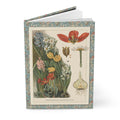
Her engravings of spring bulbous flowers, published posthumously in De Europischen Insecten (J.F. Bernard, c. 1730), represent some of the most beautiful natural history illustrations ever produced. Four quadrants document the relationships between spring bulbs and their associated insects: blue hyacinths with butterflies and caterpillars; white narcissus with purple iris; white daffodils with caterpillar and butterfly; and the Crown Imperial (Fritillaria imperialis) with butterfly and pupa. Each image is simultaneously a scientific document and a work of art — the flowers rendered with botanical precision, the insects with the intimacy of an observer who had watched them, not pinned them.
Ivan Sytin and the Art Nouveau Classroom
Two centuries later, in the Moscow of 1910, a very different kind of botanical illustration was being produced. Ivan Dmitrievich Sytin (1851–1934) was pre-revolutionary Russia’s most influential educational publisher — a self-made man who had risen from peasant origins to build a publishing empire that produced textbooks, encyclopedias, and educational wall charts for the rapidly expanding school system of late Imperial Russia. His Tipografiya Tovarishchestva I. D. Sytina was the largest printing house in Russia, and its educational plates — combining scientific rigor with the decorative aesthetics of Art Nouveau — were found in classrooms across the empire.
The Plantas Bulbosas Plate I (c. 1910) is a masterpiece of this tradition. The plate classifies bulbous plants into four functional categories — floral (decorative blooms), ornamental (garden specimens), edible (culinary bulbs), and useful (medicinal or practical) — and documents complete biological structures from bulb cross-section to seed. Hyacinths, tulips, daffodils, and narcissus are rendered with the combination of scientific precision and decorative elegance that defined the best Russian educational illustration of the pre-revolutionary era: the sinuous lines of Art Nouveau in service of botanical science, the classroom wall transformed into a garden.
Two Centuries, One Flower
What unites Merian and Sytin is the hyacinth. Both artists drew it. Both gave it their full attention. And yet the results could not be more different: Merian’s hyacinth is alive with insects, embedded in the ecological web of the spring garden, observed by a woman who had spent her life watching; Sytin’s hyacinth is classified, categorized, cross-sectioned, placed in its functional relationship to human use and scientific knowledge.
Together, they tell the full story of the spring bulb — not just what it looks like, but what it does, what it feeds, what it means. From Merian’s 18th-century entomological intimacy to Sytin’s early 20th-century educational precision, two centuries of botanical wonder converge on the same flowers: the hyacinth, the tulip, the daffodil, and the Crown Imperial.
Explore the journal that brings these two centuries of botanical wonder together.