Maurice Sand and the Characters of Commedia dell'Arte
In 1860, when the great age of Commedia dell'Arte had long passed from the European stage, a French illustrator and writer named Maurice Sand published a book that would become the definitive visual record of its characters. Masques et bouffons (comédie italienne) — Masks and Buffoons — was the work of a man who had grown up surrounded by artists and writers, who had inherited from his mother, George Sand, a passion for theatre and storytelling, and who had spent years studying the masks, costumes, and personalities of a theatrical tradition that had shaped European comedy for three centuries.
The book documented approximately fifty characters through detailed illustrations and scholarly text, produced in collaboration with the engraver Alexandre Manceau. It was, and remains, the most comprehensive visual catalogue of the Commedia dell'Arte ever assembled — a work of historical preservation as much as artistic creation.

The Theatre of Masks
Commedia dell'Arte emerged in northern Italy in the sixteenth century as a form of professional, improvised theatre unlike anything that had existed before. Its performers were not amateurs reciting fixed texts but trained actors who worked within a framework of stock characters, each with a defined mask, costume, and set of characteristic behaviours, improvising dialogue and action around a loose scenario. The result was a theatre of extraordinary energy and flexibility — capable of bawdy comedy, sharp social satire, acrobatic spectacle, and genuine pathos, sometimes within the same scene.
The characters were immediately recognisable to any audience in Italy or, later, across Europe. Arlecchino — Harlequin — in his diamond-patterned costume, quick-witted and physically brilliant, the servant who outwits his masters. Pantalone, the miserly Venetian merchant, his long nose and stooped posture the embodiment of avarice. Pulcinella, hunchbacked and anarchic, the ancestor of Punch. Colombina, the clever maidservant who sees through every deception. Il Capitano, the braggart soldier whose courage exists only in his own imagination. The innamorati — the lovers — who alone among the characters performed unmasked, their beauty and sincerity a deliberate contrast to the grotesque comedy around them.
Each character was a type, but a type of extraordinary richness. The same mask could be played a thousand different ways by a thousand different actors, and the tradition accumulated over generations a vast repertoire of lazzi — comic routines, physical gags, verbal exchanges — that performers could deploy and recombine in endless variation. It was a theatre of archetypes, and its archetypes proved durable: Harlequin and Pulcinella passed into pantomime, into puppet theatre, into the paintings of Watteau and Picasso, into the vocabulary of European comedy at every level.
Maurice Sand and the Work of Preservation
Maurice Sand (1823–1889) came to the Commedia dell'Arte through a lifelong passion for puppet theatre — he had built and performed with marionettes since childhood, staging elaborate productions at the family home at Nohant that drew audiences from across the literary and artistic world of mid-nineteenth-century France. His interest in the Commedia was not merely antiquarian; he understood it as a living tradition, one whose characters and techniques had shaped the popular theatre he loved.
Masques et bouffons was the product of years of research in libraries, archives, and collections across France and Italy. Sand drew each character with meticulous attention to historical accuracy — the specific cut of a costume, the precise form of a mask, the characteristic posture and gesture that distinguished one zanni from another. His illustrations combine the precision of a scholar with the sensitivity of an artist who genuinely loved his subjects: there is warmth in these drawings, a delight in the particularity of each figure, that lifts them above mere documentation.
The book presented approximately fifty characters in full, from the most famous — Arlecchino, Pantalone, Pulcinella, Colombine — to the more obscure regional variants: Giangurgolo from Calabria, Meo-Patacca from Rome, Stenterello from Florence, Gianduja from Turin. Together they constitute a map of Italian theatrical culture, a record of the regional diversity that the Commedia both reflected and helped to create.
The Characters on the Cover
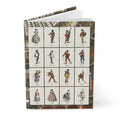
The cover of our journal reproduces a mosaic of thirty-two characters from Sand's Masques et bouffons — sixteen on the front, sixteen on the back. The front presents La Comédie, Arlechino, Trivelin, Pulcinella, Pulcinelo, Polliciniella, Polichinelle, Meo-Patacca, La Ballerina, Spavento, Spezzafer, Giangurgolo, Colombine, Arlequine, Coraline, and Pagliaccio. The back continues with Lélio, Leandre, Pantalon, Baloardo, Biscegliese, Cassandre, La Cantatrice, Stenterello, Menego, Gianduja, Fiorinetta, Isabella, Silvia, Brighella, Beltrame, and Scapino. To look at these thirty-two figures together is to understand the extraordinary range of the tradition Sand documented — from the acrobatic servants to the pompous old men, from the elegant lovers to the regional clowns, each one a distinct personality, each one a thread in the larger fabric of European theatrical history.
—

The illustrations from Maurice Sand's Masques et bouffons (comédie italienne) (Paris, 1860) appear on the cover of our Commedia dell'Arte Illustrated Character Journal, a hardcover journal with casewrap sewn binding and matte laminated full-wrap cover.
References
- Sand, Maurice. Masques et bouffons (comédie italienne): texte et dessins. 2 vols. Paris: Michel Lévy Frères, 1860.
- Duchartre, Pierre Louis. The Italian Comedy. Dover Publications, 1966.
- Gordon, Mel. Lazzi: The Comic Routines of the Commedia dell'Arte. Performing Arts Journal Publications, 1983.
- Richards, Kenneth, and Laura Richards. The Commedia dell'Arte: A Documentary History. Blackwell, 1990.
- Oreglia, Giacomo. The Commedia dell'Arte. Hill and Wang, 1968.