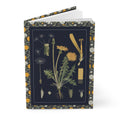
The Most Democratic Flower: Masalin, Hoffstad, and the Nordic Botanical Portrait of Taraxacum officinale
There is no flower more overlooked, and none more extraordinary. Taraxacum officinale — the dandelion, the dent de lion, the løvetand — grows in every crack in every pavement on every continent, has been eaten, drunk, and used medicinally by every culture that has encountered it, and has inspired more scientific admiration than almost any other common plant. It is the weed that is not a weed, the flower that is not a single flower, the seed head that is one of the most elegant dispersal mechanisms in the plant kingdom.

At the turn of the twentieth century, two Nordic naturalists gave the dandelion the scientific and artistic portrait it had always deserved: Ebba Masalin in Finland in 1905, and Olaf Alfred Hoffstad in Norway in 1899. Together, their work represents the finest tradition of Scandinavian botanical education — rigorous, beautiful, and deeply committed to the idea that the most common plant in the world is worthy of the most careful attention.
Ebba Masalin and the Finnish Opetustaulu Tradition
In the early twentieth century, Finland was in the midst of a remarkable cultural flowering. The country was still a Grand Duchy of the Russian Empire, but Finnish national identity — expressed through language, art, and education — was asserting itself with extraordinary energy. The opetustaulu (school poster) was one of the instruments of this assertion: large-format botanical and zoological illustrations designed for classroom use, combining scientific accuracy with the visual boldness necessary to communicate across a crowded schoolroom.
Ebba Masalin was one of the most gifted practitioners of this tradition. Her 1905 dandelion opetustaulu is a complete anatomical study of Taraxacum officinale: the taproot penetrating deep into the soil, the jagged leaves arranged in their characteristic rosette, the flower heads in various stages of development from bud to full bloom, and the seed head — the familiar white globe — with individual achènes shown in detail to reveal the pappus structure that makes the dandelion’s seed dispersal so extraordinarily efficient.
The poster is designed to be read at a distance, its lines bold and clear, its colors vivid but accurate. But it is also, unmistakably, a work of art — the dandelion rendered with the combination of scientific precision and aesthetic elegance that distinguished the best Finnish educational illustration of the period.
Olaf Alfred Hoffstad and the Norwegian Botanical Plate Tradition
In Norway, the tradition of botanical illustration took a different form. The farvelagte botaniske plancher — colored botanical plates — produced by Norwegian naturalists in the late nineteenth century were closer to the scientific illustration tradition of Central Europe: detailed, precise, and focused on the morphological structures that allowed taxonomic identification and botanical understanding.
Olaf Alfred Hoffstad’s 1899 plate of Taraxacum officinale is a masterpiece of this tradition. Where Masalin’s poster shows the whole plant in its natural setting, Hoffstad’s plate dissects it: individual florets shown in cross-section to reveal their structure, the achène documented with its pappus intact, the floral diagram reduced to its essential geometry. It is the dandelion as a botanist sees it — not as a weed or a wildflower, but as a system of extraordinary complexity and elegance.
The plate reveals what the casual observer misses: that the dandelion’s flower head is not a single flower but a composite of dozens of individual florets, each a complete flower with its own stamens, pistil, and petal. That the achène — the seed — is a perfectly aerodynamic capsule, its pappus a parachute of extraordinary delicacy. That the taproot, which makes the dandelion so difficult to remove from a garden, is also what allows it to survive in compacted soils where other plants cannot.
The Dandelion as Scientific Subject
Taraxacum officinale belongs to the family Asteraceae — the daisy family — and its composite flower head is one of the defining characteristics of the family. Each of the florets that make up the flower head is a ligulate flower: a single petal extended into a strap-like ray, with the reproductive organs — stamens and pistil — contained within the floret’s tube.
The seed dispersal mechanism is equally remarkable. The pappus — the white filaments that form the seed head’s globe — is attached to the achène by a slender stalk that acts as a lever, orienting the pappus into the wind and allowing the seed to travel extraordinary distances. Studies have shown that dandelion seeds can travel up to five kilometres from the parent plant in favorable conditions — a dispersal range that explains the dandelion’s extraordinary success as a colonizer of disturbed habitats.
The taproot, which can penetrate up to a metre into the soil, serves multiple functions: it stores carbohydrates that allow the plant to survive winter and regenerate in spring, it breaks up compacted soil and brings minerals to the surface, and it is the source of the milky latex that gives the dandelion its characteristic bitter taste and its long history of medicinal use.
A Plant for Every Culture
The dandelion has been used as food, medicine, and dye by virtually every culture that has encountered it. Its leaves are eaten as salad greens across Europe and Asia; its flowers are used to make wine and beer; its roots are roasted as a coffee substitute; its latex has been investigated as a source of natural rubber. In traditional medicine, it has been used as a diuretic — hence the French pissenlit — a liver tonic, a digestive aid, and a treatment for skin conditions.
Its common names reflect this cultural ubiquity: dent de lion in French (lion’s tooth, from the jagged leaves), løvetand in Norwegian and Danish, Löwenzahn in German, dandelion in English (from the French). In Finnish, it is voikukka — butter flower — a name that captures the golden intensity of its bloom.
The Nordic Botanical Legacy
Masalin and Hoffstad worked in a tradition that understood botanical illustration as both science and pedagogy — a way of making the natural world legible to students, farmers, and citizens who needed to identify, use, and understand the plants around them. Their dandelion portraits are documents of this tradition at its finest: rigorous enough to satisfy the botanist, beautiful enough to inspire the artist, and clear enough to teach the schoolchild.
The dandelion they documented is the same plant that grows in every garden and every pavement crack today — unchanged, unremarkable, and extraordinary. Masalin and Hoffstad saw what most people walk past without noticing: that the most democratic flower in the world is also one of the most perfectly engineered.