Mary Orvis Marbury and the Art of the Artificial Fly: Favourite Flies and Their Histories (1892)
The artificial fly is one of the most beautiful objects in the history of sport. Made from feathers, fur, silk thread, and wire, tied onto a hook with a precision that borders on the obsessive, it is designed to deceive a fish into mistaking it for an insect — a deception that requires not just technical skill but a deep knowledge of entomology, of river ecology, of the behavior of trout in different conditions and seasons. The great fly patterns of the nineteenth century — the Royal Coachman, the Parmachene Belle, the Professor, the Montreal — were developed by anglers who combined the instincts of a naturalist with the hands of a craftsman and the eye of an artist. And in 1892, a woman named Mary Orvis Marbury undertook the extraordinary project of documenting them all.

The Orvis Company and the American Fly Fishing Tradition
To understand Mary Orvis Marbury, it is necessary to understand the company her father built. Charles F. Orvis founded the Orvis Company in Manchester, Vermont, in 1856, with the aim of producing high-quality fishing tackle for the growing market of American sport fishermen. The company quickly established a reputation for excellence: its split-cane fly rods, its reels, and its flies were considered among the finest available, and the Orvis name became synonymous with quality in American angling circles.
Charles Orvis was also a man of considerable business acumen. He understood that the market for fly fishing equipment was not just a market for hardware but a market for knowledge — that the angler who wanted to catch trout needed not just a rod and a reel but information about which flies to use, when to use them, and how to fish them effectively. The Orvis Company's catalogues, which began appearing in the 1860s, were among the first American publications to provide this kind of systematic information about fly patterns and their uses.
Mary Orvis Marbury grew up in this environment. Born in 1856 — the same year her father founded the company — she was immersed from childhood in the world of fly fishing, fly tying, and the culture of American angling. She worked at the Orvis Company from an early age, eventually taking responsibility for the fly-tying operation and developing an intimate knowledge of the hundreds of patterns that American anglers were using on rivers from Maine to California.
Favourite Flies and Their Histories: The Making of a Masterwork
The project that would become Favourite Flies and Their Histories began, by Marbury's own account, as a practical exercise. She wanted to create a comprehensive catalogue of the fly patterns that American anglers were actually using — not just the patterns sold by Orvis, but the full range of flies that had been developed by anglers across the country for their local waters and conditions. To gather this information, she wrote to anglers throughout the United States, asking them to send her their favourite patterns along with accounts of their experiences fishing them.
The response was extraordinary. Anglers from across the country — from the salmon rivers of Maine to the trout streams of the Rocky Mountains, from the bass lakes of the Midwest to the mountain streams of the Appalachians — sent Marbury their flies, their stories, and their knowledge. The result was a book that was simultaneously a technical reference, a social document, and a work of considerable literary interest: a portrait of American fly fishing at a specific moment in its history, told through the voices of the anglers who practised it.
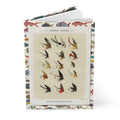
The book was published in 1892 by Houghton Mifflin in Boston, with colour plates illustrating the fly patterns described in the text. The plates — which appear on our journal — are among the most beautiful examples of sporting illustration produced in nineteenth-century America. Each fly is rendered with meticulous accuracy: the colors of the hackle and the wing, the proportions of the body and the tail, the precise way in which the materials are tied onto the hook. They are scientific illustrations in the tradition of natural history, but they are also objects of considerable aesthetic beauty — the artificial fly as art form.
The Flies Themselves: A Taxonomy of Deception
The fly patterns documented in Favourite Flies and Their Histories represent the full range of American fly fishing practice in the late nineteenth century. Some — like the Royal Coachman, developed in the 1870s by John Haily and later refined by the professional fly tier Mary Orvis herself — were already classics by the time the book was published. Others were regional specialities, developed by individual anglers for specific rivers and conditions and largely unknown outside their local area.
The variety of the patterns reflects the variety of American fly fishing itself. Unlike British fly fishing, which was dominated by the chalk streams of southern England and the precise, imitative dry fly tradition associated with them, American fly fishing in the nineteenth century was a more eclectic practice. American anglers fished wet flies and dry flies, streamers and nymphs; they fished for trout and salmon, for bass and pike; they fished in mountain streams and lowland rivers, in lakes and ponds and tidal estuaries. The flies they developed reflected this diversity — a rich, varied, and distinctly American tradition that Marbury's book was the first to document comprehensively.
The illustrations in the book capture this variety with remarkable fidelity. The color plates show flies in groups, arranged by type or by the waters for which they were intended, each one rendered with the precision of a botanical illustration. The hackle feathers — often from exotic birds, in the days before conservation legislation restricted their use — are shown in their full chromatic richness: the iridescent greens and blues of peacock herl, the warm browns of partridge, the brilliant reds and yellows of tropical birds that found their way into American fly boxes through the global trade networks of the nineteenth century.
Mary Orvis Marbury and Women in American Sport
Mary Orvis Marbury's achievement in publishing Favourite Flies and Their Histories was remarkable not just for its intellectual and practical content but for its cultural significance. In 1892, the idea of a woman writing authoritatively about a sport that was almost exclusively male — and doing so in a way that was immediately recognised as definitive — was genuinely unusual. Marbury was not the first woman to fish, or even the first to write about fishing, but she was among the first to produce a work of systematic scholarship about the sport, and her book was received with a respect that was not always extended to women writing in male-dominated fields.
Her position at the Orvis Company gave her a credibility that a purely amateur angler might not have had: she was not just an enthusiast but a professional, someone whose livelihood depended on her knowledge of fly patterns and their effectiveness. But her achievement went beyond professional competence. The letters she gathered from anglers across the country, and the way she wove them into a coherent narrative about American fly fishing, showed a genuine literary sensibility — an ability to listen to other people's voices and to present them in a way that was both informative and engaging.
Favourite Flies and Their Histories went through multiple editions and remained in print for decades. It is still consulted by fly fishing historians and by anglers interested in the history of the patterns they fish. And it established Mary Orvis Marbury as one of the founding figures of American angling literature — a woman who, in documenting the knowledge of her contemporaries, helped to preserve a tradition that might otherwise have been lost.
The Art of the Fly Plate
The colour plates in Favourite Flies and Their Histories occupy a distinctive place in the history of sporting illustration. They are not quite natural history illustration — the flies they depict are artificial objects, not living creatures — but they share with natural history illustration the commitment to accuracy, the attention to detail, and the aesthetic sensibility that transforms a scientific document into a work of art.
The tradition of fly illustration had developed alongside the sport itself. British angling books of the eighteenth and early nineteenth centuries had included illustrations of flies, but these were often schematic and imprecise — more symbolic than accurate. By the mid-nineteenth century, improvements in colour printing technology — particularly chromolithography — had made it possible to reproduce the complex colors and textures of artificial flies with much greater fidelity, and the fly plate became an established genre of sporting illustration.
Marbury's plates represent the high point of this tradition in American angling literature. The flies are shown against plain backgrounds that allow their colors and proportions to be seen clearly; the rendering of materials — feather, fur, silk, wire — is precise enough to serve as a practical guide to tying; and the overall composition of each plate has a visual coherence that makes it satisfying to look at quite apart from its informational content. They are, in the fullest sense, illustrations: images that illuminate their subject while also being beautiful in their own right.
A Journal for Those Who Fish and Those Who Dream of Fishing

Our Mary Orvis Marbury Trout Flies Journal carries these 1892 fly illustrations across its full wraparound cover — the patterns rendered in their original colors, the hackles and wings and bodies of each fly shown with the precision that Marbury's plates demanded. It is a journal for those who know what these patterns are and for those who are simply drawn to the beauty of the objects themselves — for the fly fisher who wants to record a season on the river, and for the reader who finds in these small, intricate, brilliantly colored objects a kind of concentrated beauty that is hard to find elsewhere.
Inside, 150 perforated lined pages await your fishing logs, fly tying notes, river observations, or whatever form your engagement with the natural world takes. The casewrap sewn binding opens completely flat — ideal for field use. The matte laminated cover preserves every detail of Marbury's illustrations in a finish that rewards close examination.
Mary Orvis Marbury spent years gathering the knowledge of anglers across America so that it would not be lost. Perhaps the pages inside will serve a similar purpose for you.
References & Further Reading
- Bates, Joseph D. Streamer Fly Tying and Fishing. Stackpole Books, 1966. [On the development of American fly patterns and their history.]
- Gingrich, Arnold. The Fishing in Print: A Guided Tour Through Five Centuries of Angling Literature. Winchester Press, 1974. [On the literary tradition of angling, including Marbury's place in it.]
- Marbury, Mary Orvis. Favourite Flies and Their Histories. Houghton Mifflin, Boston, 1892. [Primary source; digitized editions available via the Internet Archive.]
- McDonald, John. The Origins of Angling. Doubleday, 1963. [On the history of fly fishing and its literature.]
- Schullery, Paul. American Fly Fishing: A History. Nick Lyons Books, 1987. [The standard history of American fly fishing, with substantial discussion of Marbury.]
- Tapply, William G. Bass Bug Fishing. Lyons & Burford, 1994. [On the broader American angling tradition.]
- Wulff, Lee. Trout on a Fly. Nick Lyons Books, 1986. [On the art and practice of fly fishing for trout.]