Mary Delany's Flora Delanica: The Paper Mosaics That Astonished Botanists
Share
In 1772, Mary Delany was 72 years old. She had lived through the courts of Queen Anne and George III, befriended Jonathan Swift and Handel, and spent decades as one of the most accomplished women in Georgian England. And then, almost by accident, she invented an entirely new art form.
Working with scissors, paper, and a pot of paste, she began cutting tiny fragments of hand-coloured paper and assembling them into botanical portraits of extraordinary precision — each petal, stamen, and leaf built up from hundreds of individual pieces, layered to create depth and shadow, always against a black background that made the colours sing. She called them her "paper mosaics." Botanists called them the most accurate botanical illustrations ever made without a paintbrush.
Over the next decade, until failing eyesight forced her to stop at 88, Mary Delany created 985 of these works. She called the collection the Flora Delanica. It is now preserved in the British Museum, London, where it remains one of the most remarkable artistic achievements in the history of natural history illustration.
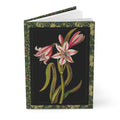
The Crinum zeylanicum — Asphodil Lily (1778)
Among the 985 works in the Flora Delanica, the two portraits of Crinum zeylanicum — the Asphodil Lily, created in 1778 — stand out for their combination of botanical precision and visual drama. The characteristic bright pink-striped white flowers glow against the black background with an intensity that no white-background illustration could achieve. The long, elegant stamens curve with botanical exactness; the translucency of the petals is suggested through the layering of paper fragments of subtly different tones.
Delany did not work from memory or from other illustrations. She regularly dissected real plants — cutting them open to study their internal structures — to ensure that every detail was botanically exact. The Flora Delanica was as scientifically rigorous as it was visually extraordinary, and it was recognised as such by the botanists of her day, including Sir Joseph Banks, who visited her studio and declared her work superior to any botanical illustration he had seen.
An Art Form Invented at 72
What makes Mary Delany's achievement so remarkable is not just the quality of the work — it is the circumstances in which it was created. She began the Flora Delanica at an age when most people of her era were considered elderly, working with materials available to any household, driven by a curiosity about the natural world that never diminished. She continued until she was 88, producing nearly a thousand works of sustained scientific and artistic excellence.
The Flora Delanica is a reminder that the most extraordinary things are sometimes made by people who simply decided, late in life, that it was time to begin.
—
Carry the legacy of Mary Delany in the Crinum Lily Journal — Mary Delany Flora Delanica 1778, featuring two works from the British Museum collection printed on a hardcover journal with 150 lined pages.