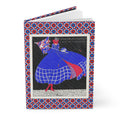
Rain and Flowers: Marthe Romme and the Art Déco Calendar, 1919
In 1919, as Paris was finding its footing after the First World War, a French designer named Marthe Romme published a portfolio of fourteen hand-coloured lithographs. The subject was the French Republican Calendar — the revolutionary system of months that had replaced the Gregorian calendar in 1793 and been abolished by Napoleon in 1806. More than a century after its abolition, Romme returned to its poetic month-names and gave them new life in the visual language of Art Déco: geometric, dynamic, saturated with colour, and unmistakably modern.
Two plates from that portfolio appear on the covers of our journal. They are among the most striking images in the series — one a study in movement and rain, the other a celebration of spring in full bloom.
Pluviôse: The Month of Rain
The front cover reproduces Pluviôse — the fifth month of the French Republican Calendar, corresponding roughly to late January and February, its name derived from the Latin pluviosus, meaning rainy. Romme's figure is immediately arresting: a woman in a wide blue checked dress, her red and white parasol tilted against the wind, her posture caught mid-stride in a gust of rain. The composition is all diagonal energy — the angle of the umbrella, the sweep of the skirt, the implied direction of the downpour — held together by the flat, geometric forms that define the Art Déco aesthetic.
In the upper right corner of the plate, a line of text reads: Jamais pluie dans le printemps ne passa pour un mauvais temps — Never was rain in springtime considered bad weather. It is a proverb that reframes the month's defining characteristic not as hardship but as necessity, the rain that makes the flowers of Floréal possible.
The technique is pochoir — a method of hand-colouring using cut stencils, each colour applied separately with a brush or pad, layer by layer. Pochoir was the preferred technique of the great French fashion illustrators of the early twentieth century, used by publishers like Lucien Vogel and Gazette du Bon Ton precisely because it produced colours of an intensity and precision that photographic reproduction could not match. Each print coloured by pochoir is, in a small but real sense, unique — the pressure of the hand, the density of the pigment, the slight variations between impressions making every copy subtly different from every other.
Floréal: The Month of Flowers
The back cover presents Floréal — the eighth month of the Republican Calendar, spanning late April and May, its name from the Latin flos, flower. Where Pluviôse is all movement and weather, Floréal is exuberance: a woman in a white dress, light and vaporous, adorned with a circular garland of multicoloured flowers, her posture suggesting dance rather than walking, a figure caught in the act of celebrating spring.
The contrast with Pluviôse is deliberate and complete. The solid black background of Floréal throws the whiteness of the dress and the vivid colours of the flowers into sharp relief — a compositional device characteristic of Romme's series, in which each month is given its own palette and mood while remaining unmistakably part of the same visual world. At the top of the plate, another line of text: Nous n'irons plus au bois, les lauriers sont coupés — We shall go to the wood no more, the laurels are cut. The line comes from a famous French nursery rhyme, a song that evokes the end of winter and the return of warmth, sung by generations of French children as a celebration of the season's turning.
The French Republican Calendar
The calendar that Romme illustrated had been one of the most ambitious cultural projects of the French Revolution. Adopted in 1793 and backdated to the founding of the Republic in September 1792, it was designed to break entirely with the Christian calendar and its saints' days, replacing them with a rational, decimal system rooted in nature and agriculture. The year was divided into twelve months of thirty days each, with five or six supplementary days at the end. Each month was given a name drawn from the natural world: Vendémiaire (vintage), Brumaire (mist), Frimaire (frost), Nivôse (snow), Pluviôse (rain), Ventôse (wind), Germinal (germination), Floréal (flowers), Prairial (meadows), Messidor (harvest), Thermidor (heat), Fructidor (fruit).
The names were the work of the poet Fabre d'Églantine, who wanted each month to evoke the sensory experience of the season it described. They are among the most beautiful coinages in the French language — precise, musical, and deeply connected to the agricultural rhythms of the French countryside. Napoleon abolished the calendar on 1 January 1806, but its month-names have never entirely disappeared from French cultural memory, surfacing in literature, art, and history with a persistence that suggests they captured something true about the French relationship with the natural year.
Marthe Romme and the Art of the Portfolio
Marthe Romme was a French designer and illustrator active in the early decades of the twentieth century, working in the tradition of the great Art Déco fashion illustrators — Georges Barbier, Paul Iribe, Georges Lepape — who transformed the illustrated portfolio into one of the defining art forms of the period. Her Les douze mois de l'année portfolio of 1919 is a characteristic example of the genre: a limited series of prints, hand-coloured by pochoir, designed to be collected, framed, and displayed as well as read.
The fourteen plates of the series — twelve months plus two additional images — demonstrate the full range of the pochoir technique: the flat areas of saturated colour, the precise outlines, the layered application of pigment that gives the prints their characteristic depth and tactility. To hold one of these prints is to understand why collectors and institutions have preserved them so carefully: they are objects as much as images, the product of a craft tradition that valued the hand-made in an age of mechanical reproduction.
—

The Pluviôse and Floréal plates from Marthe Romme's Les douze mois de l'année (1919) appear on the cover of our Marthe Romme Art Déco Calendar Journal — Pluviôse & Floréal 1919, a hardcover journal with casewrap sewn binding and matte laminated full-wrap cover.
References
- Romme, Marthe. Les douze mois de l'année. Paris, 1919.
- Battersby, Martin. The Decorative Twenties. Studio Vista, 1969.
- Chadwick, Whitney. Women, Art, and Society. Thames & Hudson, 2007.
- Winock, Michel. La Belle Époque. Perrin, 2002.
- Vox, Maximilien. Le pochoir dans l'illustration française. Paris, 1925.