She Only Said: Mariana from Shakespeare to Tennyson to Millais
She has been waiting for more than four centuries. She first appeared in 1603, in a minor scene of Shakespeare’s Measure for Measure — a woman abandoned at a moated grange, her dowry lost, her fiancé gone, her story seemingly over before it began. She waited there, in the margins of the play, for two hundred and twenty-seven years. Then Tennyson found her.

Shakespeare’s Mariana
In Measure for Measure, Mariana is a plot device as much as a character. Angelo, the deputy left in charge of Vienna while the Duke is away, had been betrothed to Mariana but broke off the engagement when her dowry was lost at sea. When the play’s protagonist Isabella refuses Angelo’s corrupt advances, the Duke devises the “bed trick” — Mariana will take Isabella’s place in the dark, consummating the betrothal and forcing Angelo to honor it. Mariana agrees, motivated by her enduring love for the man who abandoned her.
Shakespeare gives Mariana little interiority. She is defined by her waiting, by her fidelity to a man who does not deserve it, by her willingness to be used as an instrument of justice. The moated grange where she lives is described but not dwelt upon. Her emotional life is implied rather than explored. She is, in the economy of the play, a means to an end.
But the image Shakespeare planted — a woman alone in a moated grange, waiting for a man who does not come — proved extraordinarily generative. It lodged in the imagination of English literature and waited there, as Mariana herself waited, for someone to give it the attention it deserved.
Tennyson’s Mariana
Alfred, Lord Tennyson was twenty years old when he published Mariana in 1830, in his collection Poems, Chiefly Lyrical. The poem took Shakespeare’s marginal figure and made her the center of her own story — not a plot device but a consciousness, a voice, a study in the phenomenology of waiting and longing that has never been surpassed in English poetry.
Tennyson’s Mariana does not act. She does not plot or scheme or hope for rescue. She simply waits, and the poem documents the texture of that waiting with extraordinary precision — the blackened water, the rusted nails, the broken shed, the moss upon the stone, the poplar tree that shakes in the wind. The natural world around the moated grange is alive with the melancholy that Mariana herself cannot fully articulate:
With blackest moss the flower-plots
Were thickly crusted, one and all:
The rusted nails fell from the knots
That held the pear to the gable-wall.
The broken sheds look’d sad and strange:
Unlifted was the clinking latch;
Weeded and worn the ancient thatch
Upon the lonely moated grange.
She only said, “My life is dreary,
He cometh not,” she said;
She said, “I am aweary, aweary,
I would that I were dead!”
The refrain — “He cometh not” — is one of the most famous lines in Victorian poetry, a distillation of longing so pure that it has become almost proverbial. Tennyson’s Mariana is not tragic in the classical sense; she does not die, does not act, does not resolve. She simply endures, and the poem’s power comes from the unflinching honesty with which it documents that endurance.
Millais’s Mariana
John Everett Millais was twenty-two years old when he exhibited Mariana at the Royal Academy in 1851. He was already a founding member of the Pre-Raphaelite Brotherhood — the group of young English painters who had formed in 1848 in rebellion against what they saw as the formulaic conventions of academic painting, and who had taken as their model the vivid colors, meticulous naturalism, and moral seriousness of Italian painting before Raphael.
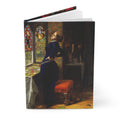
Millais’s Mariana is a painting of extraordinary ambition. The figure of Mariana — in her blue dress, her back arched in a stretch that suggests both physical exhaustion and emotional longing — is placed before a stained glass window that floods the room with colored light. The botanical detail is characteristic Pre-Raphaelite: the embroidery on the altar cloth, the autumn leaves on the windowsill, the pansy (the flower of remembrance) that Mariana holds. Every element is painted with the meticulous attention to natural detail that the Brotherhood had made their signature.
The painting was exhibited with lines from Tennyson’s poem — “He cometh not, she said; / I am aweary, aweary, / I would that I were dead” — making explicit the literary source that Millais had transformed into visual form. The critical response was mixed, as Pre-Raphaelite work often was, but the painting’s power was undeniable. It now hangs in Tate Britain as one of the movement’s most celebrated works.
The Victorian Mariana
The Mariana that Millais painted in 1851 was not quite Shakespeare’s Mariana and not quite Tennyson’s. She was something new — a Victorian woman, defined by her waiting but also by her interiority, her physical presence, her relationship to the domestic space that confines her. The moated grange had become a Victorian interior, the stained glass window a source of both beauty and imprisonment.
The white lily stained glass that appears on the back cover of this journal — created around 1880 by Boreham and Brown of Bloomsbury for Leicester Secular Hall — belongs to the same visual world that Millais inhabited. The Madonna lily, with its associations of purity, spiritual aspiration, and the Virgin Mary, was one of the defining symbols of Victorian decorative art, appearing in stained glass, wallpaper, embroidery, and painting throughout the second half of the 19th century. In the context of Mariana’s story, the lily’s symbolism of purity and waiting takes on a particular resonance.

Our Mariana Journal carries Millais’s 1851 masterpiece on the front cover and the Victorian white lily stained glass on the back — Shakespeare’s abandoned heroine, Tennyson’s melancholy voice, and Millais’s Pre-Raphaelite vision, preserved in a journal you can carry every day.
References
- Shakespeare, William. Measure for Measure. c. 1603.
- Tennyson, Alfred Lord. “Mariana.” Poems, Chiefly Lyrical. 1830.
- Prettejohn, Elizabeth. The Art of the Pre-Raphaelites. Tate Publishing, 2000.
- Barringer, Tim. Reading the Pre-Raphaelites. Yale University Press, 1998.