Agile as a Swallow's Flight: Marcello Dudovich and the Italian Typewriter Posters of the 1920s
In the summer of 1923, the Italian graphic artist Ernesto Pirovano produced a poster that remains one of the most vivid images in the history of advertising. It showed a typewriter — the La Rapidissima model — racing ahead of a locomotive on a track that disappeared into the distance, with the slogan "La Rapidissima" blazing across the top in bold Art Deco lettering. The image was an argument: that the typewriter was faster than the train, that mechanical writing had outpaced the most powerful symbol of industrial modernity, that the office had become the new frontier of speed and efficiency. It was also, simply, a beautiful piece of graphic art — one that captured, in a single image, the excitement and optimism of the Italian 1920s, the decade in which Italian graphic design reached its first great flowering and the typewriter became the defining machine of the modern office.
The posters that Pirovano, Marcello Dudovich, Teodoro Wolf Ferrari, and their contemporaries produced for the Italian typewriter market in the 1920s and 1930s are among the finest works of commercial art ever made. They are images that transformed the advertising of a machine into a celebration of modernity — images that understood, before most of their contemporaries, that the typewriter was not merely a tool but a symbol: of speed, of efficiency, of the new professional culture that was reshaping the economies and societies of the industrialised world. And they are images of extraordinary visual beauty, produced by artists who brought to commercial advertising the same ambition and skill that their predecessors had brought to painting and illustration.
The Italian Typewriter Industry and the Art Deco Moment
The Italian typewriter industry of the 1920s was dominated by a small number of manufacturers whose machines — the M20 and its successors — competed in a market that was expanding rapidly as the modernisation of Italian business created an insatiable demand for mechanical writing instruments. The typewriter had been invented in the United States in the 1860s and had spread rapidly across the industrialised world in the following decades; by the 1920s, it was an essential piece of office equipment in every country with a modern commercial economy, and the competition between manufacturers was intense.
Italian manufacturers responded to this competition with a marketing strategy that was, in retrospect, one of the most inspired in the history of advertising: they commissioned the finest graphic artists of the day to produce posters that would make their machines not merely desirable but beautiful. The result was a body of advertising art that drew on the full resources of the Italian Art Deco tradition — the bold colours, the elegant figures, the dynamic compositions, the integration of text and image — to create posters that were as much works of art as commercial advertisements. These posters appeared on the walls of Italian cities, in the windows of office supply shops, in the pages of business magazines, and at the great trade fairs of the period; they made the typewriter a glamorous object, associated with elegance, speed, and the sophisticated modernity of the new professional class.
Marcello Dudovich: The Master of Italian Advertising Art
Marcello Dudovich was born in Trieste in 1878 and trained as an artist in Munich before establishing himself in Milan as one of the leading commercial illustrators of his generation. His career spanned more than half a century — from his early posters for the Ricordi publishing house in the 1890s to his work for the great Italian manufacturers of the 1930s and 1940s — and it produced a body of work that is, by any measure, among the finest in the history of Italian graphic art.
Dudovich’s typewriter posters are among the most celebrated works of his career. His characteristic style — elegant figures, sophisticated colour harmonies, a sense of effortless modernity that made his images immediately recognisable — was perfectly suited to the advertising of a machine that was itself a symbol of elegance and efficiency. His most famous typewriter poster — showing an elegant woman in a white dress seated at an M20, her posture conveying both competence and grace — is one of the defining images of Italian Art Deco: an image that captured, in a single figure, the transformation of the professional typist from a mere office worker into an emblem of modern femininity and professional achievement.
The poster was also, in its way, a social document. The professional typist of the 1920s was a new figure in Italian society — a woman who had entered the workforce in large numbers during and after the First World War, who had acquired skills and independence that her mother’s generation had not possessed, and who was beginning to reshape the social landscape of the Italian city. Dudovich’s poster celebrated this figure with the same elegance and respect that he brought to his fashion illustrations for the great Italian department stores — and in doing so, it made the typewriter not merely a machine but a symbol of the new possibilities that the twentieth century was opening for Italian women.
La Rapidissima and La Tastiera: Speed, Agility, and the Poetry of the Machine
Ernesto Pirovano’s La Rapidissima poster of circa 1923 is one of the great images of Italian advertising art. Its central conceit — the typewriter racing ahead of a locomotive — was a bold and immediately comprehensible argument for the speed of mechanical writing, and it was executed with the visual energy and compositional confidence that characterised the best Italian graphic design of the period. The locomotive — the dominant symbol of industrial modernity in the nineteenth century — is left behind; the typewriter — the symbol of the new, office-based modernity of the twentieth — races ahead. It is an image that captures, in a single composition, the transition from one era to another.
La Tastiera — the keyboard poster — took a different approach. Where Pirovano’s poster argued for speed through the drama of a race, La Tastiera argued for agility through the poetry of a metaphor: "agile come un volo di rondini" — agile as a swallow’s flight. The image showed a keyboard surrounded by swallows in flight, their movement echoing the light, rapid touch of fingers on keys. It was a poster that understood something important about the experience of typing — that the pleasure of a good typewriter was not merely its speed but its responsiveness, the way that a well-designed keyboard translated the movement of the fingers into the movement of type on paper with a lightness and precision that felt, at its best, like flight.
Teodoro Wolf Ferrari and the International Reach of Italian Design
Teodoro Wolf Ferrari — born in Venice in 1878, the son of the composer Ermanno Wolf-Ferrari — brought to Italian advertising art a sensibility shaped by his training in Munich and his deep familiarity with the German Jugendstil tradition. His typewriter posters combined the elegance of the Italian Art Deco tradition with the graphic boldness of the German poster school, producing images that were at once distinctively Italian and internationally legible.
The international reach of Italian typewriter advertising was demonstrated by the 1935 poster created for the Spanish market — one of the images that appears on the back cover of this journal. The fact that Italian manufacturers were producing advertising specifically tailored to the Spanish market by the mid-1930s is a reminder that the Italian typewriter industry was, by this point, a genuinely international enterprise, competing in markets across Europe and beyond. The poster — adapting the visual language of Italian Art Deco to the tastes and expectations of a Spanish audience — is a document of the globalisation of Italian design, and of the extraordinary reach that the Italian graphic tradition had achieved by the interwar period.
A Journal for Those Who Find Beauty in the Written Word

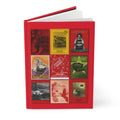
Our Vintage Typewriter Journal carries eighteen of these Italian advertising posters across its full wraparound cover — nine on the front, nine on the back — documenting the golden age of Italian typewriter advertising with the visual richness and historical depth that these images deserve. It is a journal for those who find beauty in the written word, who understand that the tools of writing have their own history and their own aesthetics, who appreciate the extraordinary moment in Italian design history when commercial advertising became fine art.
Inside, 150 perforated lined pages await your writing — agile, perhaps, as a swallow’s flight. The casewrap sewn binding opens completely flat. The matte laminated cover preserves every detail of Dudovich and Pirovano’s posters in a finish that rewards close examination.
In 1923, Ernesto Pirovano showed a typewriter racing ahead of a locomotive and called it La Rapidissima. In the years that followed, Marcello Dudovich showed an elegant woman at her M20 and made the professional typist an emblem of modern Italian femininity. Perhaps the pages inside will help you find your own speed — agile as a swallow’s flight.
References & Further Reading
- Arrasich, Mila. Dudovich. Edizioni Musei Civici di Trieste, 1988. [The standard monograph on Marcello Dudovich, covering his typewriter posters and their place in his career.]
- Bargiel, Réjane & Zagrodzki, Christophe. Le Affiche Belle Époque. Flammarion, 1997. [On the European poster tradition within which Italian Art Deco advertising belongs.]
- Cimorelli, Dario & Iannone, Antonello (eds.). La pubblicità in Italia: Dal dopoguerra a oggi. Il Sole 24 Ore, 2007. [On the history of Italian advertising, including the interwar period covered by the typewriter posters.]
- Current, Richard N. The Typewriter and the Men Who Made It. University of Illinois Press, 1954. [The standard history of the typewriter industry, covering the competitive market within which Italian manufacturers operated.]
- Heller, Steven & Chwast, Seymour. Graphic Style: From Victorian to Digital. Abrams, 2001. [On the Art Deco graphic tradition within which Dudovich, Pirovano, and Wolf Ferrari worked.]
- Maffei, Giorgio & Picciau, Paola (eds.). Olivetti: Una bella società. Silvana Editoriale, 2008. [On the Italian typewriter industry and its design culture, including the advertising tradition.]
- Weil, Alain. The Poster: A Worldwide Survey and History. G.K. Hall, 1985. [A comprehensive history of the poster as an art form, covering the Italian Art Deco tradition and its leading practitioners.]