Natural History for Everyone: Lorenz Oken, the Allgemeine Naturgeschichte, and the Democratic Ideal of Science
In 1833, a German physician and philosopher named Lorenz Oken began publishing what would become one of the most ambitious scientific projects of the 19th century. The Allgemeine Naturgeschichte für alle Stände — Universal Natural History for All Classes — was exactly what its title promised: a comprehensive account of the natural world designed not for specialists but for everyone. For the schoolteacher and the artisan, the merchant and the curious reader, the person who wanted to understand the living world but had no access to the expensive Latin treatises and limited-edition illustrated folios that had previously defined natural history as a science for the privileged few.

It was a radical idea. And it worked.
Lorenz Oken and the Naturphilosophie Tradition
Lorenz Oken (1779–1851) was one of the most remarkable figures of early 19th-century German science — a man whose career spanned medicine, philosophy, zoology, and scientific publishing, and whose influence on the development of German natural history was profound even when his specific theories were later superseded.
Oken was a product of the Naturphilosophie movement — the German Romantic philosophy of nature that sought to understand the living world as a unified, dynamic whole rather than a collection of isolated facts. Associated with figures like Friedrich Schelling and Johann Wolfgang von Goethe, Naturphilosophie held that nature was organized according to rational principles that the human mind could grasp through systematic observation and philosophical reflection. For Oken, this meant that natural history was not merely a catalogue of species but a window into the fundamental organization of life itself.
This philosophical ambition shaped the Allgemeine Naturgeschichte in important ways. Oken organized his natural history not merely taxonomically but according to what he saw as the underlying principles of biological organization — the progression from simple to complex, from lower to higher forms of life. The result was a work that was simultaneously a scientific reference and a philosophical argument, a catalogue of species and a meditation on the unity of nature.
The Democratic Ideal of Natural History
But what distinguished the Allgemeine Naturgeschichte from other ambitious natural history projects of the era was its explicit commitment to accessibility. Oken was deeply influenced by the Enlightenment ideal that knowledge should be available to all — that the discoveries of science should not be locked away in expensive volumes accessible only to the wealthy, but should be shared with the broadest possible public.
The title said it all: für alle Stände — for all classes. This was not merely a marketing phrase but a genuine commitment. The Allgemeine Naturgeschichte was priced to be affordable, written in clear German rather than Latin, and illustrated with hand-colored lithographic plates that made the visual beauty of the natural world accessible to readers who could never afford the great luxury natural history publications of the era — Audubon’s Birds of America, Gould’s bird monographs, the illustrated folios of the great botanical gardens.
The lithographic plates, executed by the printmaker C. Schach, were central to this democratic project. Lithography — the technique invented by Alois Senefelder in 1796 — was significantly cheaper than copperplate engraving, allowing high-quality illustrated publications to reach a much wider audience. Schach’s plates combined the systematic precision that scientific illustration required with the artistic quality that made the natural world genuinely beautiful on the page.
The Insects of Plates 14 and 15
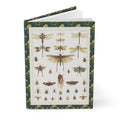
The insect plates of the Allgemeine Naturgeschichte are among the finest examples of mid-19th century entomological illustration. Plate 15 (Supplement Taf. 15) documents three insect orders with the systematic breadth that characterized Oken’s encyclopedic approach.
The migratory locust (Locusta migratoria) — the dominant figure at the center of the plate — was one of the most economically significant insects of the 19th century, its periodic swarms devastating crops across Europe, Africa, and Asia. Oken’s documentation of the species reflected both its scientific importance and its cultural resonance: the locust was a creature that everyone knew, that appeared in the Bible and in agricultural records stretching back to antiquity, and that the systematic naturalist had a particular obligation to document accurately.
The dragonflies — including Libellula depressa, the broad-bodied chaser — were among the most visually spectacular subjects in the entomological illustrator’s repertoire. Their large transparent wings, with the complex venation that makes each species distinctive, presented a particular challenge to the lithographer: to capture the delicate structure of the wing membrane while preserving the overall elegance of the insect. Schach’s rendering of the wing venation in fine lithographic detail is one of the technical achievements of the plate.
Plate 14 (Supplement Taf. 14) turns to the Lepidoptera — the butterflies and moths — and documents them across their complete life cycle: adults, caterpillars, and pupae. The hawk moths (Sphingidae) receive particular attention, including the Oak hawk moth (Marumba quercus), one of the largest and most impressive moths of the European fauna. The warm hand-applied color that gives Schach’s lithographs their distinctive luminosity is especially effective in the Lepidoptera plates, where the subtle gradations of wing color and pattern are essential to species identification.
The Legacy of the Allgemeine Naturgeschichte
The Allgemeine Naturgeschichte was a commercial and scientific success. It went through multiple editions, was widely used in German schools and universities, and established Oken as one of the leading figures of German natural history. Its influence can be traced in the development of popular science publishing throughout the 19th century — in the illustrated natural history magazines, the museum guidebooks, the school textbooks that brought the living world to a mass audience.
Oken’s democratic ideal — that natural history should be for everyone — was not merely a publishing strategy but a philosophical commitment that shaped the development of science communication in the 19th century and beyond. The idea that scientific knowledge should be accessible, beautiful, and shared with the broadest possible public is one that we have inherited from Oken and his contemporaries, and it remains as radical and as necessary as it was in 1833.

Our Lorenz Oken Insects Journal carries Plates 14 and 15 from the 1833–1843 Allgemeine Naturgeschichte — dragonflies, locusts, beetles, hawk moths, and butterflies documented by C. Schach with the hand-colored lithographic precision of German natural history at its most democratic and most beautiful.
References
- Oken, Lorenz. Allgemeine Naturgeschichte für alle Stände. Hoffmann’sche Verlags-Buchhandlung, Stuttgart, 1833–1843.
- Jardine, Nicholas, James A. Secord & Emma C. Spary, eds. Cultures of Natural History. Cambridge University Press, 1996.
- Nyhart, Lynn K. Biology Takes Form: Animal Morphology and the German Universities, 1800–1900. University of Chicago Press, 1995.
- Blunt, Wilfrid. The Art of Botanical Illustration. Collins, 1950.