The Wonder of the Menagerie: London Zoo, the Victorian Imagination, and the Giraffe That Changed Everything
On 27 April 1828, the Zoological Society of London opened its gardens in Regent’s Park to the Fellows of the Society — a select group of naturalists, aristocrats, and gentlemen of science who had subscribed to the ambitious project of assembling, in one place, the most comprehensive collection of living animals ever seen in Britain. The gardens were not yet open to the general public; that would come in 1847. But from the beginning, the Zoological Gardens of Regent’s Park were something new in the world: not a royal menagerie, not a travelling fair, but a scientific institution dedicated to the systematic study of the animal kingdom — and to the spectacle of its living representatives.

The idea had been proposed by the naturalist Sir Stamford Raffles, who had spent years in Southeast Asia and returned to England with a vision of a zoological collection that would do for animals what Kew Gardens had done for plants. Raffles died before the gardens opened, but his vision survived him. The Zoological Society commissioned the architect Decimus Burton to design the layout of the gardens — a commission that would produce some of the most elegant animal houses in Victorian London, including the famous bear pit, the giraffe house, and the original camel house, all visible in the background of William Spooner’s celebrated lithograph of 1844.
II. The Victorian Appetite for the Exotic
To understand the significance of the London Zoo in the 1830s and 1840s, it is necessary to understand the Victorian appetite for the exotic — an appetite that was at once scientific, imperial, and deeply emotional. Britain was at the height of its imperial expansion; ships returned from every corner of the globe carrying not only goods and intelligence but animals: parrots and pythons, kangaroos and cassowaries, lions and leopards. The question of what to do with these creatures — how to house them, feed them, study them, display them — was both a practical and a philosophical one.
The zoo offered an answer. Here, in the orderly green spaces of Regent’s Park, the animal kingdom could be observed, classified, and contemplated. For the Victorian visitor, the experience was genuinely extraordinary. Most people had never seen a lion, let alone a giraffe. The animals of the zoo were not illustrations in a book or specimens in a museum case — they were alive, breathing, moving, occasionally alarming. The encounter with a living exotic animal was, for many Victorians, one of the most memorable experiences of their lives.
III. Zarafa and the Arrival of the Giraffe
No animal captured the Victorian imagination quite like the giraffe. The story begins not in London but in Paris, in the summer of 1827, when a young Nubian giraffe named Zarafa arrived in France as a diplomatic gift from Muhammad Ali, Viceroy of Egypt, to King Charles X. Zarafa had traveled from Sudan to Alexandria, crossed the Mediterranean by ship, and walked from Marseille to Paris — a journey of some six hundred kilometers, accompanied by her Egyptian keeper and two Nubian cows whose milk sustained her during the voyage. She arrived in Paris to scenes of extraordinary public excitement. Parisians lined the streets to watch her pass. À la girafe became a fashion; giraffe-print fabrics, giraffe-shaped hairstyles, and giraffe-themed accessories flooded the shops of the Palais-Royal.
Britain was not to be outdone. In 1836, the Zoological Society received its first giraffes — four animals, also from Egypt, also descendants of the Nubian population that had produced Zarafa. Their arrival in London caused a sensation comparable to the Parisian excitement of nine years earlier. The Illustrated London News devoted pages to them. Crowds gathered at Regent’s Park in numbers that strained the Society’s resources. The giraffe house — designed by Burton specifically for these animals — became one of the most visited buildings in London.
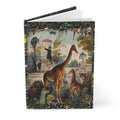
It is this moment of wonder that William Spooner captured in his lithograph of circa 1844: a large adult giraffe and her calf dominating the foreground, the zoo’s original layout stretching behind them, Victorian visitors in top hats observing the spectacle with a mixture of scientific curiosity and simple delight.
IV. William Spooner and the Art of the Educational Print
William Spooner (active 1830s–1860s) was one of the most prolific publishers of educational illustrated prints in Victorian London. Working from his premises in the Strand, he produced a vast range of prints, dissected puzzles, and illustrated games designed to bring knowledge — geographical, historical, natural — to a broad middle-class audience. His prints were not fine art; they were popular science, produced in quantity and sold at prices that made them accessible to the schoolroom and the parlor alike.
The lithograph of the Zoological Gardens, Regent’s Park — now held in the Wellcome Collection (catalogue 23154i) — is characteristic of Spooner’s best work: detailed, informative, and animated by a genuine enthusiasm for its subject. The composition is carefully organized to show as many of the zoo’s attractions as possible: the giraffes in the foreground, the tiger in its cage at the right, the peacock in the lower foreground, a bison at the left, a camel in the background, monkeys above, and a keeper pointing toward a bear on a pole — a complete panorama of the early Victorian zoo experience, rendered with the lively precision of the best popular illustration of the period.
V. The Lithograph as Democratic Medium
Spooner’s print was produced by lithography — a technique invented in Bavaria in 1796 and rapidly adopted across Europe as a faster, cheaper alternative to copper engraving. Where engraving required the laborious cutting of lines into a metal plate, lithography worked by drawing directly onto a flat stone with a greasy crayon; the stone was then wetted and inked, and the image transferred to paper. The process was quicker, the results softer and more atmospheric, and the costs significantly lower.
Hand-coloring remained a feature of the most desirable prints, however. Spooner’s Zoological Gardens lithograph was issued in a hand-colored version — each sheet passed to a colorist who applied watercolor washes by hand, following a model. The results varied, as they always did with hand-coloring, but the best examples have a warmth and immediacy that no mechanical color process of the period could match. The giraffes’ tawny patches, the peacock’s iridescent tail, the tiger’s orange and black — these were applied by human hands, one sheet at a time, in the workshops of Victorian London.
VI. The Zoo as Institution
By the time Spooner published his lithograph, the London Zoo had established itself as one of the great institutions of Victorian public life. It was a place of scientific research — the Zoological Society published its Proceedings and Transactions, and the zoo’s collection was a resource for naturalists from across Europe. It was also a place of popular entertainment, drawing hundreds of thousands of visitors each year from every class of London society.
The zoo’s role in shaping the Victorian understanding of the natural world was profound. For most visitors, it was their only opportunity to see the animals of Africa, Asia, and the Americas in anything approaching their living reality. The zoo did not merely display animals — it educated, it astonished, and it cultivated in its visitors a sense of the extraordinary diversity and richness of the living world.
VII. Regent’s Park and the City
The choice of Regent’s Park as the site for the Zoological Gardens was not accidental. The park had been laid out by John Nash in the 1810s as part of a grand urban vision — a green lung for the expanding metropolis, surrounded by the elegant stucco terraces that still define the northern edge of central London. The zoo occupied the northern corner of the park, separated from the public gardens by a canal. It was, from the beginning, a place apart: a world within a world, where the ordinary rules of the city were suspended and the extraordinary was on display.
This sense of the zoo as a place of wonder — a space where the boundaries of the familiar were dissolved and the remote made present — is what Spooner’s lithograph captures so perfectly. The Victorian visitors in their top hats and crinolines are not merely spectators; they are participants in an encounter with the living world that their grandparents could not have imagined.
VIII. A Legacy Still Living
The Zoological Gardens of Regent’s Park are still there. Founded in 1828, they remain one of the oldest and most important zoological institutions in the world, home to more than 700 species and a leading center for conservation research. The giraffe house that Burton designed is long gone, replaced by more modern facilities; but the spirit of wonder that animated the Victorian zoo — the sense that here, in the heart of the city, the world’s animals could be encountered, studied, and celebrated — is as alive as ever.
William Spooner’s lithograph of the Zoological Gardens, Regent’s Park — giraffes and peacocks, tigers and bears, Victorian visitors in top hats — is now the front cover of a hardcover journal. A small homage to the wonder of the Victorian menagerie, and to the giraffe that enchanted two cities.
👉 London Zoo Journal — Spooner 1844 Zoological Gardens Regent’s Park

References
- Spooner, W. (c. 1844). The Zoological Gardens, Regent’s Park. London. Wellcome Collection, catalogue 23154i.
- Grigson, C. (2016). Menagerie: The History of Exotic Animals in England. Oxford University Press.
- Robbins, L.E. (2002). Elephant Slaves and Pampered Parrots: Exotic Animals in Eighteenth-Century Paris. Johns Hopkins University Press.
- Kisling, V.N. (ed.) (2001). Zoo and Aquarium History: Ancient Animal Collections to Zoological Gardens. CRC Press.
- Dagg, A.I. (2014). Giraffe: Biology, Behaviour and Conservation. Cambridge University Press.
- Allin, M. (1998). Zarafa: A Giraffe’s True Story, from Deep in Africa to the Heart of Paris. Walker & Company.