London After the War: Jazz, Cabarets, and the Roaring Twenties
When the Armistice was signed on 11 November 1918, London had been at war for four years and three months. The city had endured Zeppelin raids, food rationing, the systematic loss of an entire generation of young men, and the grinding psychological weight of a conflict that had killed more people than any war in human history. When it ended, the relief was so overwhelming, and the need to forget so urgent, that what followed was not a period of quiet recovery but an explosion — of music, of dancing, of fashion, of pleasure, of a determined, almost desperate gaiety that the newspapers called the Roaring Twenties and that historians have been trying to explain ever since.
The Relaxation of Wartime Restrictions
The legal framework for London's post-war cultural renaissance was established by the relaxation of the Defence of the Realm Act restrictions that had governed public life since 1914. During the war, pub closing times had been drastically curtailed, music halls had been regulated, and the sale of alcohol had been restricted in ways that would have been unthinkable in peacetime. The gradual lifting of these restrictions between 1919 and 1921 opened the door to a new kind of nightlife — one that was more sophisticated, more cosmopolitan, and more deliberately hedonistic than anything London had seen before.
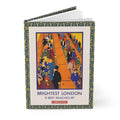
It was in this context that the Underground Electric Railways Company of London commissioned Horace Taylor's celebrated "Brighter London" posters in 1924 — an initiative explicitly designed to encourage Londoners to use the Underground to visit the theaters, restaurants, and nightlife venues of the West End. The posters — with their bold Art Deco compositions, their fashionably dressed crowds, their gleaming escalators and glittering cabarets — were not merely transit advertising. They were a portrait of a city that had decided, with complete conviction, that it was time to live again.
The Jazz Invasion
The soundtrack of post-war London was jazz — American, syncopated, rhythmically complex, and to many older ears, deeply unsettling. Jazz had arrived in Britain with the American troops who passed through London during the war, and by 1919 it had established itself in the dance halls and nightclubs of the West End with a speed that alarmed moralists and delighted the young. The Original Dixieland Jazz Band played the London Hippodrome in April 1919 to audiences that included the Prince of Wales; within months, jazz orchestras were performing in hotels, restaurants, and private houses across the city.
The appeal of jazz to the post-war generation was not merely musical. Its rhythms demanded a new kind of dancing — the foxtrot, the Charleston, the Black Bottom — that was physically expressive, socially mixed, and entirely incompatible with the formal, hierarchical social rituals of the Edwardian era. To dance the Charleston in a Mayfair nightclub in 1925 was to make a statement about who you were and what you believed: that the old world was gone, that its rules no longer applied, and that the future belonged to those who could move with the music.
The Nightclub and the Cabaret
The institutional heart of London's post-war nightlife was the nightclub — a new kind of venue that combined dancing, dining, drinking, and live entertainment in a single space, open until the early hours of the morning, and accessible (in theory) to anyone who could afford the cover charge. The most celebrated of these establishments — the Embassy Club in Old Bond Street, the Kit-Cat Club in the Haymarket, the Café de Paris in Coventry Street — became the social centers of a new kind of London society that cut across the old boundaries of class and background.
The cabaret, imported from Paris and Berlin, added a theatrical dimension to the nightclub experience. Performers like the American singer and dancer Florence Mills, who appeared at the London Pavilion in 1923 in the all-Black revue Dover Street to Dixie, introduced London audiences to a kind of performance that was simultaneously entertainment and cultural statement. The Bright Young Things — the aristocratic and bohemian young people who dominated the society pages of the illustrated press — organized elaborate themed parties, treasure hunts, and fancy-dress balls that were reported with a mixture of fascination and disapproval by the newspapers.
The West End Theater
The West End theater experienced a golden age in the 1920s that was inseparable from the broader cultural energy of the period. Noël Coward, whose career as a playwright and performer defined the decade, captured the brittle, sophisticated, self-consciously modern sensibility of post-war London with a precision that no other writer matched. His plays — The Vortex (1924), Hay Fever (1925), Private Lives (1930) — were not merely entertainment but social documents, portraits of a generation that had survived the war and was determined to live on its own terms, whatever the cost.
The musical theater of the period was equally vital. American imports like No, No, Nanette (1925) and Show Boat (1928) brought the energy of Broadway to the West End, while British productions like Mr. Cinders (1929) demonstrated that London could match New York in the sophistication and wit of its musical comedy. The theaters of Shaftesbury Avenue and the Strand were full every night, their audiences drawn from across the social spectrum by the Underground that Taylor's posters celebrated.
The Underground as Gateway
The London Underground was not merely the means by which Londoners reached the West End — it was, in the 1920s, a cultural institution in its own right. Under the leadership of Frank Pick, the commercial manager who became the driving force behind the Underground's visual identity, the system had developed one of the most sophisticated and coherent design programs in the history of public transport. The Johnston typeface, commissioned in 1916, gave the Underground a typographic identity of extraordinary clarity and elegance. The Beck diagram, introduced in 1933, would transform the way people understood and navigated the city. And the poster program — which commissioned artists of the caliber of Horace Taylor, Edward McKnight Kauffer, and Man Ray — turned the walls of Underground stations into galleries of contemporary art.
Taylor's "Brighter London" posters of 1924 were the perfect expression of this program: images that were simultaneously advertisements, works of art, and invitations to participate in the cultural life of the most exciting city in Europe. The escalator poster — voted the public's favorite London Underground poster in a 2013 poll — captures something essential about the post-war moment: the sense of a city in motion, fashionably dressed, going somewhere, determined to arrive.
If the glamour of 1920s London inspires you, our London Journal — Horace Taylor 1924 Art Deco Underground brings Taylor's celebrated posters to the cover of a hardcover journal, ready to accompany your own London adventures.
References
- Graves, R. & Hodge, A. The Long Week-End: A Social History of Great Britain 1918–1939. Faber & Faber, 1940.
- Nicholson, V. Singled Out: How Two Million Women Survived Without Men After the First World War. Viking, 2007.
- Taylor, D. J. Bright Young People: The Lost Generation of London's Jazz Age. Farrar, Straus and Giroux, 2007.
- Green, O. The London Underground: An Illustrated History. Ian Allan, 1987.
- Overy, R. The Morbid Age: Britain Between the Wars. Allen Lane, 2009.