Beauty for Everyone: Paul and Albert Leseine and the Progressive Architecture of the Parisian Suburbs
In 1878, a French architectural journal called Architecture Nouvelle began publishing the work of two brothers from the Parisian suburbs whose villas were unlike anything else being built in France at the time. Paul and Albert Leseine were not designing for the aristocracy or the very wealthy. They were designing for the new suburban middle class — the merchants, professionals, and civil servants who had moved to Colombes and Enghien-les-Bains on the new railway lines and wanted homes that were comfortable, well-crafted, and beautiful, without costing a fortune.

Their motto, as it appeared in Architecture Nouvelle, was simple and radical: grand confort à prix réduit — great comfort at reduced cost.
The Leseine Brothers and Their World
Paul and Albert Leseine were products of the École des Beaux-Arts tradition — the French system of architectural education that had dominated the profession since the 17th century and that trained architects in the classical and historical styles that defined French public architecture. But the Leseine brothers were not interested in designing public monuments or aristocratic palaces. They were interested in the house — the private villa, the suburban home, the dwelling that ordinary people of modest means could inhabit with dignity and beauty.
This was a genuinely progressive position in the France of the 1870s and 1880s. The dominant tradition of French domestic architecture was either the grand hôtel particulier of the Parisian bourgeoisie — expensive, formal, and designed to impress — or the anonymous apartment building that housed the urban working and middle classes in conditions that prioritized density over comfort. The suburban villa occupied a middle ground that the architectural profession had largely ignored.
The Leseine brothers saw this as an opportunity. Working primarily in Colombes — a commune on the Seine northwest of Paris that was being rapidly developed as a suburban residential area — they designed a series of villas that demonstrated what could be achieved with modest budgets and ambitious design thinking.
The Architecture of the Leseine Frères
The Leseine brothers’ style is immediately recognizable: a rich eclecticism that draws primarily on medieval and Gothic sources, combined with the practical requirements of comfortable suburban living. Their villas typically feature prominent corner towers with pointed roofs, ornate brickwork in contrasting colors, decorative glazed tiles, and elaborate wooden detailing — all elements drawn from the neo-medieval vocabulary that had been popularized in France by Viollet-le-Duc and his followers.
But the Leseine brothers were not mere historicists. They used historical forms in the service of contemporary needs, adapting medieval motifs to create homes that were genuinely comfortable and livable by the standards of the late 19th century. Their floor plans were carefully thought out, with attention to light, ventilation, and the practical requirements of bourgeois domestic life. The ornate exterior was not merely decorative but expressed a genuine conviction that beauty was a legitimate aspiration for ordinary people.
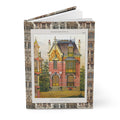
The Petit Hôtel à Colombes, designed for Mr. Pigache, is a perfect example of this approach. The building is modest in scale — a “petit hôtel” rather than a grand villa — but it is designed with the same care and ambition that a more expensive commission would receive. The corner tower, the ornate brickwork, the mix of materials — brick, glazed tiles, and wood — give the building a richness and character that belie its modest cost. It is a home that its owner could be proud of, that expressed his aspirations and his taste, that made a claim for beauty in the suburban landscape.
The Hôtel de M. Decary, Plate 66 from Architecture Nouvelle, demonstrates the same principles at a slightly larger scale. The richly articulated façade, drawing on medieval and Gothic sources, is rendered with the precision and clarity of 19th-century architectural draughtsmanship. The building is confident and assured — the work of architects who knew exactly what they were doing and why.
Architecture Nouvelle and the Democratization of Design
The publication of the Leseine brothers’ work in Architecture Nouvelle was itself part of a broader movement to democratize architectural knowledge in France. The journal — one of several architectural periodicals that flourished in the second half of the 19th century — was designed to make good design accessible to a wide audience: not just professional architects, but the builders, craftsmen, and clients who were shaping the suburban landscape of France.
By publishing detailed plates of their villa designs, the Leseine brothers were making their ideas available to anyone who could afford the journal. Their drawings were not merely illustrations but working documents — precise enough to be used as the basis for construction, detailed enough to convey the full richness of their architectural vision. In this sense, Architecture Nouvelle was doing for architecture what Oken’s Allgemeine Naturgeschichte had done for natural history: making specialized knowledge beautiful, accessible, and useful to a broad public.
The Legacy of the Leseine Frères
The Leseine brothers’ work in Colombes and the surrounding suburbs left a permanent mark on the landscape of the Parisian banlieue. Their villas — those that survive — are among the most distinctive and characterful buildings in the area, their neo-medieval towers and ornate brickwork standing out against the more anonymous architecture of the 20th century.
But their legacy is more than architectural. The progressive conviction that animated their work — that beautiful, well-crafted architecture should be available to everyone, not just the wealthy — is one that resonates as strongly today as it did in the 1880s. In an era when the quality of the built environment is increasingly recognized as a matter of social justice as well as aesthetic preference, the Leseine brothers’ motto — grand confort à prix réduit — remains as radical and as necessary as it ever was.
Our Leseine Frères French Villas Journal carries the Petit Hôtel à Colombes and the Hôtel de M. Decary on its covers — two villas designed by brothers who believed that beauty was not a privilege but a right, preserved in a journal you can carry to every drawing board and every drafting table.
References
- Leseine, Paul & Albert. Plates published in Architecture Nouvelle. Paris, 1878–1895.
- Loyer, François. Paris Nineteenth Century: Architecture and Urbanism. Abbeville Press, 1988.
- Middleton, Robin, ed. The Beaux-Arts and Nineteenth-Century French Architecture. MIT Press, 1982.
- Viollet-le-Duc, Eugène. Dictionnaire raisonné de l’architecture française du XIe au XVIe siècle. Paris, 1854–1868.