Learning to Swim on Paper: The Picture-Lessons of the Mid-Century Aquatic Education
How illustrated instruction manuals taught a generation to move through water — and why they still captivate us.

In the decades following the Second World War, a quiet revolution took place in swimming pools, lakes, and public baths across the English-speaking world. Swimming — once the preserve of the athletic elite or those lucky enough to live near water — became a democratic skill, something every child was expected to learn. Behind that transformation was not just infrastructure or policy, but a remarkable body of illustrated educational material that made the mechanics of swimming legible to anyone who could read a picture.
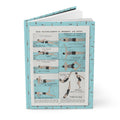
Among the most enduring of these were the Four Picture-Lessons in Swimming and Diving, published as part of the Book of Knowledge educational series in the 1940s and 1950s. Compact, clear, and visually elegant, they distilled the complexity of aquatic movement into sequences that a child — or an adult — could study, memorize, and take to the water.
The Book of Knowledge and the Democratization of Learning
The Book of Knowledge was one of the great publishing achievements of the twentieth century. First published in 1910 by the Grolier Society, it was conceived as a children’s encyclopedia that would make the accumulated knowledge of the world accessible to ordinary families. By the interwar period, it had become a fixture in middle-class homes across Britain, the United States, Canada, and Australia — a set of volumes that promised to answer any question a curious child might ask.
What distinguished the Book of Knowledge from its competitors was its commitment to visual instruction. Its editors understood, ahead of their time, that children learn differently from adults — that a well-drawn diagram could communicate in seconds what a paragraph of prose might fail to convey in minutes. The swimming lessons were a perfect expression of this philosophy: four images, carefully sequenced, showing the body in motion through water.
By the 1940s and 1950s, the series had been updated to reflect the latest thinking in physical education. The post-war period brought with it a new emphasis on health, fitness, and outdoor recreation. Swimming was no longer merely a survival skill — it was a sport, a leisure activity, and increasingly, a competitive discipline. The Book of Knowledge swimming lessons reflected this shift, presenting not just the mechanics of staying afloat but the technique of moving efficiently and beautifully through water.
Four Strokes, Four Pictures
The Four Picture-Lessons covered the essential repertoire of mid-century swimming: the crawl, the breast stroke, the side stroke, and the swallow dive.
Each had its own character, its own history, and its own place in the culture of aquatic sport.
The crawl — what we now call freestyle — was the fastest and most modern of the strokes. Its origins lay in the indigenous swimming traditions of the Pacific and the Americas, brought to European attention in the late nineteenth century and refined into the competitive technique that would dominate Olympic swimming throughout the twentieth century. By the 1940s, the crawl was the stroke every serious swimmer aspired to master.
The breast stroke was the oldest of the four, with roots stretching back to at least the sixteenth century. Slower than the crawl but more sustainable, it was the stroke most associated with recreational swimming and water safety — the stroke you used when you needed to keep your head above water and your eyes on the horizon.
The side stroke occupied a curious middle ground: older than the crawl, more efficient than the breast stroke, and deeply associated with lifesaving. It was the stroke of the rescuer, the stroke that allowed a swimmer to pull another person through the water without submerging them. In the post-war era, with its emphasis on community safety and civil preparedness, the side stroke carried a particular moral weight.
The swallow dive — known in North America as the swan dive — was something different altogether: not a stroke but an entry, a moment of pure aesthetic ambition. To execute a swallow dive correctly was to transform the act of entering water into something approaching flight. Arms extended, back arched, the diver hung for a moment between air and water before the surface closed over them. It was the most theatrical of the four lessons, and perhaps the most memorable.
The Art of Instructional Illustration
What made the Four Picture-Lessons remarkable was not just their content but their visual language. The illustrators of mid-century educational publishing worked within strict constraints — limited color palettes, small reproduction sizes, the need for absolute clarity — and produced images of surprising elegance.
The figures in the swimming lessons are rendered with a kind of idealized precision: bodies in perfect form, movements frozen at their most instructive moment. There is no splashing, no struggle, no imperfection. The swimmer in the crawl illustration pulls through the water with the efficiency of a machine; the diver in the swallow dive achieves a symmetry that real bodies rarely manage. These are not photographs of swimming — they are arguments about what swimming should look like.
This idealization was not naivety. It was pedagogy. The illustrators understood that the learner needed to see the goal, not the process of reaching it. By showing the perfect form, they gave the student something to aim for — an image to hold in the mind while the body struggled to catch up.
Water and Memory
There is something about swimming that resists forgetting. Unlike many physical skills, swimming learned in childhood tends to persist — the body remembers the movements long after the conscious mind has moved on. The mid-century swimming lessons tapped into this quality of aquatic memory, creating images that lodged themselves in the minds of a generation.
For many people who grew up with the Book of Knowledge, the swimming illustrations were among the first technical diagrams they ever encountered — the first time they understood that a picture could teach a body how to move. That experience of visual instruction, of learning to read an image as a set of instructions, was itself a kind of education, one that extended far beyond the swimming pool.

If the world of mid-century aquatic education resonates with you, the Swimming Journal brings the Four Picture-Lessons in Swimming and Diving to a hardcover journal — 150 perforated lined pages, ready for training notes, observations, or whatever your days require.
References
- Grolier Society. The Book of Knowledge. Various editions, 1910–1960s.
- Love, C. A Social History of Swimming in England, 1800–1918. Routledge, 2008.
- Sprawson, C. Haunts of the Black Masseur: The Swimmer as Hero. Jonathan Cape, 1992.
- Oppenheim, F. The History of Swimming. Swimming World Publications, 1970.
- Keil, I. & Wix, D. In the Swim: The Amateur Swimming Association from 1869 to 1994. ASA, 1996.