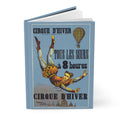
Le Cirque d’Hiver: The Winter Circus and the Art of the Belle Époque Poster
On the evening of 11 December 1852, a new building opened on the rue Amelot in the 11th arrondissement of Paris: the Cirque Napoléon, a purpose-built circular arena designed by the architect Jacques Ignace Hittorff and commissioned by Louis-Napoléon Bonaparte to serve as a permanent home for the equestrian and acrobatic spectacles that had been among the most popular entertainments in Paris since the late 18th century. The building — later renamed the Cirque d’Hiver, the Winter Circus, to distinguish it from the Cirque d’Été that operated in the warmer months — was from the beginning one of the most remarkable entertainment venues in Europe: a twenty-sided polygon with a capacity of nearly four thousand spectators, its interior decorated with bas-reliefs of equestrian and athletic figures, its central ring surrounded by tiers of seats that gave every member of the audience an unobstructed view of the performance. It remains open to this day, the oldest permanent circus venue in Paris and one of the oldest in the world.
The Cirque d’Hiver and the Belle Époque Circus
The Cirque d’Hiver reached the height of its fame in the 1870s, 1880s, and 1890s — the decades of the Belle Époque, when Paris was the cultural capital of the world and its entertainments set the standard for the rest of Europe. Under the direction of the Fratellini family and other celebrated circus dynasties, the Cirque d’Hiver presented the finest equestrian acts, aerial acrobats, clowns, and animal trainers in Europe, drawing audiences from across the social spectrum — from the working-class residents of the 11th arrondissement to the aristocrats and wealthy bourgeois who made the circus one of the essential social rituals of the Parisian winter season.
The circus in the Belle Époque was not merely an entertainment but a cultural institution — a place where the boundaries between high and popular culture were suspended, where the physical virtuosity of the acrobat and the equestrian was celebrated alongside the wit of the clown and the spectacle of the animal act, and where the audience could experience the thrill of danger and the pleasure of beauty in a single evening. It attracted the attention of the greatest artists of the period: Toulouse-Lautrec painted the Cirque Fernando, Seurat depicted the Cirque d’Hiver in his final masterpiece Le Cirque (1891), and Degas, Renoir, and Picasso all found in the circus a subject that combined the physical grace they admired in the ballet with the popular energy they found in the café-concert and the music hall.
The Art of the Belle Époque Circus Poster
The promotional posters of the Cirque d’Hiver were among the most spectacular examples of the color lithographic poster art that transformed the visual culture of Paris in the 1880s and 1890s. The development of chromolithography — the printing of images in multiple colors from a series of lithographic stones — had made it possible to produce posters of extraordinary visual richness and complexity at a cost that allowed them to be plastered across the walls of Paris in their thousands, and the circus was one of the most enthusiastic patrons of the new medium.
The printing house of Morris Père et Fils was among the most important producers of circus posters in Paris in the late 19th century. Their posters for the Cirque d’Hiver combined the bold typography and vivid color that were the hallmarks of the Belle Époque poster tradition with compositions of extraordinary dramatic power: aerial acrobats suspended above the Parisian skyline, hot-air balloons rising behind the circus tent, the city itself transformed into a backdrop for the spectacle of the big top. The c. 1890 poster that appears on the front cover of the journal is one of the finest examples of their work: a composition that captures in a single image the essential promise of the Cirque d’Hiver — that within its circular walls, the laws of gravity could be suspended, the impossible made real, and the Parisian winter transformed into a season of wonder.
The Belle Époque circus poster was not merely an advertisement but a work of art in its own right — a form of public art that brought color, drama, and visual excitement to the streets of Paris and made the city itself into a gallery of popular imagery. The great poster artists of the period — Jules Chéret, Henri de Toulouse-Lautrec, Alphonse Mucha — all worked in the medium, and their circus posters are among the most celebrated images of the era. The Morris Père et Fils posters for the Cirque d’Hiver belong to this tradition: anonymous in authorship but extraordinary in visual impact, they are documents of a moment when the art of the poster and the art of the circus were both at the height of their powers.
Paluzíe and the Spanish Recortables Tradition
While the Cirque d’Hiver was dazzling Parisian audiences with its aerial acrobats and equestrian spectacles, a parallel circus culture was flourishing in Spain — not in the ring, but on the printed page. The publishing house of Paluzíe, founded in Barcelona in the early 19th century, was one of the most important producers of recortables — printed paper sheets featuring figures, animals, and scenes designed to be cut out and assembled into three-dimensional models or arranged into miniature theatrical scenes. The recortables tradition was one of the most beloved forms of popular entertainment in 19th-century Spain, combining the pleasures of craft, play, and visual art in a format that was accessible to children across the social spectrum.
Paluzíe’s circus recortables — featuring ringmasters, acrobats, clowns, equestrians, and performing animals rendered in the vivid, charming style of late 19th-century Spanish popular illustration — were among the most popular of their productions. They captured the magic of the big top in a format that children could hold in their hands, cut with scissors, and arrange into their own miniature circus performances. Against the sky blue background of the back cover, the figures create a composition of joyful, colorful energy that perfectly complements the dramatic grandeur of the Cirque d’Hiver poster on the front — two traditions of circus culture, French and Spanish, united in a single object.
The Circus and the Belle Époque Imagination
The circus of the Belle Époque — whether experienced in the ring of the Cirque d’Hiver, in the pages of Paluzíe’s recortables, or in the posters of Morris Père et Fils — was above all an art of transformation: the transformation of the ordinary into the extraordinary, of the human body into an instrument of impossible grace, of the winter city into a place of wonder and delight. It was an art that spoke to something deep in the human imagination — the desire to see the laws of the everyday world suspended, if only for an evening, and to believe that the impossible might, after all, be real.
That art of transformation is what the Cirque d’Hiver has offered its audiences for more than 170 years, and it is what the posters of Morris Père et Fils and the recortables of Paluzíe captured in paper and ink. It is an art worth carrying with you.
If the wonder of the Belle Époque circus inspires you, our Cirque D’Hiver Journal — Paris 1890 & Paluzíe Barcelona Circus brings these extraordinary images to the cover of a hardcover journal.
References
- Carmeli, Y. S. “The Invention of Circus and Bourgeois Hegemony.” Journal of Popular Culture 29.1 (1995).
- Stoddart, H. Rings of Desire: Circus History and Representation. Manchester University Press, 2000.
- Timmers, M. (ed.). The Power of the Poster. V&A Publications, 1998.
- Weill, A. The Poster: A Worldwide Survey and History. G.K. Hall, 1985.
- Zeder, S. Performing Arts for Young Audiences. Anchorage Press, 1978.