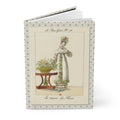
Le Bon Genre and the Art of Parisian Fashion Satire
In 1801, a Parisian publisher named Pierre de la Mésangère began producing a series of hand-colored engravings documenting the fashions and customs of the French capital. He called it Le Bon Genre: Observations sur les modes et les usages de Paris — Good Taste: Observations on the Fashions and Customs of Paris. By the time the series ended in 1817, it had produced 115 plates and evolved from straightforward fashion documentation into something considerably more interesting: a sustained work of social satire, poking fun at the absurdities of Napoleonic Paris with a precision and wit that has rarely been matched.
The title was ironic from the start. Le bon genre — good taste, good form, the right way of doing things — was precisely what Mésangère’s subjects so often lacked. The series documented not the elegant restraint of genuine aristocratic taste but the frantic excess of the nouveaux riches: the bankers and merchants and their wives who had prospered under Napoleon and were now spending their money with an enthusiasm that outran their judgment. The result was a portrait of a society in the grip of fashion mania — and a very French meditation on the difference between style and its imitation.

Pierre de la Mésangère and the Pochoir Tradition
Pierre de la Mésangère (1761–1831) was a man of many parts: a priest before the Revolution, a professor of philosophy, a writer, and eventually the editor of the Journal des Dames et des Modes, the most influential fashion periodical of the Napoleonic era. Le Bon Genre grew out of his work on the journal, sharing its combination of fashion documentation and social observation.
The plates were produced using the pochoir technique — a method of hand-coloring prints through stencils that allowed for precise, repeatable color application while retaining the warmth and variation of hand-work. Each plate was engraved, printed, and then colored by hand, with the pochoir stencils ensuring consistency across the edition. The result was a series of images that combined the precision of engraving with the richness of hand-coloring — scientific in their documentation, artistic in their execution.
The 1931 limited edition reprint, with a preface by the French writer Léon Moussinac, helped preserve the series for later generations. It is through this reprint that most modern readers have encountered Mésangère’s work — and it remains the standard reference for the study of Empire era Parisian fashion.
Plate No. 78: La Manie des Fleurs, April 1815
“La manie des Fleurs” — Flower Mania — was published in April 1815, at the height of the fashion for floral decoration that had swept Parisian society. The plate shows a woman in a high-waisted Empire gown whose every surface has been colonized by flowers: a massive arrangement on her head, trailing down her dress, encircling her hem, dividing her sleeves with strings of roses, framing her bodice with a vertical floral border. She is less a woman wearing flowers than a woman who has been consumed by them.
Mésangère’s caption described the “ridiculous profusion” of floral decoration with the dry precision of a naturalist cataloguing a new species. The plate is both a document and a joke — a record of what Parisian women were actually wearing in 1815, and a commentary on the absurdity of following fashion to its logical extreme.
Plate No. 60: Une Chinoise de la Chaussée d’Antin, August 1813
The Chaussée d’Antin was the fashionable banking district of Napoleonic Paris — the address of the new money, the financiers and their families who had prospered under the Empire. “Une Chinoise de la Chaussée d’Antin” satirizes the enthusiasm for chinoiserie that had swept this milieu in 1813.
The woman in the plate is not Chinese. She is a Parisian banker’s wife who has dressed herself in what she imagines to be Chinese fashion: a high-waisted Empire dress adorned with geometric motifs and pompoms, a monumental headdress crowned with exotic flowers and ribbons, pointed shoes, a fan. Mésangère’s satire is gentle but precise — the comedy emerges from the gap between her evident confidence and the viewer’s awareness of the absurdity of her costume.
A Portrait of Napoleonic Paris
Together, the 115 plates of Le Bon Genre constitute one of the most vivid portraits of Napoleonic Paris ever produced — documenting not the grand events of the Empire but the texture of daily life among the Parisian bourgeoisie: what they wore, how they spent their leisure, what they found fashionable, what they found ridiculous. It is a portrait that feels surprisingly contemporary. Mésangère understood that fashion is always, at some level, comedy — and that the best way to document it is with a combination of precision and affection.