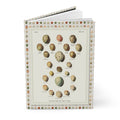
Every Egg Is a Signature: Kleinschmidt’s 1921 Plates and the Art of European Songbird Oology
Before the age of field recording and spectrogram analysis, the study of birds was inseparable from the study of their eggs. Oology — the science of eggs — was one of the great preoccupations of nineteenth and early twentieth-century natural history: a discipline that combined the precision of taxonomy with the aesthetic pleasure of collecting, and that produced some of the most beautiful scientific illustrations ever made.

Otto Kleinschmidt’s Die Singvögel der Heimat (The Songbirds of the Homeland), published in Leipzig by Quelle & Meyer in 1921, stands at the end of this tradition — a summation of decades of German ornithological scholarship rendered in plates of extraordinary detail and beauty. Its oology plates are among the finest ever produced: a systematic survey of European songbird eggs that reveals, in the arrangement of color and spot and form, the extraordinary diversity of solutions that evolution has found to the same basic problem.
Otto Kleinschmidt and the German Ornithological Tradition
Otto Kleinschmidt (1870–1954) was one of the most influential and controversial ornithologists of the early twentieth century. A Lutheran pastor by vocation and a naturalist by passion, he spent his career challenging the prevailing Darwinian taxonomy of birds, arguing that what were classified as separate species were often regional forms of a single underlying type — a concept he called the Formenkreis (circle of forms).
His ornithological work was meticulous, his illustrations precise, and his publications — produced through the Leipzig publisher Quelle & Meyer, one of the great houses of German natural history publishing — reached a wide audience of professional ornithologists and educated amateurs alike. Die Singvögel der Heimat was designed for both: a work of scientific rigor that was also a celebration of the songbirds of the German countryside, their songs, their nests, and their eggs.
The Front Cover — Oology Plate (p. 188)
The first plate is a comprehensive portrait of European songbird egg diversity, arranged to demonstrate the range of color, pattern, and form across twenty-five species.
At the center of the plate, the pale blue-green egg of the Starling serves as a visual anchor — smooth, luminous, and immediately recognizable. Around it, the plate unfolds into a lesson in evolutionary strategy. The Cuckoo egg is the most famous: a master of mimicry, the Cuckoo lays its egg in the nests of other species, and its egg has evolved to match the host’s own clutch with remarkable precision. The plate shows this mimicry in action — the Cuckoo egg placed beside the eggs it is designed to resemble.
The Goldcrest egg is among the smallest on the plate — a tiny, delicate thing from one of Europe’s smallest birds, barely larger than a fingernail. The Oriole egg is large and white with bold black spots, the opposite of camouflage — a statement rather than a concealment. The Tit family occupies the lower circle: Great, Blue, Crested, and Coal Tits, each with its own variation on the theme of white with reddish spotting, close enough to be recognizably related, different enough to be individually distinct.
The Back Cover — Table 85
The second plate takes a different approach: a deep focus on field and forest songbirds selected to demonstrate the extraordinary variety of what Kleinschmidt called the natural ‘brushstrokes’ on eggshells.
The Song Thrush egg is an intense blue with bold black dots — one of the most striking eggs in European ornithology, instantly recognizable in the nest. The Dunnock egg is a smooth, pure blue-green, unmarked and luminous. The Barn Swallow egg carries elongated brown-purple spots, adapted to the dark interior of the mud nest where camouflage matters less than structural integrity.
But the most remarkable entry on the plate is the Common Redstart in three distinct color variations: smooth blue, pale pink, and bright brown. Three eggs from the same species, laid by different individuals, demonstrating that even within a single species the egg is not a fixed form but a variable expression — a signature that differs from bird to bird, nest to nest, season to season.
The plate closes with the Nightingale in dark olive, the Robin in sandy fine spots, and the Wren in white with tiny red dots — three of the most celebrated songbirds of European tradition, their eggs as distinctive as their songs.
The Art of the Egg
What makes oology plates like Kleinschmidt’s so compelling is the combination of scientific precision and aesthetic pleasure. Each egg is rendered at exact scale, its color and pattern documented with the accuracy of a taxonomic record. But arranged together on the plate, they become something more than a catalogue: a demonstration of the extraordinary creativity of natural selection, the range of solutions that evolution has found to the problems of camouflage, mimicry, recognition, and survival.
The egg is the beginning of the bird — the moment before the song, before the flight, before the nest-building and the migration. In Kleinschmidt’s plates, that beginning is preserved in extraordinary detail: twenty-five species, fifty eggs, a hundred variations on the theme of shell and pigment and the miracle of spring.
Every Egg Is a Signature
The Common Redstart’s three color variations are perhaps the most striking demonstration of this principle: that even within a single species, every egg is unique. The Cuckoo’s mimicry is its opposite — an egg that tries to be invisible, to pass as something it is not. Between these two extremes, Kleinschmidt’s plates map the full range of European songbird oology: from the bold statement of the Oriole to the tiny whisper of the Goldcrest, from the pure blue of the Dunnock to the complex spotting of the Song Thrush.
Every egg is a signature. Every nest is a story. And every spring, across the hedgerows and forests and gardens of Europe, the same story is written again in shell and pigment, one clutch at a time.