Keika Hasegawa and the Lost Art of One Hundred Chrysanthemums: A Meiji Legacy in Ukiyo-e
In 1893, as Japan navigated the profound transformations of the Meiji era, an artist whose name barely survived time completed one of the most exquisite botanical series in the late ukiyo-e tradition: Keika Hyakugiku — One Hundred Chrysanthemums. Hasegawa’s life remains largely undocumented; only his work survives, and it is enough to establish him as a master of the mokuhanga woodblock technique applied to botanical documentation with a precision and luminosity that no other medium of the period could achieve.
The Mystery of Keika Hasegawa
Keika Hasegawa remains one of the most enigmatic figures in Japanese art history. Active in Kyoto approximately between 1891 and 1905, he worked during a period of extraordinary cultural tension: the Meiji government’s programme of rapid Westernisation was transforming every aspect of Japanese life, and the traditional arts — including the ukiyo-e woodblock printing tradition that had flourished since the seventeenth century — were under pressure from imported technologies and changing tastes.
Unlike the great ukiyo-e masters whose lives are extensively documented — Katsushika Hokusai, Utagawa Hiroshige, Kitagawa Utamaro — Hasegawa left almost no biographical traces. No portraits survive. No letters. No accounts of his training or his patrons. What we have is Keika Hyakugiku, published in three volumes between 1891 and 1893, and a small number of related prints. It is, in the fullest sense, a work that outlived its maker’s identity.
Keika Hyakugiku: Functional Art in the Meiji Era
Keika Hyakugiku (慶華百菊) was not conceived as decorative art in the modern sense. It had a deeply practical purpose within Kyoto’s luxury textile industry. During the Meiji era, Kyoto remained the centre of kimono and washi paper production — industries that required precise botanical references to create patterns that captured the essence of flowers with authenticity and accuracy.
Pattern books (hinagata-bon) had been a feature of Kyoto’s textile culture since the seventeenth century, providing designers with visual catalogues of motifs drawn from nature, literature, and classical art. Hasegawa’s chrysanthemum series belonged to this tradition: it was a working document, a reference tool for artisans who needed to reproduce the ogiku varieties — the large, elaborate chrysanthemums cultivated in Japan’s imperial and private gardens — with botanical fidelity on silk and paper.
This dual function — scientific documentation and aesthetic model — gives Keika Hyakugiku its particular character. The prints are precise enough to serve as botanical records, beautiful enough to stand as independent works of art.
The Chrysanthemum in Japanese Culture
The chrysanthemum (kiku) occupies a singular place in Japanese cultural history. Introduced from China in the eighth century, it was adopted as the emblem of the imperial family in the thirteenth century and has remained the symbol of the Chrysanthemum Throne ever since. The Imperial Seal of Japan — a sixteen-petalled chrysanthemum — appears on Japanese passports, on the prow of naval vessels, and on the gates of imperial residences.
Beyond its imperial associations, the chrysanthemum carries a complex symbolic vocabulary in Japanese culture: longevity, rejuvenation, nobility, and the melancholy beauty of autumn. The annual Kiku no Sekku — the Chrysanthemum Festival, celebrated on the ninth day of the ninth month — was one of the five sacred seasonal festivals of the imperial court, a tradition that persisted from the Heian period through the Meiji era and beyond.
During the Meiji period, the cultivation of ogiku reached extraordinary levels of sophistication. Horticulturists developed hundreds of hybrid varieties with increasingly elaborate petal formations — spider chrysanthemums with tubular petals that curve like tentacles, pompon varieties with densely compacted petals, decorative flowers with flat, wide petals in shades from pure white to deep scarlet. Hasegawa documented this diversity with scientific meticulousness, creating a visual record of Meiji floriculture that has no equivalent in any other medium.
The Technique: Mokuhanga Applied to Botany
Hasegawa’s prints employ the traditional Japanese woodblock printing technique — mokuhanga — on washi paper, but with a chromatic palette and attention to botanical detail that reflect the influence of Western natural history illustration filtering into Japan through the Meiji government’s programme of cultural exchange.
The mokuhanga process required the collaboration of three specialists: the artist, who produced the original design; the carver, who transferred the design to multiple wooden blocks (one for each colour); and the printer, who applied pigment to each block in sequence, building up the final image through successive impressions. The use of mineral and vegetable pigments on the absorbent surface of washi created a luminosity — a quality of light within the colour — that Western printing techniques of the period could not replicate.
Each plate in Keika Hyakugiku presents one or several chrysanthemum varieties with their stems and leaves, accompanied by Japanese inscriptions identifying the specific cultivar. The precision of the botanical observation — the exact curvature of each petal, the arrangement of the leaves, the structure of the stem — reflects a discipline of looking that is simultaneously scientific and aesthetic.
The Seirioden: An Imperial Chrysanthemum
Among the varieties documented in Keika Hyakugiku, the Seirioden — the Seiryo Palace Chrysanthemum — holds particular significance. Named after the Seiryo Palace (Seiryōden), the private residential quarters of the Emperor within the Kyoto Imperial Palace complex, this variety carried the full symbolic weight of the chrysanthemum’s imperial associations.
The Seirioden is a spider chrysanthemum: its tubular petals unfurl in all directions from the centre, creating an almost architectural form that is simultaneously delicate and dramatic. Hasegawa depicts it as a solitary long-stemmed flower — a compositional choice that emphasises its individuality and its status as a named, cultivated variety with a specific cultural identity.
The print exemplifies what makes Keika Hyakugiku exceptional: the ability to render a specific botanical specimen with scientific accuracy while investing it with the aesthetic and cultural resonance that made the chrysanthemum one of the defining symbols of Japanese civilisation.

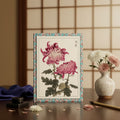
Keika Hasegawa’s woodblock prints from Keika Hyakugiku (1893) appear on the cover of our Chrysanthemum Journal, a hardcover lined journal with 150 perforated pages, casewrap sewn binding, and matte laminated full-wrap cover.
References
- Keika Hasegawa. Keika Hyakugiku (慶華百菊). Kyoto, 1891–1893.
- Newland, Amy Reigle, ed. The Hotei Encyclopedia of Japanese Woodblock Prints. Hotei Publishing, 2005.
- Screech, Timon. Obtaining Images: Art, Production and Display in Edo Japan. Reaktion Books, 2012.
- Wichmann, Siegfried. Japonisme: The Japanese Influence on Western Art Since 1858. Thames & Hudson, 1981.
- Hayashi, Yoshikazu. Meiji no Hana: Botanical Illustration in the Meiji Period. Tokyo National Museum, 1998.