The Golden Summer of Kate Greenaway: Art, Fashion, and the Victorian Garden
Kate Greenaway did not merely illustrate the Victorian age — she shaped it. Her cottage gardens, high-waisted gowns, and golden summer light enchanted a generation, changed the way an era dressed its children, and created a visual language of English pastoral innocence that has never entirely faded.

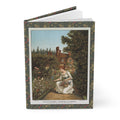
There is a particular quality of light in Kate Greenaway’s illustrations — soft, even, unhurried — that seems to belong to a summer that never quite existed and yet feels entirely real. It is the light of an English garden at its most perfect: the roses in full bloom, the gate half-open, the young woman in her high-waisted gown pausing in the act of gathering flowers as if time itself had agreed to slow down for the occasion. It is a light that Greenaway invented, and that Victorian England immediately recognised as its own.
Kate Greenaway (1846–1901) was born in Hoxton, London, the daughter of a wood engraver, and trained at the National Art Training School and the Slade. Her early career was modest — greeting cards, magazine illustrations, the ordinary work of a commercial artist in the 1860s and 1870s. But in 1879, the publication of Under the Window, a collection of children’s verses illustrated in her distinctive style and printed by the master colour printer Edmund Evans, transformed her overnight into one of the most celebrated artists in England. The book sold a hundred thousand copies. Ruskin praised her. The public adored her. And the “Greenaway style” — the Regency-inspired gowns, the cottage gardens, the children in mob caps and pinafores — became a cultural phenomenon that extended far beyond the pages of her books.
The Greenaway Style and the Transformation of Victorian Fashion
What made Greenaway’s influence so remarkable was that it did not remain confined to illustration. The children she drew — in their high-waisted dresses, their wide sashes, their soft bonnets and buckled shoes — became a model for how Victorian parents actually dressed their children. Dressmakers and department stores produced “Greenaway costumes”. Liberty of London stocked fabrics in the soft, muted tones she favoured. The Queen magazine and The Girl’s Own Paper published patterns based on her designs. For a decade and more, to dress a child in the Greenaway manner was to signal a particular kind of aesthetic sensibility — a preference for the handmade over the industrial, the historical over the fashionable, the garden over the city.
This influence was not accidental. Greenaway was deeply interested in historical costume — particularly the dress of the late eighteenth century and the Regency period — and she brought to her illustrations a genuine knowledge of how clothes were constructed and worn. Her figures are not dressed in vague “old-fashioned” garments but in specific, historically informed costumes that she adapted with great care to the needs of her compositions. The high waist, the soft muslin, the wide sash — these were not inventions but recoveries, drawn from a period that Greenaway and her contemporaries associated with a simpler, more graceful way of life.
Edmund Evans and the Art of Colour Printing
The visual impact of Greenaway’s work was inseparable from the technical achievement of Edmund Evans (1826–1905), the colour printer who produced her books and who understood, better than anyone of his generation, how to translate a watercolour original into a printed page without losing its essential quality. Evans had already worked with Walter Crane and Randolph Caldecott — the other great illustrators of the Victorian “picture book revolution” — but his collaboration with Greenaway was perhaps his most sustained and successful.
The chromolithographic process that Evans used was extraordinarily labour-intensive: each colour required a separate printing, and a typical Greenaway illustration might require eight or ten passes through the press. The result, at its best, was a printed page that retained the delicacy of the original watercolour — the soft gradations of tone, the subtle variations of colour, the fine detail of a flowering border or a child’s embroidered collar. It was Evans who brought Greenaway’s work to its widest audience, and it was the quality of his printing that ensured that audience encountered her art at something close to its full power.
The Girl’s Own Paper and “Golden Summer”
The Girl’s Own Paper was one of the great publishing phenomena of the Victorian era — a weekly magazine founded in 1880 by the Religious Tract Society, aimed at young women and girls, that combined practical advice, fiction, poetry, and illustration in a format that reached hundreds of thousands of readers at its peak. It was, in its way, a mirror of the aspirations of the Victorian middle-class girl: educated, accomplished, morally serious, and deeply interested in the domestic arts that Greenaway’s illustrations so perfectly embodied.
“Golden Summer,” published in the 1891–1892 season and printed by Edmund Evans, is characteristic of Greenaway at her most assured. A young woman in a high-waisted white gown with a blue sash stands by a wooden gate in a flowering garden, in the pose of quiet waiting — or quiet contemplation — that Greenaway made her own. The gate is half-open; the garden beyond is in full bloom; the light is the soft, even light of an English summer at its most perfect. It is an image that asks nothing of its viewer except the willingness to pause, and to look, and to feel the particular quality of a summer afternoon that seems to have been arranged, by some benevolent intelligence, for the sole purpose of being beautiful.
A Legacy of Golden Light
Greenaway died in 1901, at fifty-five, her later career shadowed by illness and by the changing tastes of the Edwardian era. But her influence did not die with her. The Kate Greenaway Medal, awarded annually since 1955 by the Chartered Institute of Library and Information Professionals for distinguished illustration in children’s books, keeps her name alive in the world she helped to create. And her images — the cottage gardens, the high-waisted gowns, the golden summer light — continue to circulate, reproduced on cards and calendars and journals, as reminders of a particular vision of English pastoral life that has never entirely lost its power to enchant.
That power is not nostalgia, exactly — or not only nostalgia. It is something more specific: the recognition that Greenaway understood, with great clarity and great skill, that beauty is not a luxury but a necessity, and that the act of making something beautiful — a garden, a dress, an illustrated page — is itself a form of care for the world.

If the world of Kate Greenaway and the golden age of Victorian illustration resonates with you, the Golden Summer Journal brings her 1891 Girl’s Own Paper illustration to a hardcover journal — 150 lined pages, ready for notes, sketches, or whatever your days require.
References
- Greenaway, K. Under the Window. George Routledge & Sons, London, 1879.
- Spielmann, M.H. & Layard, G.S. Kate Greenaway. Adam & Charles Black, London, 1905.
- Evans, E. The Reminiscences of Edmund Evans. Oxford University Press, 1967.
- Engen, R. Kate Greenaway: A Biography. Macdonald, London, 1981.
- Drotner, K. English Children and Their Magazines, 1751–1945. Yale University Press, 1988.