Reading the Earth: John Morris, James Reynolds, and the Victorian Art of Geological Illustration
The Earth, it turns out, is a book. Its pages are layers of rock — sandstone and limestone, shale and chalk, granite and basalt — deposited over millions of years and folded, faulted, and eroded into the landscape we inhabit. To read this book, you need to know the alphabet: the names and characteristics of the different rock types, the principles by which they were laid down, the processes that have deformed and transformed them since. In the mid-nineteenth century, a generation of scientists, educators, and publishers set about creating the tools that would teach this alphabet to a rapidly expanding audience of students, field geologists, and curious amateurs. Among the most important of those tools were the colored lithographic diagrams produced by John Morris for the London publisher James Reynolds.

The Geological Revolution
The first half of the nineteenth century was one of the most intellectually exciting periods in the history of science. Geology — the study of the Earth's structure, composition, and history — was transforming from a gentlemanly pursuit into a rigorous discipline with its own methods, institutions, and professional practitioners. The Geological Society of London, founded in 1807, had established geology as a serious science. William Smith's geological map of England and Wales, published in 1815, had demonstrated that rock strata could be identified and correlated across vast distances by the fossils they contained. And Charles Lyell's Principles of Geology, published between 1830 and 1833, had established the principle of uniformitarianism — the idea that the Earth's geological features could be explained by the same processes observable today, operating over immense spans of time.
These developments had profound implications. If the Earth was genuinely ancient — if its strata represented millions of years of accumulated sediment rather than the products of a single catastrophic flood — then the history of life itself was written in those strata, waiting to be read by anyone who knew how. The discovery of dinosaur fossils, the systematic description of fossil invertebrates, the mapping of coal measures and limestone formations: all of these depended on the ability to understand stratigraphy — the science of rock layers, their sequence, their relationships, and their significance.
By the 1850s, geology had become one of the most popular sciences in Britain. The Great Exhibition of 1851 had included geological displays that attracted enormous public interest. Geological field trips were fashionable. Amateur fossil collectors were active across the country. And the demand for educational materials — diagrams, textbooks, museum displays — that could explain the principles of the new geology to non-specialists was greater than it had ever been.
James Reynolds and the Educational Publisher
Into this market stepped James Reynolds, a London publisher based at 174 Strand — one of the great commercial thoroughfares of Victorian London, lined with booksellers, print shops, and publishers of every kind. Reynolds specialised in educational materials: maps, diagrams, charts, and illustrated publications designed to make complex subjects accessible to students and general readers. His publications covered a wide range of subjects — geography, natural history, astronomy, and the physical sciences — and were distinguished by the quality of their illustration and the clarity of their presentation.
Reynolds understood that the new geology required a new kind of educational tool. Textbooks could explain the principles of stratigraphy in words, but words alone could not convey the visual complexity of a geological cross-section — the way different rock types were distinguished by color and texture, the way faults and folds disrupted the orderly succession of strata, the way igneous intrusions cut across sedimentary layers. What was needed was a diagram: a large, clearly colored, carefully labeled visual representation of geological structure that could be displayed in a classroom, studied in a laboratory, or consulted in the field.
The series of 44 scientific teaching diagrams that Reynolds published between 1850 and 1860 was his answer to this need. Produced as colored lithographs — a printing technology that allowed the reproduction of complex, multi-colored images at relatively low cost — the diagrams covered the full range of geological subjects: rock types and their characteristics, fossil sequences, volcanic phenomena, glacial features, and, most importantly, stratigraphic cross-sections showing the structure of the Earth's crust in different geological settings.
John Morris and the Art of the Geological Diagram
The lithographer responsible for the geological diagrams in Reynolds' series was John Morris — an artist working in the tradition of scientific illustration that had developed alongside the geological sciences themselves. The geological diagram was a relatively new art form in the 1850s, and it made distinctive demands on its practitioners. Unlike botanical or zoological illustration, which required the accurate rendering of specific organisms, geological illustration required the ability to represent abstract concepts — the succession of strata over time, the geometry of faults and folds, the relationships between different rock types — in a form that was both scientifically accurate and visually comprehensible.
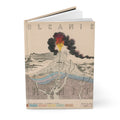
Morris met these demands with considerable skill. His stratigraphic cross-section — the diagram that appears on our journal — is a masterwork of scientific visualization. The diagram shows a vertical section through the Earth's crust, revealing the arrangement of rock layers from the surface down to the deeper formations below. Different rock types are distinguished by color and pattern: the warm ochres and browns of sedimentary rocks, the darker tones of igneous formations, the distinctive patterns used to indicate limestone, sandstone, shale, and coal. Faults are shown as clean lines cutting across the strata; folds are rendered with careful attention to the geometry of compression and deformation; igneous intrusions are depicted cutting through the surrounding sedimentary layers.
The diagram is not just a scientific document. It is also a beautiful object — a composition in which the colors and patterns of different rock types create a visual rhythm that is genuinely aesthetic, quite apart from its scientific content. The Victorian geological diagram occupies an interesting position in the history of scientific illustration: it is functional, certainly, but it is also a form of art, shaped by the aesthetic conventions of its time as well as by the scientific requirements of its subject.
Stratigraphy and Deep Time
The science that Morris's diagram illustrates — stratigraphy — is, at its core, a science of time. The principle of superposition, established by the Danish geologist Nicolas Steno in the seventeenth century, holds that in any undisturbed sequence of rock layers, the oldest layers are at the bottom and the youngest at the top. This simple principle, combined with the recognition that different rock types were formed under different conditions — limestone in shallow seas, sandstone in river deltas, coal in tropical swamps — allowed geologists to reconstruct the environmental history of a region from its rock record.
By the 1850s, this reconstruction had revealed something extraordinary: the Earth was immensely old. The thickness of the sedimentary sequences that geologists were mapping — thousands of metres of rock, each layer representing centuries or millennia of deposition — implied a timescale that dwarfed the few thousand years of recorded human history. The concept of deep time — geological time, measured in millions rather than thousands of years — was one of the most intellectually challenging ideas of the nineteenth century, and it was the geological diagram, more than any other medium, that made it visually comprehensible.
Morris's cross-section is, in this sense, a diagram of deep time as much as of rock structure. Each layer in the section represents not just a type of rock but a period of Earth history — an environment, a climate, a community of organisms that lived and died and left their traces in the sediment. To read the diagram is to read the Earth's autobiography, written in the language of stone.
The Legacy of Victorian Scientific Illustration
The tradition of scientific illustration that Morris and Reynolds contributed to was one of the great intellectual achievements of the Victorian period. At a time when photography was still in its infancy and could not yet reproduce color, the colored lithograph was the primary medium for communicating complex visual information across the scientific community and to the general public. The geological diagrams, natural history illustrations, anatomical plates, and astronomical charts produced by Victorian publishers like Reynolds were not merely decorative: they were essential tools of scientific communication, the means by which new knowledge was disseminated and made accessible.
That tradition has not entirely disappeared. Modern geological maps and cross-sections still use many of the same conventions — the color coding of rock types, the representation of faults and folds, the use of vertical exaggeration to make stratigraphic relationships visible — that Morris employed in his 1850s diagrams. The science has advanced enormously, but the fundamental challenge of representing three-dimensional geological structure in two dimensions remains, and the solutions developed by Victorian illustrators remain relevant.
What has changed is the context in which these images are encountered. Morris's diagrams were made to be used — to be displayed in classrooms, consulted in the field, studied by students learning the principles of stratigraphy. Today, they are encountered primarily as historical objects: beautiful artifacts of a period when science and art were more closely intertwined than they have since become, when the making of a scientific diagram required not just knowledge but skill, not just accuracy but aesthetic judgment.
A Journal for Those Who Read the Earth

Our John Morris Geological Diagram Journal carries this 1850s stratigraphic cross-section across its full wraparound cover — the colored layers of rock, the faults and folds, the igneous intrusions, all rendered in Morris's careful lithographic hand. It is a journal for those who share the Victorian geologist's habit of reading the landscape — who look at a cliff face and see not just rock but time, who understand that the ground beneath their feet is a document as rich and complex as any written text.
Inside, 150 perforated lined pages await your field notes, stratigraphic sketches, rock descriptions, or whatever form your own engagement with the Earth takes. The casewrap sewn binding opens completely flat — ideal for field use. The matte laminated cover preserves every detail of Morris's diagram in a finish that rewards close examination.
The Earth has been writing its autobiography for four billion years. Morris gave us one way to read it. Perhaps you will find your own.
References & Further Reading
- Gould, Stephen Jay. Time's Arrow, Time's Cycle: Myth and Metaphor in the Discovery of Geological Time. Harvard University Press, 1987. [On the concept of deep time and its intellectual history.]
- Lyell, Charles. Principles of Geology. 3 vols. John Murray, 1830–1833. [The foundational text of Victorian geology; available digitized via the Internet Archive.]
- Oldroyd, David R. Thinking About the Earth: A History of Ideas in Geology. Harvard University Press, 1996.
- Rudwick, Martin J. S. Bursting the Limits of Time: The Reconstruction of Geohistory in the Age of Revolution. University of Chicago Press, 2005.
- Rudwick, Martin J. S. Worlds Before Adam: The Reconstruction of Geohistory in the Age of Reform. University of Chicago Press, 2008. [The definitive study of early nineteenth-century geology.]
- Secord, James A. Victorian Sensation: The Extraordinary Publication, Reception, and Secret Authorship of Vestiges of the Natural History of Creation. University of Chicago Press, 2000. [On the popularisation of science in Victorian Britain.]
- Winchester, Simon. The Map That Changed the World: William Smith and the Birth of Modern Geology. HarperCollins, 2001. [Accessible account of the geological revolution and its key figures.]