The Light of Delft: Johannes Vermeer, The Little Street, and the View of Delft
There are cities that have been painted so often, and so well, that the paintings have become inseparable from the cities themselves — that to visit the place is to walk into the image, and to look at the image is to feel the presence of the place. Venice has its Canaletto; Paris has its Impressionists; Rome has its centuries of vedutisti. But no city has been painted with the luminous precision and quiet tenderness that Johannes Vermeer brought to Delft. He painted it only twice in surviving works — a quiet alley in The Little Street, a grand panorama in View of Delft — and yet those two paintings have made his city immortal. They are among the most beloved images in the history of Western art, and they carry within them a quality of light that no artist before or since has quite managed to capture.

Vermeer (1632–1675) spent almost his entire life in Delft. He was born there, worked there, died there, and is buried in the Oude Kerk. He painted the women of Delft in their quiet interiors, the light falling through their windows onto their letters and their lutes and their jugs of milk. And twice — in works that stand apart from the rest of his small surviving oeuvre — he turned his attention to the city itself: to its brick façades and white-framed windows, its canals and towers and the soft northern light that falls on ordinary streets and transforms them into something eternal.
Delft in the Golden Age
The Delft that Vermeer painted was one of the most prosperous cities in the most prosperous republic in the world. The Dutch Republic of the seventeenth century — the United Provinces, as it was formally known — had achieved, in the space of a few decades, a commercial and cultural dominance that astonished contemporaries and has fascinated historians ever since. Its merchant fleet controlled the trade routes of the world; its cities were the centres of a new kind of urban culture, based on commerce and civic virtue rather than aristocratic patronage; and its painters — Rembrandt, Hals, Steen, de Hooch, and above all Vermeer — produced a body of work that remains, four centuries later, among the greatest achievements of Western art.
Delft was not the largest or the most powerful of the Dutch cities — Amsterdam and Rotterdam were larger, and The Hague was the seat of government — but it had a character of its own. It was the home of the Delftware pottery industry, whose blue-and-white ceramics had made the city’s name synonymous with a particular kind of refined domestic beauty. It was the city where Antonie van Leeuwenhoek — Vermeer’s contemporary and, according to some scholars, his friend — first looked through a microscope and discovered the invisible world of microorganisms. And it was the city where Vermeer spent his life, painting its light with a precision and sensitivity that no other artist has brought to any other place.
The Little Street: A Quiet Alley Made Eternal
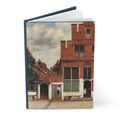
The Little Street (c.1658, Rijksmuseum, Amsterdam) is one of only three surviving Vermeer cityscapes — the others being View of Delft and a small view of a house façade that may or may not be by Vermeer’s hand. It shows a quiet Delft alley: two brick houses with white-framed windows, a woman sitting in a doorway, children playing on the step, another figure visible through an open gate at the side. The scale is intimate — this is not a grand public space but a private corner of the city, the kind of place that most painters would have passed without a second glance.
What Vermeer does with this unpromising subject is extraordinary. The painting is, on one level, a precise documentary record of a specific place — scholars have spent decades trying to identify the exact location of the alley, with some success — but it is also something much more than a topographical document. The light that falls on the brick façades, the way the mortar between the bricks catches the northern sky, the tender observation of the figures in the doorway — all of this transforms a quiet corner of a seventeenth-century Dutch city into something that feels, four centuries later, both completely specific and completely universal. This is a particular place, at a particular moment; and it is also every quiet street, every ordinary afternoon, every moment of domestic life that has ever been lived.
The painting entered the Rijksmuseum collection in 1921, where it has remained one of the most visited works in the museum. It hangs near Vermeer’s other great works — The Milkmaid, Woman Reading a Letter, The Love Letter — and it holds its own among them, not through grandeur or complexity but through the quiet intensity of its attention to the ordinary.
View of Delft: The Greatest Cityscape Ever Painted
View of Delft (c.1660–1661, Mauritshuis, The Hague) is a different kind of painting entirely. Where The Little Street is intimate and close, View of Delft is panoramic and grand: a view of the city from across the water, its towers and rooftops reflected in the still canal, bathed in the luminous light of a clearing storm. The sky takes up more than half the canvas; the city is seen from a distance, its silhouette rising above the water with a clarity and solidity that makes it feel both real and ideal, both a specific place and a vision of what a city could be.
Marcel Proust, who saw the painting at an exhibition in Paris in 1902, described it as “the most beautiful painting in the world.” He returned to it repeatedly in his writing — most famously in In Search of Lost Time, where the dying writer Bergotte drags himself from his sickbed to see the painting one last time, and dies in front of it, contemplating “a little patch of yellow wall” that he feels he should have painted better. The passage is one of the most celebrated in twentieth-century literature, and it has made View of Delft — and that little patch of yellow wall — famous far beyond the world of art history.
The painting is now in the Mauritshuis in The Hague, where it has been since 1822. It is one of the most studied paintings in the history of art: scholars have analysed its perspective, its light, its topography, and its technique with extraordinary thoroughness, and yet it retains, after all this analysis, a quality of mystery that no amount of scholarship has quite explained. How did Vermeer achieve that light? How did he render the reflections in the water with such precision? How did he make a view of a provincial Dutch city feel like a vision of eternity?
Vermeer’s Light: The Camera Obscura and the Northern Sky
The quality of light in Vermeer’s paintings — the luminosity that seems to come from within the canvas rather than from any external source — has been the subject of intense scholarly debate for more than a century. The most influential theory, advanced by the artist David Hockney and the physicist Charles Falco, is that Vermeer used a camera obscura — a device that projects an image of the external world onto a surface through a lens — to achieve the extraordinary precision of his compositions and the subtle gradations of light and shadow in his paintings.
Whether or not Vermeer used a camera obscura — and the evidence, while suggestive, is not conclusive — the quality of light in his paintings reflects something more than technical ingenuity. It reflects a sustained, attentive engagement with the specific quality of northern European light — the soft, diffused light of the Dutch sky, filtered through clouds and reflected off water and brick, that gives the Dutch landscape and the Dutch city their characteristic luminosity. Vermeer looked at this light with an attention and a sensitivity that no other painter has brought to it, and he found in it a quality that transcends the merely meteorological: a light that is also a kind of grace, a way of seeing the ordinary world that makes it feel, for a moment, extraordinary.
A Journal for Those Who Find Beauty in Quiet Moments

Our Johannes Vermeer Delft Views Journal carries The Little Street on the front cover and View of Delft on the back — the intimate alley and the grand panorama, the domestic and the monumental, the quiet beauty of a city seen through the eyes of its greatest painter. It is a journal for those who find beauty in ordinary moments, who understand that a quiet street can be as worthy of attention as a grand landscape, who appreciate the Dutch Golden Age tradition of looking carefully at the world and finding in it something worth preserving.
Inside, 150 perforated lined pages await your travel notes, art observations, daily reflections, or whatever form your engagement with beauty takes. The casewrap sewn binding opens completely flat. The matte laminated cover preserves every detail of Vermeer’s paintings in a finish that rewards close examination.
In 1658, Vermeer looked at a quiet Delft alley and made it eternal. In 1660, he looked at his city across the water and painted the most beautiful cityscape in the history of art. Perhaps the pages inside will help you look a little more carefully at the world around you.
References & Further Reading
- Bailey, Anthony. Vermeer: A View of Delft. Henry Holt, 2001. [The most readable biography of Vermeer, with detailed discussion of both cityscapes.]
- Hockney, David. Secret Knowledge: Rediscovering the Lost Techniques of the Old Masters. Viking, 2001. [On the camera obscura theory and Vermeer’s optical techniques.]
- Liedtke, Walter. Vermeer: The Complete Paintings. Ludion, 2008. [The standard scholarly catalogue of Vermeer’s work.]
- Proust, Marcel. In Search of Lost Time, Vol. 5: The Captive. Trans. C.K. Scott Moncrieff & Terence Kilmartin. Modern Library, 1993. [The Bergotte episode and the “little patch of yellow wall.”]
- Schama, Simon. The Embarrassment of Riches: An Interpretation of Dutch Culture in the Golden Age. Knopf, 1987. [The essential cultural history of the Dutch Golden Age.]
- Steadman, Philip. Vermeer’s Camera: Uncovering the Truth Behind the Masterpieces. Oxford University Press, 2001. [The most thorough scholarly investigation of the camera obscura theory.]
- Wheelock, Arthur K. Jan Vermeer. Harry N. Abrams, 1988. [A comprehensive study of Vermeer’s life and work.]