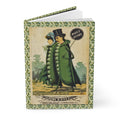
Jerome B. Rice & Co. and the Art of the Victorian Trade Card
In the 1880s, if you wanted to sell seeds to American home gardeners, you needed a salesman. Not a real one — the distances were too great, the farms too scattered, the postal routes too unreliable for door-to-door commerce. What you needed was something that could travel through the mail, sit on a counter, be picked up and admired and kept, and do its persuasive work quietly, over time. What you needed, in other words, was a trade card. And if you were Jerome B. Rice of Cambridge Valley, New York, you dressed your trade card in a tailcoat and a bonnet and gave it a face, and you sent a pea couple out into the world to sell your seeds.

The Trade Card and Its World
The trade card was one of the defining commercial forms of the Gilded Age in America. It emerged in the 1870s, when advances in chromolithographic printing made it possible to produce small, colourful cards cheaply and in large quantities, and it flourished through the 1880s and into the 1890s, when it was gradually displaced by magazine advertising and the illustrated catalogue. At its peak, the trade card was ubiquitous: distributed by merchants, collected by consumers, pasted into scrapbooks, traded among children, and preserved with a care that their commercial origins might not seem to warrant.
The appeal of the trade card was partly practical and partly aesthetic. Practically, it was a portable advertisement — a reminder of a merchant's name and goods that could be carried in a pocket or pinned to a wall. Aesthetically, it was often genuinely beautiful: the best chromolithographic trade cards of the 1880s are small masterpieces of popular art, with vivid colours, intricate designs, and a visual wit that reflected the tastes and humours of the Gilded Age. They were collected not despite their commercial purpose but because of it — because the combination of beauty and utility, of art and commerce, was itself a characteristic expression of the era.
The subjects of trade cards were as varied as the businesses that produced them: patent medicines, corsets, thread, soap, stoves, pianos, insurance. But the seed companies of the northeastern United States produced some of the most inventive and charming trade cards of the period, and among them, Jerome B. Rice & Co. of Cambridge Valley, New York, produced some of the most inventive and charming of all.
Jerome B. Rice and Cambridge Valley
The Rice seed business had its origins in 1832, when Roswell Rice began growing and selling seeds in Cambridge Valley — a fertile agricultural district in Washington County, in the Hudson Valley region of upstate New York, well-watered and well-connected by rail to the markets of Albany, Troy, and New York City. Roswell's son Jerome transformed the family operation into one of the largest seed packet businesses in the United States, developing a mail-order operation that distributed seeds across the country and a marketing approach that was, for its time, remarkably sophisticated.
Jerome B. Rice understood that selling seeds was not simply a matter of providing good seeds at a fair price — though Rice's seeds were, by all accounts, excellent. It was a matter of building a relationship with the home gardener, of making the Rice name synonymous with quality, reliability, and a certain cheerful confidence in the pleasures of the kitchen garden. The trade cards were central to this strategy: they were designed to be kept, to be admired, to be shown to neighbours, to create the kind of affectionate brand loyalty that no amount of straightforward advertising could achieve.
The Cambridge Valley Seed Gardens developed heirloom varieties that are still celebrated today, including the legendary “Longfellow” cucumber — a long, slender, dark green variety of exceptional flavour that became one of the most popular cucumbers in American kitchen gardens of the late nineteenth century. The company operated until 1932, a century after its founding, and left behind the Rice Mansion Inn as a lasting Victorian landmark in Cambridge, NY.
The Plant People
The most celebrated of Rice's trade cards are the “plant people” series — a group of cards in which vegetables and fruits are given human faces, human bodies, and human clothes, and sent out into the world as ambassadors for the Rice seed range. The pea couple of 1885 is the finest example: a man and a woman, both constructed from pea pods and pea plants, dressed in the formal attire of the Victorian middle class — the man in a tailcoat and top hat, the woman in a bonnet and a full-skirted dress — and bearing the legend: “Rice's Seeds. We Are American Wonders. We Are the Earliest and Best.”
The anthropomorphic vegetable was not Rice's invention. The tradition of giving human characteristics to plants and animals has roots in medieval manuscript illustration, in the grotesque decorations of Renaissance art, and in the popular prints of the eighteenth century. But Rice's plant people have a specific quality that sets them apart: they are not grotesque or satirical but genuinely charming, rendered with a warmth and humour that invites affection rather than unease. The pea couple are not monstrous hybrids but cheerful neighbours, dressed in their Sunday best, proud of their origins and confident in their quality.
This combination of whimsy and confidence — the willingness to be playful in the service of a serious commercial purpose — is characteristic of the best American advertising of the Gilded Age, and it reflects a sophisticated understanding of the psychology of the home gardener. The person who received a Rice trade card featuring a pea couple in formal attire was not being sold to in any straightforward sense. They were being entertained, charmed, and invited into a relationship with a brand that understood their pleasures and shared their sense of humour.
The Grand American Pea
The pea that Rice's couple so proudly represented — Pisum sativum L., the garden pea — was one of the most important vegetables in the American kitchen garden of the 1880s. It was a cool-season annual, sown in early spring as soon as the ground could be worked, and harvested before the summer heat arrived. The “Grand American” variety — a hardy, vigorous climber reaching up to six feet, with large, sweet, starchy seeds — was among the most popular varieties of the period, celebrated for its productivity, its flavour, and its reliability in the variable conditions of the northeastern American spring.
The botanical lithographs that accompanied seed catalogue descriptions of the Grand American Pea — showing the cross-section of the pod, the arrangement of the seeds, the structure of the seedling, the mature plant climbing its trellis — were works of popular science as much as commercial art. They reflected the Victorian era's passion for natural history education, for the precise documentation of the living world, and for the belief that the home gardener who understood the botany of their plants would be a better, more successful, more fulfilled gardener. The seed catalogue was, in this sense, a form of popular education as well as a commercial document.
The Legacy of the Trade Card
Rice's 1885 plant people trade cards are now prized collectibles in horticultural and Americana collections — small, vivid windows into a world of commercial art and popular culture that has largely disappeared. They are collected for their beauty, their humour, and their historical resonance: as documents of a moment when American commerce was finding its visual language, when chromolithography was making colour available to everyone, and when a seed company in Cambridge Valley, New York, could dress a pea in a tailcoat and send it out to conquer the world.
To look at the Rice pea couple now is to understand something important about the relationship between art and commerce, between beauty and utility, between the serious business of growing food and the human need for play and delight. The pea couple are selling seeds. They are also, in their small and cheerful way, celebrating the pleasures of the kitchen garden — the anticipation of spring, the satisfaction of a well-tended row, the sweetness of the first peas of the season, eaten straight from the pod in the garden on a warm afternoon.

Our Pea Journal reproduces Rice's 1885 trade card and a vintage-style Grand American Pea botanical lithograph across its covers — a celebration of Victorian whimsy, horticultural heritage, and the art of the American seed garden.
References
Holt, M. (2009). The Seed Garden: The Art and Practice of Seed Saving. Seed Savers Exchange.
Lear, L. (1998). Rachel Carson: Witness for Nature. Houghton Mifflin.
McLean, A. (2004). Victorian Book Design and Colour Printing. Faber & Faber.
Webb, W. (1999). Trade Cards in 19th-Century America. University of Missouri Press.
Wheeler, A. (2015). Designing Brand Identity. John Wiley & Sons.