The Bamboo That Flowers Once in a Century: Shirasawa, Makino, and the 1912 Atlas of Japanese Bamboo
In 1912, a forestry bureau publication quietly became one of the most beautiful scientific atlases ever produced in Japan — a work that documented not just the morphology of bamboo, but the extraordinary patience required to truly know it.
There is a particular quality of attention that Japanese botanical science brought to the natural world in the Meiji era — a combination of Western taxonomic rigour and a native tradition of close, unhurried looking that produced illustrations unlike anything being made elsewhere at the time. Nowhere is this more evident than in the Nihon Chikurui Zufu — the Icones of the Bamboos of Japan — published in Tōkyō in 1912 by Yasuyoshi Shirasawa for the Nōshōmushō Sanrinkyoku, the Forestry Bureau of the Ministry of Agriculture and Commerce.
The atlas was a scientific commission, produced to document the bamboos of Japan with the taxonomic precision that modern forestry management required. But in the hands of Tomitaro Makino — Japan's most celebrated botanical artist and one of the great naturalists of his age — it became something more: a work of sustained visual intelligence that captured not only the morphology of each species but the subtle variations of form, leaf texture, and colouration that distinguish one bamboo variety from another.
Tomitaro Makino and the Art of Botanical Seeing
Tomitaro Makino (1862–1957) is a figure of almost legendary status in the history of Japanese botany. Self-taught, obsessively dedicated, and possessed of a draughtsmanship that combined scientific accuracy with genuine artistic sensibility, Makino spent his long life — he died at ninety-four — documenting the flora of Japan with an intensity that has never been surpassed. His Makino's New Illustrated Flora of Japan, first published in 1940 and still in print, remains the standard reference for Japanese plant identification.
What made Makino exceptional was not merely his technical skill but his understanding that a botanical illustration must do two things simultaneously: it must be accurate enough to serve as a scientific record, and it must be clear enough to teach. His plates for the Nihon Chikurui Zufu achieve both with apparent effortlessness — the culms, sheaths, nodes, and leaf structures rendered with anatomical precision, the overall composition arranged so that the eye moves naturally through the information the image contains.
Tab. 6: The Variability of a Single Species
The sixth plate of the atlas is devoted entirely to Arundinaria variabilis (Makino) — today reclassified as Sasaella ramosa — and it is, in its quiet way, a remarkable document of botanical diversity. In a single plate, Makino illustrated five distinct varieties of the same species: f. foliis pubescentis, with its characteristic fine leaf pubescence; var. variegata, displaying the striking white and yellow longitudinal stripes now prized in ornamental horticulture; var. pygmaea, the dwarf ground-covering form; var. viridi-striata, with its elegant green-striped pattern; and var. tanakae, named in honour of a collaborator of the era.
The plate is an argument, made entirely in images, for the extraordinary plasticity of plant life — for the way a single species can transform its appearance across its natural varieties while remaining, in its essential structure, recognisably itself.
Tab. 7: The Rarest Event in the Forest
The seventh plate documents three bamboo species of great importance in Japanese culture and science: Arundinaria simonii (Pleioblastus simonii), prized for basket-making and crafts; Arundinaria narihira (Semiarundinaria fastuosa), the columnar Narihira bamboo named for a Heian poet, with its distinctive purple-red ageing sheaths; and Sasa paniculata f. nebulosa (Sasa palmata f. nebulosa), with its broad palmate leaves and the dark nebulous markings on its culms that Makino documented with extraordinary care.
But it is the floral details in figures 13 and 14 that make this plate genuinely extraordinary. Bamboo flowers only once in its lifetime — an event that occurs, depending on the species, only once every sixty to one hundred and twenty years, after which the entire grove dies. To document a bamboo in flower was, for a botanist of Makino's era, an event of the rarest scientific significance: a glimpse of a biological process so infrequent that most observers would never witness it in a lifetime of fieldwork. That Makino captured it with the same calm precision he brought to every other detail of the plate is, in itself, a kind of testament to his extraordinary patience as a scientist and an artist.
The Atlas as Cultural Object
The Nihon Chikurui Zufu belongs to a particular moment in Japanese scientific history — the late Meiji period, when Japan was simultaneously absorbing the methods of Western natural science and beginning to produce original scientific work of its own. The atlas is a product of that double inheritance: Western in its taxonomic rigour and its commitment to systematic documentation, Japanese in the quality of attention it brings to the natural world and in the aesthetic sensibility that shapes every plate.
More than a century after its publication, the atlas remains the definitive visual record of Japanese bamboo — a work that has not been superseded because it has never been equalled. It is a reminder that the greatest scientific illustrations are not merely records but acts of understanding: images that teach us not just what something looks like, but what it means to look carefully at the world.

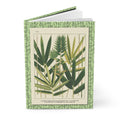
If the world of Meiji botanical science and the quiet elegance of Japanese bamboo illustration resonates with you, the Japanese Bamboo Journal brings Shirasawa and Makino's 1912 plates to a hardcover journal — 150 lined pages, ready for notes, sketches, or whatever your days require.
References
- Shirasawa, Y. & Makino, T. Nihon Chikurui Zufu (Icones of the Bamboos of Japan). Nōshōmushō Sanrinkyoku, Tōkyō, 1912.
- Makino, T. Makino's New Illustrated Flora of Japan. Hokuryukan, Tōkyō, 1940.
- Koidzumi, G. "Bambusaceae Japonicae." Botanical Magazine, Tōkyō, 1925.
- Blunt, W. & Stearn, W.T. The Art of Botanical Illustration. Antique Collectors' Club, 1994.
- Lack, H.W. Garden Eden: Masterpieces of Botanical Illustration. Taschen, 2008.