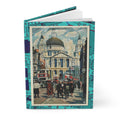
James Bateman and the Golden Age of British Railway Poster Art
Between the two world wars, the major British railway companies embarked on one of the most ambitious public art programmes in the history of graphic design. Commissioning leading artists — among them Frank Brangwyn, Edward McKnight Kauffer, Tom Purvis, and dozens of others — to produce posters promoting travel to destinations across Britain and beyond, the railway companies created a body of work that transformed the commercial poster into a vehicle for serious artistic expression, and that remains, nearly a century later, among the most admired graphic art ever produced in Britain. At the heart of this tradition stood James Bateman — a Royal Academician whose 1939 poster of St. Paul's Cathedral from Ludgate Hill is one of the finest and most historically resonant images in the entire canon of British railway art.

The Railway Poster as Public Art
The British railway poster had its origins in the Victorian era, when the railway companies began commissioning illustrated bills to advertise their services and destinations. But it was in the interwar period — roughly from 1923, when the grouping of Britain's railways into four major companies created organizations large enough to sustain ambitious artistic programmes, to 1939, when the outbreak of war transformed the railways into instruments of national mobilization — that the railway poster reached its artistic peak.
The four grouped companies — the Great Western Railway, the London Midland and Scottish Railway, the Southern Railway, and the London and North Eastern Railway — each developed distinctive approaches to poster commissioning, but all shared the conviction that the poster was a form of public art as well as a commercial communication, and that the quality of the artwork reflected on the quality of the railway. The result was a sustained programme of commissioning that brought together the most diverse range of artistic styles — from the bold abstraction of McKnight Kauffer to the romantic realism of Terence Cuneo, from the decorative modernism of Tom Purvis to the meticulous topographical precision of James Bateman — in the service of a single commercial purpose: persuading the British public to travel by train.
James Bateman: The Royal Academician as Poster Artist
James Bateman (1893–1959) was an unusual figure in the world of railway poster art: a Royal Academician, trained in the academic tradition of oil painting and portraiture, who brought to the commercial poster the technical resources and artistic ambitions of the fine art world. Born in Kendal in the Lake District, he studied at the Slade School of Fine Art under Henry Tonks — one of the most demanding drawing teachers of his generation — and developed a style characterized by meticulous attention to surface texture, atmospheric light, and the precise rendering of architectural detail that set him apart from the more stylized approaches of his contemporaries.
Bateman's railway posters — produced for several of the major companies over the course of his career — are distinguished by their documentary quality: they look less like commercial advertisements than like carefully observed paintings of specific places at specific moments, capturing the texture of stone, the quality of light, and the movement of figures with a precision that gives them an almost photographic immediacy. Unlike the bold simplifications of the modernist poster tradition, Bateman's work invites close looking — the individual pedestrians on Ludgate Hill, the red buses navigating the street, the play of light on the dome of St. Paul's — and rewards it with a richness of detail that reveals more the longer one looks.
St. Paul's from Ludgate Hill, 1939
Bateman's 1939 poster depicting St. Paul's Cathedral from Ludgate Hill is, by any measure, one of the finest works in the British railway poster tradition. The composition is deceptively simple: the view up Ludgate Hill toward the cathedral, with the dome rising above the roofline of the surrounding buildings, flanked by the red AEC Regent buses that were the most familiar sight on London's streets in the late 1930s, and populated with the pedestrians and traffic of an ordinary London day. But the execution is anything but simple: the stone of the cathedral is rendered with a tactile precision that captures the weight and texture of Wren's masonry; the atmospheric perspective of the street receding toward the dome is managed with the skill of a trained academic painter; and the figures — the office workers, the tourists, the bus passengers — are observed with the sympathetic attention of an artist who understood that the life of a city is made by its people as much as its buildings.
The poster was published in 1939, in the last months of peace before the outbreak of the Second World War. Within a year, the area it depicted would be transformed by the Blitz: the bombing raids of 1940 and 1941 destroyed or damaged many of the buildings visible in Bateman's composition, and the famous photograph of St. Paul's standing amid the smoke and flames of the Second Great Fire of London on 29 December 1940 — taken by Herbert Mason from the roof of the Daily Mail building — gave the cathedral a symbolic significance that Bateman's poster, painted in the calm of the last peacetime summer, could not have anticipated. Together, the poster and the photograph frame one of the most dramatic episodes in the history of London: the city as it was, and the city as it survived.
MacDonald Gill and the Pictorial Map Tradition
The back cover of the journal presents a section of a 1940 pictorial map of London by MacDonald "Max" Gill (1884–1947), the younger brother of the sculptor and typographer Eric Gill, and one of the most gifted decorative cartographers of the 20th century. Gill's most celebrated work — the Wonderground Map of the London Underground, first published in 1914 — established the pictorial map as a popular art form in Britain, combining geographical accuracy with decorative illustration in a style that was simultaneously informative and delightful.
The 1940 London map centres on the City — the square mile of the ancient Roman and medieval city that surrounds St. Paul's — and documents, with Gill's characteristic combination of precision and wit, the dense medieval street network that had survived largely unchanged since the Great Fire of 1666: Sermon Lane, Old Change, Knightrider Street, Cordwainers Hall. The last of these — Cordwainers Hall, the livery hall of the guild of shoemakers that had stood on Cannon Street since the 14th century — was destroyed by incendiary bomb in May 1941, months after Gill's map was printed. Like Bateman's poster, the map is a document of a city on the eve of transformation — a record of what was there before the bombs fell.
A Time Capsule in Two Images
Together, Bateman's 1939 poster and Gill's 1940 map form one of the most poignant historical documents in the history of British graphic art: two images of the same square mile of London, made within a year of each other by two of the finest graphic artists of their generation, in the last months before the Blitz changed it forever. They are a reminder that art — even commercial art, even a railway poster and a decorative map — can serve as a form of historical witness: a record of how things looked, and how life was lived, before the world changed.
If the London of Bateman and Max Gill inspires you, our London Journal — Bateman 1939 St Paul's & Max Gill 1940 Map brings both images to the cover of a hardcover journal.
References
- Cole, B. & Durack, R. Railway Posters 1923–1947. Laurence King, 1992.
- Hewitt, J. The Commercial Art of Tom Purvis. Antique Collectors' Club, 2008.
- Ovenden, M. Railway Maps of the World. Penguin, 2011.
- Stamp, G. The Memorial to the Missing of the Somme. Profile Books, 2006.
- Gardiner, J. The Blitz: The British Under Attack. HarperPress, 2010.