From Spaghetti to Stars: The History of Italian Pasta and How It Conquered the World
Pasta is one of the most documented foods in history. From the medieval Arab geographers who first described dried pasta in Sicily to the 20th-century factory catalogs that classified hundreds of shapes with the precision of engineering drawings, the story of pasta is also the story of how a simple combination of flour and water became one of the most culturally significant foods on earth.

This is that story — told through two of its most extraordinary documents: Artemas Ward’s 1911 Grocer’s Encyclopedia and a 1930 Italian pasta factory catalog.
The Origins of Pasta
The question of where pasta comes from has generated more controversy than almost any other topic in culinary history. The popular legend that Marco Polo brought pasta back from China in the 13th century is almost certainly false — there is clear documentary evidence of pasta in Italy before Polo’s journey, and the Chinese noodle tradition is sufficiently different from Italian pasta to make direct derivation unlikely.
The most credible account traces dried pasta to the Arab world, specifically to Sicily under Arab rule in the 9th and 10th centuries. The Arab geographer Muhammad al-Idrisi, writing in 1154, describes a food made from wheat flour in the form of strings — itriyya — being produced in large quantities near Palermo and exported throughout the Mediterranean. This is the earliest clear documentary reference to dried pasta in the Western world, and it establishes Sicily as the likely point of entry for pasta into European culinary culture.
From Sicily, dried pasta spread northward through Italy over the following centuries, adapting to local ingredients, local tastes, and local traditions as it went. By the 14th century, pasta was being produced and consumed throughout the Italian peninsula, and by the 16th century, it had become a staple food in many regions. The extraordinary diversity of pasta shapes — the hundreds of regional varieties that Artemas Ward would attempt to document in 1911 — was already well established by the Renaissance.
The Geometry of Pasta
The diversity of pasta shapes is one of the most remarkable phenomena in culinary history. There are, depending on how you count, somewhere between 300 and 600 distinct pasta shapes in the Italian tradition — each with its own name, its own regional associations, its own relationship to specific sauces and preparations.
This diversity is not arbitrary. The shape of a pasta determines how it interacts with sauce: long, thin pasta like spaghetti and vermicelli works best with light, oil-based sauces that coat the strands evenly; short, ridged pasta like rigatoni and penne traps chunky meat sauces in its tubes and grooves; flat, wide pasta like pappardelle and lasagne supports rich, slow-cooked ragù. The geometry of pasta is, in this sense, a functional geometry — each shape evolved in response to the culinary traditions of its region, the sauces available, and the preferences of the people who made and ate it.
The names of pasta shapes are equally revealing. Many are diminutives or augmentatives of common objects: farfalle (butterflies), conchiglie (shells), orecchiette (little ears), vermicelli (little worms), capellini (little hairs). Others refer to their shape more abstractly: rigatoni (ridged), penne (quills), fusilli (little spindles). Still others carry regional or historical associations: strozzapreti (priest-stranglers), maltagliati (badly cut), trofie (from the Ligurian dialect). The vocabulary of pasta is a vocabulary of everyday life, of observation, of humor, of regional pride.
Artemas Ward and the Grocer’s Encyclopedia
Artemas Ward (1848–1925) was an American food writer and editor whose 1911 Grocer’s Encyclopedia remains one of the most comprehensive and entertaining food reference works of the early 20th century. Ward was not a chef or a culinary professional but a journalist and businessman who had spent decades in the food trade, and his encyclopedia reflects both his practical knowledge and his genuine enthusiasm for the diversity of the foods he documented.
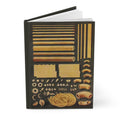
The pasta section of the Grocer’s Encyclopedia is a remarkable document. Ward illustrates fifty distinct pasta varieties — from the familiar spaghetti and vermicelli to the more exotic stars, rings, and bow-ties — with the educational clarity of a scientific taxonomy. Each shape is identified by its Italian name and its American equivalent (where one existed), and Ward provides notes on the appropriate uses of each variety and the regional traditions from which it came.
The illustration itself — a vintage screen-print style composition that arranges the fifty varieties in a grid — is one of the most visually striking food illustrations of the early 20th century. It captures the extraordinary geometric diversity of Italian pasta at a moment when most Americans were still unfamiliar with anything beyond spaghetti and macaroni, and it served as an introduction to Italian culinary culture for a generation of American food retailers and their customers.
The Industrial Pasta Tradition
By 1930, Italian pasta manufacturing had become a major industry, with large factories producing hundreds of shapes to precise specifications for domestic and export markets. The factory catalog that appears on the back cover of this journal is a document of that industrial tradition — recording the precise cross-sections, diameters, and specifications of each pasta variety produced, for industrial and commercial purposes.
The result is a set of technical diagrams that have the precision of engineering drawings and the unexpected beauty of industrial art. The dark brown background of the catalog pages — a consequence of the printing technology of the time — gives the white cross-section diagrams a warmth and depth that purely functional documentation rarely achieves. The pasta shapes, rendered in precise cross-section, reveal the geometric logic that underlies their diversity: the hollow tube of rigatoni, the ridged surface of penne, the twisted spiral of fusilli, each shape a solution to a specific culinary problem, documented with the pride of a manufacturer who understood that the geometry of pasta was also the geometry of Italian culture.
Pasta and the World
By the time Ward published his encyclopedia in 1911, Italian pasta was already well established in the United States — brought by the millions of Italian immigrants who had arrived in the previous decades and who had recreated the food traditions of their home regions in the tenements of New York, Chicago, and San Francisco. By 1930, pasta was on its way to becoming a global food — one that would, in the decades after the Second World War, become as familiar in Tokyo and São Paulo as in Naples and Bologna.
The story of pasta’s global conquest is, in many ways, the story of Italian emigration — the movement of people that carried Italian culinary traditions to every corner of the world and transformed them in the process. The spaghetti and meatballs of Italian-American cuisine, the pasta dishes of Italian-Brazilian cooking, the ramen of Japan — all are, in different ways, descendants of the Italian pasta tradition, adapted to local ingredients and local tastes in ways that their originators could never have imagined.

Our Italian Pasta Journal carries Ward’s fifty varieties on the front cover and a 1930 Italian factory catalog on the back — two of the most extraordinary documents in the history of Italian pasta, preserved in a journal you can carry to every kitchen and every table.
References
- Serventi, Silvano & Françoise Sabban. Pasta: The Story of a Universal Food. Columbia University Press, 2002.
- Ward, Artemas. The Grocer’s Encyclopedia. New York, 1911.
- Riley, Gillian. The Oxford Companion to Italian Food. Oxford University Press, 2007.
- Dickie, John. Delizia! The Epic History of the Italians and Their Food. Free Press, 2008.