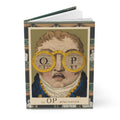
O.P.! O.P.! The Old Price Riots of 1809 and the Caricatures of Isaac Cruikshank
On the night of 18 September 1809, the newly rebuilt Covent Garden Theatre opened its doors for the first time since the fire that had destroyed the old building the previous year. The new theatre was magnificent — larger, grander, more technically sophisticated than its predecessor, designed by Robert Smirke in the Greek Revival style that was becoming fashionable in Regency London. But the audience that filled it that night had not come to admire the architecture. They had come to protest. The management, under the actor-manager John Philip Kemble, had used the rebuilding as an opportunity to raise ticket prices — the pit from three shillings and sixpence to four shillings, the boxes from six shillings to seven — and to convert a portion of the theatre into private boxes available only to wealthy subscribers. The audience’s response was immediate and unambiguous: they chanted “O.P.!” — Old Prices — throughout the performance, drowning out the actors, banging sticks on the floor, blowing whistles, and waving placards. It was the beginning of 67 consecutive nights of protest — one of the most sustained, theatrical, and ultimately successful acts of popular resistance in the history of British culture.

Isaac Cruikshank — father of the more famous George Cruikshank, and one of the great caricaturists of the Georgian era — was watching. His response was a pair of prints that remain among the finest works of Georgian satirical art: the O.P. Spectacles and the N.P. Spectacles, published in 1809, which captured the essential drama of the Old Price Riots in a single, brilliantly conceived visual conceit. Through the lenses of a pair of spectacles, Cruikshank showed two versions of the same theatre — the theatre as the protesters saw it, and the theatre as the management saw it — and in doing so, he made visible the fundamental conflict at the heart of the riots: a dispute not merely about ticket prices, but about who the theatre belonged to, and what kind of institution it was supposed to be.
Covent Garden and the Culture of the Georgian Theatre
The Theatre Royal, Covent Garden, was one of the two patent theatres of London — the only theatres legally permitted to perform spoken drama in the capital, under a system of royal patents that dated back to the Restoration of Charles II in 1660. Together with Drury Lane, Covent Garden occupied a unique position in the cultural life of Georgian London: it was at once a royal institution, a commercial enterprise, and a public space in which the social life of the city was enacted and observed. The audience at Covent Garden was not a passive consumer of theatrical entertainment; it was an active participant in the performance, with established rights and expectations that the management ignored at its peril.
The Georgian theatre audience was, by modern standards, extraordinarily rowdy. Audiences talked, ate, drank, and moved around during performances; they applauded, hissed, and booed; they threw things at actors they disliked and demanded encores from those they admired. The pit — the standing area in front of the stage, where tickets were cheapest — was the most vocal and most powerful section of the audience, and it was the pit that led the Old Price protests. The pit audience was not the working class of later Victorian theatre; it was a mixed social group that included tradesmen, clerks, students, and minor professionals — people who could afford the theatre but for whom the difference between three shillings and sixpence and four shillings was significant, and who felt, with some justice, that the theatre was being taken away from them.
John Philip Kemble and the Decision to Raise Prices
John Philip Kemble was the most celebrated actor of his generation — the leading tragedian of the London stage, famous for his performances as Hamlet, Macbeth, and Coriolanus, and for the classical, statuesque style of acting that made him the dominant theatrical figure of the late eighteenth and early nineteenth centuries. As manager of Covent Garden, he was also a shrewd and ambitious businessman who had invested heavily in the rebuilding of the theatre after the fire of 1808 and who was determined to recoup his investment.
Kemble’s decision to raise prices was not unreasonable from a purely financial perspective: the new theatre had cost £150,000 to build, and the increased capacity and improved facilities justified, in his view, a modest increase in ticket prices. But he had misjudged the mood of his audience. The conversion of part of the theatre into private boxes — removing that space from the general public and reserving it for wealthy subscribers — was seen as a direct attack on the democratic character of the theatre, and it transformed what might have been a manageable dispute about prices into a fundamental conflict about the nature of the institution.
Henry Clifford and the Legal Champion of the O.P. Cause
The Old Price Riots found their legal champion in Henry Clifford, a barrister who became the most prominent public advocate of the protesters’ cause. Clifford’s role in the riots was unusual: he was not a professional agitator or a political radical, but a respectable member of the legal profession who genuinely believed that the management of Covent Garden had violated the rights of its audience. He organised the protesters, provided legal advice to those arrested during the disturbances, and became the public face of the O.P. movement — the figure through whose spectacles, in Cruikshank’s caricature, the theatre was seen as it truly was.
Clifford’s spectacles — the central conceit of Cruikshank’s O.P. print — were a real object: he had worn a pair of spectacles decorated with the letters O.P. during the protests, as a badge of his allegiance to the cause. Cruikshank seized on this detail with the instinct of a great caricaturist: the spectacles became a device for showing two versions of reality, the theatre as the protesters saw it (chaotic, contested, alive with popular energy) and the theatre as the management wished it to be (orderly, profitable, reserved for the wealthy). The conceit was simple, immediately comprehensible, and devastatingly effective — a perfect example of the Georgian caricaturist’s art.
Isaac Cruikshank and the Georgian Caricature Tradition
Isaac Cruikshank was born in Edinburgh around 1764 and established himself in London as one of the leading caricaturists of the Georgian era — a period in which the satirical print was the most powerful form of political and social commentary available to the British public. The great caricaturists of the period — James Gillray, Thomas Rowlandson, and the Cruikshank family — produced images that circulated in their thousands, displayed in the windows of print shops where they could be viewed by anyone who passed, and purchased by collectors who recognised in them a form of art that was at once popular and sophisticated.
The Georgian satirical print was, in many ways, the social media of its era: immediate, widely distributed, capable of making a complex political or social argument in a single image, and consumed by an audience that ranged from the illiterate (who could read the images if not the captions) to the highly educated (who appreciated the classical allusions and literary references that enriched the best prints). Cruikshank’s O.P. and N.P. Spectacles prints belong to this tradition at its finest: they are images that work on multiple levels, as immediate visual jokes, as social commentary, and as documents of a specific historical moment.
The Resolution: The Audience Wins
The Old Price Riots ended on 14 December 1809, after 67 consecutive nights of protest, when John Philip Kemble appeared on stage and formally apologised to the audience, agreeing to restore the old prices for the pit and to remove the most objectionable of the new private boxes. It was a complete capitulation — one of the most remarkable victories of popular protest in the history of British culture, and a demonstration that the theatre audience of Georgian London understood itself as a community with rights and the power to enforce them.
The victory was celebrated with an O.P. dinner at the Crown and Anchor tavern in the Strand, attended by Henry Clifford and hundreds of the protesters who had sustained the campaign through 67 nights of disruption. It was, in its way, a moment of genuine democratic achievement — a reminder that the institutions of culture belong, in the end, to the people who use them.
A Journal for Those Who Love the Theatre

Our Theatre Spectacles Journal carries Cruikshank’s O.P. and N.P. Spectacles caricatures across its full wraparound cover — Henry Clifford’s spectacles on the front, John Philip Kemble’s on the back, the two perspectives on the same theatre that defined one of the most extraordinary episodes in the history of British culture. It is a journal for those who love the theatre, who understand that the stage has always been a space of conflict as well as entertainment, and who appreciate the extraordinary tradition of Georgian satirical art that gave the Old Price Riots their most vivid and enduring images.
Inside, 150 perforated lined pages await your theatre notes, performance journals, creative writing, or daily reflections. The casewrap sewn binding opens completely flat. The matte laminated cover preserves every detail of Cruikshank’s hand-coloured engravings in a finish that rewards close examination.
On 14 December 1809, John Philip Kemble walked onto the stage of Covent Garden and apologised to his audience. The O.P. rioters had won. Perhaps the pages inside will help you record the performances — on stage and off — that matter most to you.
References & Further Reading
- Baer, Marc. Theatre and Disorder in Late Georgian London. Clarendon Press, 1992. [The standard academic study of the Old Price Riots, covering the social, political, and theatrical dimensions of the conflict.]
- Donald, Diana. The Age of Caricature: Satirical Prints in the Reign of George III. Yale University Press, 1996. [On the Georgian caricature tradition within which Cruikshank’s O.P. prints belong.]
- Moody, Jane. Illegitimate Theatre in London, 1770–1840. Cambridge University Press, 2000. [On the patent theatre system and the cultural politics of the Georgian stage.]
- Nicoll, Allardyce. A History of English Drama, 1660–1900. Vol. 4. Cambridge University Press, 1955. [The standard reference for the history of the English stage, covering the Covent Garden of Kemble’s era.]
- Paston, George. Social Caricature in the Eighteenth Century. Methuen, 1905. [On the social and political functions of Georgian satirical prints, including the work of Isaac Cruikshank.]
- Ranger, Paul. Terror and Pity Reign in Every Breast: Gothic Drama in the London Patent Theatres, 1750–1820. Society for Theatre Research, 1991. [On the theatrical culture of the patent theatres in the period of the Old Price Riots.]
- Wood, Marcus. Radical Satire and Print Culture, 1790–1822. Clarendon Press, 1994. [On the radical dimensions of Georgian satirical print culture, including the political context of Cruikshank’s work.]