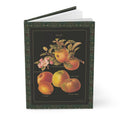
The Herefordshire Pomona and the Art of the English Apple
There is a particular kind of love that the English have always had for their apples. It is not merely culinary — though the English apple is one of the great culinary traditions of the world — but historical, almost archaeological. English apple varieties carry centuries of history in their names: the Api, documented since 1628; the Winter Queening, possibly dating to 1200 AD; the Cockpit, the Cowarne Queening, the Colonel Vaughan. Each name is a small piece of English rural history, a connection to the orchards and kitchen gardens of a world that has largely disappeared.

The Herefordshire Pomona is the greatest attempt ever made to document that world before it vanished entirely. Published between 1876 and 1885 by the Woolhope Naturalists’ Field Club of Herefordshire, edited by Robert Hogg and Henry Graves Bull, and illustrated by women artists Alice Blanche Ellis and Edith Elizabeth Bull, it is one of the finest works of botanical illustration ever produced in Britain — and one of the most important records of English fruit heritage in existence.
Henry Graves Bull and the Woolhope Club
Henry Graves Bull (1818–1885) was a Herefordshire physician and naturalist who understood that the apple orchards of his county were a living archive of English horticultural history — and that they were disappearing. The industrialization of agriculture, the consolidation of landholdings, and the changing tastes of the Victorian market were eliminating varieties that had been cultivated for centuries. Bull was determined to document them before they were lost.
The Woolhope Naturalists’ Field Club, founded in 1851, was the vehicle for this ambition. Named after the Woolhope Dome — a geological feature of Herefordshire — the club brought together the naturalists, physicians, clergymen, and gentlemen farmers of the county in a shared project of scientific documentation. The Herefordshire Pomona was its greatest achievement.
The work took nearly a decade to complete. It documented 432 apple and pear varieties grown in Herefordshire, with 77 chromolithograph plates illustrating the most significant. It was a work of science, but it was also a work of love — a monument to the orchards of a county that had been growing apples since before the Norman Conquest.
Alice Ellis and Edith Bull: The Women Behind the Plates
The chromolithographs of the Herefordshire Pomona were painted by two women: Alice Blanche Ellis and Edith Elizabeth Bull, the daughter of Henry Graves Bull himself. Their contribution to the work has not always received the recognition it deserves — the Pomona is typically cited under the names of its male editors — but it is their artistry that makes the work what it is.
Ellis and Bull worked in the chromolithographic tradition of Victorian botanical illustration, but they brought to it a distinctive quality: the dramatic black backgrounds that set the Pomona apart from every other pomological work of the period. Against these dark grounds, the apples glow with an almost luminous intensity — the reds deeper, the yellows warmer, the russeted browns richer than they would appear against the white grounds of conventional botanical illustration.
The technique required extraordinary skill. Chromolithography involved printing multiple layers of color from separate stones, each requiring precise registration. The black background added another layer of complexity, demanding that the artists work with a precision that left no margin for error. The results speak for themselves: the plates of the Herefordshire Pomona are among the most beautiful images of fruit ever produced.
Plates 52 and LXXIV: A Portrait of English Apple Heritage
Plate 52 presents five historic varieties after Alice Ellis: Dumelow’s Seedling, Annie Elizabeth, Prince Albert, Cockpit, and Greave’s Pippin. Each apple is rendered with the subtle colour gradations and botanical precision that made Ellis’s work definitive — the blush of the Annie Elizabeth, the deep red of the Prince Albert, the russeted gold of the Greave’s Pippin, all captured against the characteristic black ground.
Plate LXXIV is a more complex composition: eight varieties — Pigeonnet, Api (Lady Apple, documented since 1628), Pigeon, Colonel Vaughan (Kentish Pippin), Cowarne Queening, Tyler’s Kernel, Herefordshire Queening, and Winter Queening (White Winter Pearmain, possibly dating to 1200 AD) — arranged around a central apple blossom illustration. The plate is a portrait of English apple heritage in miniature: varieties spanning eight centuries of cultivation, from medieval monastery gardens to the Victorian kitchen garden, gathered together on a single page.
A Living Heritage
Many of the varieties documented in the Herefordshire Pomona survive today, preserved by heritage orchardists, apple day festivals, and the growing movement to conserve traditional fruit varieties. The Api, the Winter Queening, the Cockpit — these apples can still be found, still grown, still eaten. The Pomona did its work: it documented what existed, and in doing so helped ensure that it continued to exist.
It is a reminder that natural history illustration is never merely aesthetic. The best botanical and pomological illustration is always also an act of preservation — a way of holding onto things that might otherwise be lost. Alice Ellis and Edith Bull understood this. Henry Graves Bull understood this. The Woolhope Naturalists’ Field Club understood this. Their work endures.