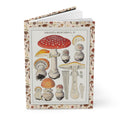
The Scarlet Cap: Hans Walty and the Botanical Illustration of Amanita muscaria
Of all the fungi that populate the forest floor, none has captured the human imagination as completely as Amanita muscaria — the fly agaric. Its scarlet cap, spotted with white, is the mushroom of fairy tales and folklore, of Alice’s Wonderland and the forests of northern Europe, of shamanic ritual and Christmas mythology and a thousand illustrated children’s books. It is also, in the hands of a skilled botanical illustrator, one of the most beautiful subjects in the natural world.

Hans Walty (1868–1948) was a Swiss botanical artist who spent the central decades of his working life documenting the fungal flora of Switzerland and the Alpine region with a combination of scientific precision and quiet artistic authority. Working between 1915 and 1945, in the tradition of Swiss natural history illustration that stretched back through the eighteenth and nineteenth centuries, he produced a body of mycological work that stands as one of the finest contributions to the genre in the early twentieth century.
Switzerland had a particular tradition of botanical and natural history illustration, rooted in the country’s extraordinary Alpine flora and fauna and in the scientific institutions — the natural history museums of Geneva, Basel, and Zurich, the universities, the botanical gardens — that had been documenting that flora and fauna since the Enlightenment. Walty worked within this tradition, producing illustrations that were designed to be scientifically useful — accurate enough to allow the identification of species in the field — while achieving a level of artistic quality that made them genuinely pleasurable as images. His Amanita muscaria illustrations are among his finest work: the scarlet pileus with its characteristic white warts, the sturdy white stipe, the delicate gills beneath the cap, all rendered with a fidelity to the living specimen that reflects direct observation rather than reliance on earlier illustrations.
Amanita muscaria: The Most Famous Mushroom in the World
Amanita muscaria — the fly agaric — is, by almost any measure, the most recognisable mushroom in the world. Its distinctive appearance — the brilliant red cap (which can range from scarlet to orange to pale yellow depending on age and exposure) adorned with white warts that are the remnants of the universal veil that enclosed the young fruiting body — has made it the default image of “mushroom” in the visual culture of the northern hemisphere. It appears in the illustrations of fairy tales, in the decorative arts of the Art Nouveau period, in the iconography of Christmas (the red-and-white color scheme of Father Christmas is sometimes attributed, in popular mythology, to the colors of the fly agaric), and in the psychedelic imagery of the 1960s and 1970s.
It is also a species of genuine scientific interest. A member of the genus Amanita — which includes both some of the most toxic mushrooms known (the death cap, Amanita phalloides; the destroying angel, Amanita virosa) and some of the most prized edible species — Amanita muscaria contains the psychoactive compounds ibotenic acid and muscimol, which have been used in shamanic and ritual contexts across Siberia, Scandinavia, and other parts of the northern hemisphere for thousands of years. Its toxicity is real but rarely fatal in adults; its psychoactive effects, which include visual distortion and a sense of altered perception, have made it the subject of considerable ethnobotanical and pharmacological research.
The Mycorrhizal Partnership
What the folklore and the pharmacology both tend to obscure is the ecological role of Amanita muscaria — which is, in the forest ecosystem, not a solitary actor but a partner. Like most Amanita species, the fly agaric is a mycorrhizal fungus: it forms a symbiotic relationship with the roots of trees — particularly birch, pine, and spruce — in which the fungal mycelium extends the effective root surface of the tree, improving its access to water and nutrients, while the tree provides the fungus with the sugars it cannot produce itself. The fruiting bodies that appear above ground in autumn — the scarlet caps that Walty documented with such care — are only the visible expression of a relationship that extends through the soil in a network of mycelial threads that can persist for decades.
This partnership is one of the reasons that Amanita muscaria is so consistently associated with particular tree species and particular habitats: the birch woods of northern Europe, the pine forests of the Alps and Scandinavia, the spruce plantations of the uplands. Where the trees are, the fly agaric will follow — or, more precisely, where the fly agaric is, the trees have been sustained by a relationship that predates the forest itself.
The Art of Mycological Illustration
Mycological illustration presents particular challenges that distinguish it from other forms of botanical art. Fungi are ephemeral — the fruiting body that appears after rain may last only a few days before it decays or is eaten — and they change significantly in appearance as they age, from the egg-like button stage through the expansion of the cap to the final flattening and decay. The illustrator must decide which stage to depict, and must work quickly from fresh specimens before they deteriorate. The colors of many fungi — including the scarlet of Amanita muscaria — fade rapidly after collection, making accurate color rendering a particular challenge.
Walty’s illustrations meet these challenges with evident skill. His Amanita muscaria plates show the mushroom at its most characteristic — the cap fully expanded but still fresh, the white warts intact, the color at its most vivid — in a rendering that suggests direct observation of living or freshly collected specimens. The scientific detail is precise: the gills, the ring on the stipe, the volva at the base, the relative proportions of cap and stem are all accurately rendered. And the overall effect is beautiful — an image that captures not just the morphology of the species but something of the quality of attention that a skilled naturalist brings to the observation of the natural world.

If the world of mycology and the art of Swiss botanical illustration resonate with you, the Amanita muscaria Journal brings Hans Walty’s 1915–1945 illustrations to a hardcover journal — 150 lined pages, ready for foraging notes, nature observations, or whatever your forest walks require.
References
- Wasson, R.G. Soma: Divine Mushroom of Immortality. Harcourt Brace Jovanovich, New York, 1968.
- Ott, J. Pharmacotheon: Entheogenic Drugs, Their Plant Sources and History. Natural Products, Kennewick WA, 1993.
- Stamets, P. Mycelium Running: How Mushrooms Can Help Save the World. Ten Speed Press, Berkeley, 2005.
- Ainsworth, G.C. Introduction to the History of Mycology. Cambridge University Press, 1976.
- Kibby, G. Mushrooms and Toadstools of Britain and Europe. Hamlyn, London, 1992.