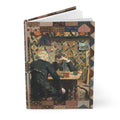
The Chess Players: Gustav Wentzel and the Bohemian Interior of 1886
In the winter of 1886, the Norwegian painter Gustav Wentzel set up his easel in a bohemian interior in Christiania — the city that would later be renamed Oslo — and painted two men playing chess. The painting he produced, known as Sjakkspillere (The Chess Players), is now part of the permanent collection of the National Museum of Art, Architecture and Design in Oslo. It is a small painting, intimate in scale and subject, but it repays close attention: the more carefully you look, the more it reveals.

Gustav Wentzel and Norwegian Naturalism
Gustav Wentzel (1859–1927) was one of the leading figures of Norwegian naturalism — the movement that dominated Norwegian painting in the 1880s and that sought to represent the world as it actually appeared, with meticulous attention to light, texture, and the specific details of everyday life. Norwegian naturalism was part of a broader European movement that included the French realists, the Dutch genre painters, and the German Leibl circle, but it had its own distinctive character: a preference for interior scenes, a fascination with the quality of northern light, and a deep interest in the texture of domestic and working-class life.
Wentzel had studied in Christiania and in Munich, where he absorbed the technical lessons of the German naturalists — above all, the mastery of chiaroscuro, the play of light and shadow that gives his interiors their characteristic atmosphere of concentrated intimacy. He returned to Norway in the early 1880s and began producing the interior scenes that would make his reputation: paintings of workers in their homes, of craftsmen at their benches, of friends gathered around a table. Sjakkspillere belongs to this series, and it is among the finest of them.
The Detail: Two Men and a Game
The detail reproduced on the front cover of our journal focuses on the two players at the centre of the composition. They are Harald Bertrand and Oscar Lærum, friends and acquaintances of the painter, and Wentzel has captured them with the kind of psychological precision that distinguishes the best naturalist portraiture. One leans forward, absorbed in the position on the board; the other sits back, considering his options with the slightly detached air of a man who has time on his side. Between them, the chess board with its carefully rendered pieces occupies the centre of the composition.
On the wooden table around the board, Wentzel has arranged the accessories of a casual but intense encounter: a beer jug, pipes, a green bottle. These objects are not merely decorative — they are documents of a specific social world, the world of the Christiania bohemian circle of the 1880s, where artists, writers, and intellectuals gathered to argue, to drink, and to play. The chess game is the occasion; the real subject is the quality of attention that two intelligent men bring to a shared intellectual challenge.
The chiaroscuro is masterful. Light falls from the left, modelling the faces and hands of the players with a sculptural precision that recalls the Dutch masters — Rembrandt, Vermeer — while the background recedes into a warm darkness punctuated by the geometric patterns of colourful tapestries and the gleam of ceramics on a shelf. It is a painting that knows exactly what it is doing with light.
The Whole: The Bohemian Studio Revealed
The full composition, reproduced on the back cover of our journal, reveals what the detail conceals: the chess game is taking place not in a domestic interior but in an artist's studio — or, more precisely, in the kind of richly furnished bohemian space that served as studio, salon, and living quarters for the artists and intellectuals of late nineteenth-century Christiania.
To the right of the players, a canvas leans face-down against the wall — the painter's own world intruding into the scene he is painting. A large indoor plant sits on a piece of furniture, its leaves catching the light. Above the shelf that runs along the back wall, a rich still life accumulates: ceramic vessels, a metal jug, a blue terrestrial globe, an open fan, a religious icon hanging on the wall. Each object is a clue to the intellectual and cultural world of its owner — the globe suggesting an interest in geography and exploration, the icon a connection to Orthodox or Byzantine culture, the fan a touch of the exotic East that fascinated European artists of the period.
In the upper left corner, a stringed instrument — a mandolin or small guitar — hangs on the wall. It is the final element in a portrait of a complete intellectual life: chess for the analytical mind, music for the emotional one, art for the visual one, books and objects from around the world for the curious one. And in the lower right corner, almost hidden, the painter's signature: N. Gustav Wentzel 1886.
Chess as Intellectual Emblem
Chess has been a subject for painters since the Renaissance, and for good reason: it is a game that makes thought visible. The concentration of the players, the tension of the position, the silence that surrounds a serious game — all of these are legible in the faces and postures of the players, and all of them are subjects that a painter of psychological interiors can explore with particular richness. Wentzel's chess players are in the tradition of Sofonisba Anguissola's The Chess Game (1555), of Lucas van Leyden's The Chess Players (c.1508), of the many Dutch and Flemish genre paintings that used chess as a vehicle for exploring the dynamics of concentration, competition, and intellectual engagement.
But Wentzel's painting is also specifically of its time and place. The Christiania bohemian circle of the 1880s — the world of Henrik Ibsen, Edvard Munch, Hans Jæger, and their contemporaries — was one of the most intellectually intense environments in late nineteenth-century Europe, a small city producing an extraordinary concentration of artistic and literary talent. The chess game in Wentzel's painting is not just a game; it is an emblem of the kind of serious, concentrated intellectual engagement that defined the bohemian ideal.

Our Chess Players Journal reproduces the detail of Wentzel's painting on the front cover and the full composition on the back — inviting you to discover, as you turn the journal over, the larger world that surrounds the game.
References
Aarseth, A. (1994). Norsk kunsthistorie. Gyldendal.
Brinchmann, C. (1920). Nasjonalgalleriets samlinger. Kristiania.
Lange, M. (2000). Norwegian Painting: A Survey. Labyrinth Press.
National Museum of Norway. Gustav Wentzel: Sjakkspillere. Permanent collection catalogue.
Thue, O. (1986). Gustav Wentzel. Nasjonalgalleriet, Oslo.