The Wandtafeln: Gottlieb von Koch and the Botanical Pedagogy of Wilhelmine Germany
In the classrooms of Wilhelmine Germany, the walls spoke. Rolled up in wooden cases at the back of the room, unfurled at the front when the lesson required, the Wandtafeln — wall charts — were the visual technology of scientific education in the late nineteenth and early twentieth centuries. They were large, precise, and beautiful: printed on heavy paper or linen, mounted on wooden rollers, designed to be seen from the back of a room of forty students. They showed the cross-section of a stem, the anatomy of a flower, the cellular structure of a leaf — things that could not be seen with the naked eye, made visible through the combined efforts of the botanist and the lithographer.
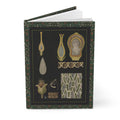
Among the most celebrated of these series were the Jung-Koch-Quentell Wandtafeln, published by Friedrich Quentell and Heinrich Jung and illustrated by Gottlieb von Koch, professor of botany at the Technische Hochschule Darmstadt. The series appeared in the first decade of the twentieth century and remained in use in German schools for decades afterward. Its plates are distinguished by a feature that sets them apart from most botanical illustration of the period: a dark background, almost black, against which the plant structures are rendered in vivid colour. The effect is striking — less like a scientific diagram than like a painting, the plant anatomy illuminated as if by a spotlight against the darkness of the unknown.
Gottlieb von Koch and the Science of Small Things
Gottlieb von Koch was not a famous botanist in the way that Linnaeus or Humboldt were famous. He was a professor, a teacher, a man whose career was devoted to the transmission of knowledge rather than its discovery. He taught at Darmstadt for many years, producing research on plant anatomy and morphology that was solid and respected without being revolutionary. His lasting contribution to science was not a discovery but a series of images — the Wandtafeln that brought the microscopic world of plant anatomy into German classrooms with a clarity and beauty that no textbook illustration could match.
The choice of subjects for the series reflects von Koch's pedagogical priorities. He was interested in the full range of the plant kingdom — not just the flowering plants that dominated most botanical education, but the bryophytes, the pteridophytes, the aquatic plants that most students would never examine closely. The Sphagnum acutifolium plate is characteristic: pointed bog moss, a plant that most people walk past without noticing, documented with the same rigour and visual care as any orchid or rose. The hyaline water-reservoir cells, the archegonium, the sporophyte anatomy — all rendered at a scale that makes the invisible visible, the overlooked monumental.
Sphagnum: The Moss That Made the World
Sphagnum moss is not a glamorous plant. It grows in bogs and fens, in the wet acidic soils of northern Europe and North America, forming the dense carpets of vegetation that, over millennia, become peat. It is slow-growing, patient, and extraordinarily effective at what it does: absorbing water, acidifying its environment, and resisting decomposition in ways that allow organic matter to accumulate rather than decay.
The ecological importance of sphagnum is difficult to overstate. Peatlands cover roughly three percent of the earth's land surface but store approximately thirty percent of all soil carbon — more than all the world's forests combined. The sphagnum moss that von Koch documented in 1909 is, in a very real sense, one of the most consequential organisms on the planet. Its hyaline cells — the large, empty, water-holding cells that give the plant its extraordinary absorptive capacity — are the mechanism by which it performs this ecological function. Von Koch's plate makes those cells visible, gives them a form and a beauty that the naked eye cannot perceive.
During the First World War, sphagnum moss was harvested across northern Europe and used as wound dressing — its absorptive capacity and natural antiseptic properties made it more effective than cotton in many applications. The plant that von Koch had documented in his 1909 wall chart became, within a few years, a material of military medicine. Science and utility, beauty and necessity: the history of sphagnum contains all of these.
Hippuris: The Mare's-Tail and the Aquatic World
Hippuris vulgaris — Mare's-tail — is an aquatic plant of European wetlands, its whorled leaves arranged in tight rings around an upright stem that emerges from the water like a miniature horsetail. It is an ancient plant, morphologically conservative, little changed from its Carboniferous ancestors. Von Koch's plate documents its radial symmetry with the same precision he brought to the sphagnum: the stem cross-section, the arrangement of the whorls, the morphological details that distinguish it from superficially similar plants.
The pairing of Sphagnum acutifolium and Hippuris vulgaris in the Jung-Koch-Quentell series is not accidental. Both are wetland plants, both are ecologically significant, and both are plants that most students would encounter in the field without being able to identify or understand. Von Koch's charts gave them a visual identity — made them legible, memorable, worthy of attention.
The Dark Background and the Art of Scientific Illustration
The most distinctive feature of the Jung-Koch-Quentell series is its dark background. Most botanical illustration of the period used a white or cream ground — the tradition of the herbarium sheet, the printed plate, the scientific journal. The dark background of the Wandtafeln was a pedagogical choice: against darkness, the coloured plant structures stand out with a clarity that white backgrounds cannot achieve. The effect is also, unmistakably, aesthetic. The plates look like paintings. The sphagnum cells glow against the black ground like stained glass. The Mare's-tail whorls radiate with a geometric precision that is as satisfying as any abstract composition.
This combination of scientific accuracy and visual beauty was not accidental. The Wandtafeln tradition understood that students learn better from images that engage them — that beauty and pedagogy are not in tension but in alliance. Von Koch and his collaborators were making an argument, implicit in every plate, that the natural world is worth looking at carefully, that the smallest and most overlooked organisms deserve the same visual attention as the most spectacular.
A Legacy in the Classroom and Beyond
The Jung-Koch-Quentell Wandtafeln remained in use in German schools well into the mid-twentieth century. They were eventually superseded by photographic slides, then by projected images, then by digital displays — each new technology promising greater accuracy and convenience, each losing something of the physical presence that made the wall charts so effective. A rolled chart, unfurled at the front of a classroom, has a scale and an immediacy that no screen can quite replicate.
The plates survive in libraries, in natural history museums, in the collections of botanical institutions across Europe. They are sought after by collectors of scientific ephemera and by designers who recognise in their dark backgrounds and precise draughtsmanship a visual language that remains as powerful as it was in 1909. The sphagnum cells still glow. The Mare's-tail whorls still radiate. The smallest plants in the bog are still, in von Koch's rendering, as monumental as any cathedral.

If you would like to carry something of that tradition with you, our Sphagnum Moss Journal reproduces von Koch's 1909 Jung-Koch-Quentell plates on its covers — Sphagnum acutifolium on the front, Hippuris vulgaris on the back.
References
Von Koch, G. (1909). Jung-Koch-Quentell Wandtafeln. Friedrich Quentell & Heinrich Jung, Leipzig.
Gorham, E. (1991). Northern peatlands: Role in the carbon cycle and probable responses to climatic warming. Ecological Applications, 1(2), 182–195.
Anderson, R., Slater, F. M., & Tallis, J. H. (Eds.) (1997). Peatland Ecology and Conservation. Blackwell Science.
Nissen, C. (1966). Die botanische Buchillustration. Hiersemann.