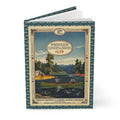
The Golden Age of Canoeing: Wilderness, Catalogs, and the Pioneer Spirit of the 1920s
In the summer of 1928, a young man in Minnesota might have spent an evening with a canoe catalog spread open on the kitchen table — studying the specifications of a cedar-strip canoe, reading the descriptions of wilderness routes, looking at the illustrations of lakes and rivers that seemed to promise something the city could not offer. The catalog was not merely a commercial document. It was an invitation.
The 1920s were the golden age of North American outdoor recreation. The automobile had made the countryside accessible to a middle class that had previously been confined to the city; the national park system, established in 1916, had given that countryside a framework of protected wilderness; and a generation that had lived through the First World War had emerged with a particular hunger for the uncomplicated pleasures of lakes, rivers, and open sky. Canoeing — which had been a practical means of transport for Indigenous peoples across the continent for thousands of years, and which had been adopted by European explorers and fur traders as the most efficient way to navigate the waterways of the interior — became, in the 1920s, a leisure activity of the first order.
The canoe manufacturers of the era understood this. Their catalogs — produced with increasing sophistication as printing technology improved through the decade — were designed not merely to sell canoes but to sell a vision of the life that a canoe made possible. The illustrations showed not just the boats themselves but the settings in which they might be used: glassy lakes at dawn, rivers winding through stands of pine, campsites on rocky shores with a fire burning and a canoe drawn up on the bank. The typography was confident and clean, the copy evocative without being overwrought. These were documents that understood their audience — people who wanted to go somewhere, and who needed only the right equipment and the right encouragement to do it.
The Canoe as Cultural Object
The canoe occupies a unique place in North American cultural history. It is, simultaneously, a practical tool, a sporting implement, a symbol of wilderness, and a vehicle for a particular kind of solitude — the solitude of moving through a landscape under one’s own power, at a pace slow enough to actually see it. The writer and canoeist Bill Mason, whose films and books introduced a generation of Canadians to wilderness paddling in the 1970s and 1980s, described the canoe as “the most beautiful and efficient machine ever devised by man to move through the natural world.” It is a description that would have resonated with the readers of the 1928 Pioneer catalog.
The cedar-strip canoe — the dominant form of the 1920s — was itself a beautiful object. Built from thin strips of western red cedar laid over a framework of ribs and covered with canvas, it combined lightness, strength, and a graceful form that had been refined over decades of practical use. The best canoe builders of the era — companies like Old Town in Maine, Peterborough in Ontario, and the various manufacturers who traded under names like Pioneer — produced boats that were as much works of craft as they were functional objects. The catalogs that sold them reflected this: the illustrations showed the canoes in three-quarter views that emphasised their lines, their proportions, their elegance.
The Catalog as Art Form
The commercial catalog of the 1920s was a more considered document than its modern equivalent. Produced by letterpress or early offset printing, illustrated by staff artists or freelance illustrators, and written by copywriters who understood that their readers had time to read, it was designed to be kept and consulted rather than glanced at and discarded. The canoe catalogs of the era were particularly well-made: the illustrations were detailed and accurate, the specifications precise, the descriptions of the various models genuinely informative about the differences between a tripping canoe and a racing canoe, a solo boat and a family boat.
But the catalogs were also aspirational documents. The lake scenes that appeared on their covers and in their interior pages were not photographs — photography was still too expensive and too technically demanding for routine catalog use — but illustrations that combined topographical plausibility with a certain idealisation of the wilderness experience. The lakes were always calm, the skies always clear, the paddlers always competent and at ease. It was a vision of outdoor recreation as it might be, rather than as it always was — and it was enormously effective as a commercial proposition, because it sold not just a canoe but a self-image.
A Heritage That Endures
The wilderness routes that the 1928 Pioneer catalog implicitly promised are still there. The Boundary Waters Canoe Area Wilderness in Minnesota, the Quetico Provincial Park in Ontario, the Algonquin Park in Ontario, the rivers of the Canadian Shield — these are still paddled by canoeists who carry much the same equipment, follow much the same routes, and experience much the same pleasures as their predecessors of a century ago. The cedar-strip canoe has been largely replaced by aluminium, fibreglass, and Kevlar, but the experience of moving through a wilderness landscape under paddle power remains essentially unchanged.
The aesthetic of the 1920s canoe catalog has proved equally durable. Its combination of clean typography, evocative illustration, and confident copy — its sense that the outdoors is a place of genuine adventure, accessible to anyone willing to make the effort — continues to resonate in a world that has more need than ever of the reminder that lakes and rivers and open sky are still there, waiting.

If the spirit of 1920s wilderness adventure and the golden age of canoeing resonate with you, the Canoe Journal brings the Pioneer 1928 vintage catalog aesthetic to a hardcover journal — 150 lined pages, ready for paddling notes, wilderness memories, or whatever your adventures require.
References
- Mason, B. Path of the Paddle: An Illustrated Guide to the Art of Canoeing. Van Nostrand Reinhold, Toronto, 1980.
- Jennings, J. (ed.) The Canoe: A Living Tradition. Firefly Books, Toronto, 2002.
- Wall, S. Wilds of Their Own Fancy: The Cultural Landscapes of Haliburton. University of British Columbia Press, 2006.
- Raffan, J. Bark, Skin and Cedar: Exploring the Canoe in Canadian Experience. HarperCollins Canada, 1999.
- Morse, E.W. Freshwater Saga: Memoirs of a Lifetime of Wilderness Canoeing in Canada. University of Toronto Press, 1987.