Glass in the Eighteenth Century: Craft, Commerce, and Art in Baroque Europe
In the 18th century, glass was everywhere and nowhere. It was everywhere in the sense that it had become, by 1700, an indispensable material of European civilization — in the windows of churches and palaces, in the mirrors of Versailles, in the telescopes and microscopes that were transforming natural philosophy, in the wine glasses and decanters of aristocratic tables, in the apothecary's bottles and the chemist's retorts. It was nowhere in the sense that its production remained concentrated in a handful of specialized centers — Murano, Bohemia, Lorraine, England — whose glassmakers guarded their techniques with a secrecy that was enforced, in Venice, by law and, in some cases, by violence. To understand glass in the 18th century is to understand one of the most remarkable intersections of craft, commerce, science, and art in the history of European material culture.

Murano and the Venetian Tradition
The story of European glassmaking begins, for practical purposes, on the island of Murano in the Venetian lagoon, where the glassmakers of Venice had been concentrated since 1291 — moved there by decree of the Great Council, ostensibly to reduce the fire risk to the city but also, and more importantly, to make it easier to control the movement of craftsmen whose knowledge was the most valuable industrial secret in Europe. Murano glassmakers enjoyed extraordinary privileges — their daughters could marry Venetian patricians, their sons were exempt from prosecution for minor crimes — but they were forbidden, on pain of death, to leave the Republic and take their knowledge elsewhere.
Despite these precautions, Venetian techniques spread. By the 17th century, faon de Venise glass — glass made in the Venetian style, by Venetian emigrés or their pupils — was being produced in Antwerp, London, Amsterdam, and Hall in Tyrol. The characteristic Venetian achievement — cristallo, a colorless, highly transparent glass of extraordinary thinness and delicacy, decorated with enameling, gilding, and the complex filigree techniques of vetro a filigrana — set the standard against which all other European glass was measured.
The Bohemian Challenge
The challenge to Venetian supremacy came from Bohemia, where the development of a new type of glass in the late 17th century transformed the European luxury market. Bohemian Waldglas — forest glass, made with potash from the abundant wood ash of the Bohemian forests — had been produced since the medieval period, but it was the development of a new, lead-free potash-lime glass in the 1680s, harder and more brilliant than Venetian cristallo, that gave Bohemian glassmakers their competitive advantage. This new glass could be cut and engraved with a wheel — a technique that Venetian glass, too fragile for the purpose, could not accommodate — and the elaborate wheel-engraved decoration that Bohemian craftsmen developed became the defining aesthetic of European luxury glass in the 18th century.
The pokal — the tall, covered goblet that appears in Martin Engelbrecht's engraving of the male glassmaker — was the supreme achievement of Bohemian glass engraving: a vessel that combined technical virtuosity with heraldic and allegorical imagery in a form that was simultaneously a functional drinking vessel and a work of art. The great Bohemian pokal makers of the early 18th century — among them the Bohemian engraver Caspar Lehmann, who had pioneered wheel engraving on glass at the court of Rudolf II in Prague — produced objects of extraordinary complexity and refinement that were collected by princes and displayed in Kunstkammern across Europe.
The Glassmaker's Trade in Augsburg
It was in this context that Martin Engelbrecht (1684–1756), the Augsburg engraver and publisher, produced his celebrated series L'assemblage nouveau des manouvriers habillés — the New Assembly of Tradespeople Dressed in Their Crafts — around 1730. Augsburg was, in the early 18th century, one of the great centers of European printmaking and publishing, and Engelbrecht's workshop was among its most prolific: he produced more than 3,000 engravings documenting nearly 200 trades, each figure dressed head to toe in the products and tools of their profession.
The glassmaker pair — Une Verrière (the female glassmaker) and Un Verrier (the male glassmaker) — is among the most visually inventive of the series. The female glassmaker's tiered skirt serves as a display counter for cups and decanters; her headdress rises in a tall funnel of glass; she holds a tray of vessels in one hand and a decanter in the other. The male glassmaker is crowned with wine glasses, his belt hung with flasks and bowls, his coat adorned with bottles and vessels, his hand holding the ceremonial pokal that was the highest achievement of the Bohemian glassmaker's art. The numbered legends in French and German that accompany each figure — identifying un bocal, un gobelet, une bouteille de verre, medicine vials, goblets, and urinal flasks — transform the images into visual encyclopedias of 18th-century glassware, documents of a trade at the height of its technical and commercial achievement.
Glass and Science
The 18th century was also the golden age of scientific glassware. The development of the thermometer, the barometer, the air pump, and the electrical machine — all of which required precisely made glass vessels and tubes — created a new market for scientific glass that was distinct from, but related to, the luxury market for decorative glassware. The Leiden jar, invented in 1745, was a glass vessel coated inside and out with metal foil that could store static electricity — the first electrical capacitor, and a device that made possible the electrical experiments of Franklin, Volta, and their contemporaries.
The glassmakers who supplied this scientific market were not the luxury craftsmen of Murano or Bohemia but a different kind of specialist — instrument makers who combined the glassblower's skill with the precision of the scientific instrument trade. Their products — the graduated cylinders, the retorts, the condensers, the thermometer tubes — were as essential to the progress of 18th-century science as the telescopes and microscopes that had preceded them, and they represent a dimension of the glassmaker's craft that Engelbrecht's whimsical engravings, focused on the luxury and domestic trade, only hint at.
The Legacy of 18th-Century Glass
The glass of the 18th century — Venetian, Bohemian, English, French — remains among the most collected and admired of all decorative arts. The great museum collections of Europe and America — the Victoria and Albert, the Corning Museum of Glass, the Musée des Arts Décoratifs — preserve thousands of examples of the glassmaker's art from this period, from the most delicate Venetian filigrana to the most elaborate Bohemian pokal, from the simplest English ale glass to the most complex scientific instrument. Together, they document a moment when glass was simultaneously the most technically demanding and the most aesthetically ambitious material in European craft — a moment captured, with characteristic wit and encyclopedic ambition, in the hand-colored engravings of Martin Engelbrecht.

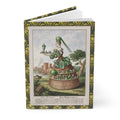
If the craft and art of 18th-century glass inspires you, our Glassmaker Journal — Martin Engelbrecht Augsburg 1730 brings the female and male glassmakers of L'assemblage nouveau to the cover of a hardcover journal.
References
- Tait, H. (ed.) Five Thousand Years of Glass. British Museum Press, 1991.
- Mentasti, R. B. et al. Mille anni di arte del vetro a Venezia. Albrizzi, 1982.
- Revi, A. C. Nineteenth Century Glass: Its Genesis and Development. Thomas Nelson, 1967.
- Drahotová, O. European Glass. Hamlyn, 1983.
- Stafford, B. M. & Terpak, F. Devices of Wonder: From the World in a Box to Images on a Screen. Getty Publications, 2001.