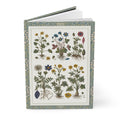
Gianbattista Morandi and the Art of Botanical Precision: Historia Botanica Practica (Milan, 1744)
In 1744, the Italian botanist and physician Gianbattista Morandi published in Milan a work that stands among the finest achievements of Enlightenment botanical illustration: Historia Botanica Practica. Combining anatomical precision with the ornate visual language of 18th-century Italian engraving, Morandi’s plates remain, nearly three centuries later, some of the most beautiful documents in the history of natural history publishing.
By the mid-eighteenth century, botanical illustration had become one of the most demanding and prestigious disciplines in European natural history. The identification, classification, and documentation of plant species was not merely a scientific enterprise — it was a cultural one, driven by the Enlightenment conviction that the natural world could be systematically known, catalogued, and represented. The botanical plate was the primary instrument of this project: a visual document that had to be simultaneously accurate enough for taxonomic use and beautiful enough to attract the patronage and readership that sustained natural history publishing.
Gianbattista Morandi and the Milanese Tradition
Gianbattista Morandi (1686–1762) was a physician and naturalist working in Milan at a moment when the city was one of the principal centres of Italian Enlightenment culture. His Historia Botanica Practica — published in Milan in 1744, with a second volume following in 1761 — was conceived as a practical guide to the medicinal and useful plants of the Italian peninsula, combining botanical description with pharmacological annotation in the tradition of the great herbals that stretched back to Dioscorides.
What distinguished Morandi’s work from its predecessors was the quality of its illustration. The plates of the Historia Botanica Practica were engraved with exceptional care, presenting botanical specimens — flowers, leaves, stems, roots — with the anatomical precision that Enlightenment taxonomy demanded, framed within ornate decorative borders in Prussian blue: the synthetic pigment discovered in Berlin in 1704 that had rapidly become one of the defining colours of 18th-century European art and design.
Prussian Blue and the Visual Language of Enlightenment Botany
The choice of Prussian blue as the dominant colour of Morandi’s decorative borders was not arbitrary. Discovered accidentally by the Berlin colour-maker Johann Jacob Diesbach around 1704, Prussian blue was the first synthetic pigment in the history of Western art — a colour that could be produced reliably, affordably, and in quantity, unlike the expensive natural blues (lapis lazuli, azurite, indigo) that had preceded it.
By the 1740s, Prussian blue had become ubiquitous in European painting, printmaking, and decorative arts. Its deep, cool intensity made it ideal for the formal borders and decorative frames that structured the visual presentation of natural history plates — providing a visual anchor that set off the delicate colours of the botanical specimens themselves. In Morandi’s plates, the Prussian blue borders function as both aesthetic frame and scientific convention: marking the boundary between the specimen and the page, between observation and representation.
The Enlightenment Botanical Plate as Document and Art
The plates of the Historia Botanica Practica belong to a tradition of botanical illustration that reached its peak in the eighteenth century — a tradition that included the work of Georg Dionysius Ehret, the Bauer brothers, and the illustrators of the great Linnaean publications. What united these artists was a shared conviction that botanical illustration was not merely decorative but documentary: a form of visual knowledge that could capture what written description alone could not.
Morandi’s illustrators worked in the engraving and hand-colouring tradition that preceded chromolithography — a technique that required extraordinary skill and patience, as each plate was first engraved on copper, then printed, then coloured by hand, often by teams of specialist colourists working from a master copy. The result was plates of remarkable consistency and beauty, in which the scientific and the aesthetic are inseparable.
A Legacy in Botanical History
The Historia Botanica Practica was not among the most widely circulated works of 18th-century natural history — Morandi worked at some distance from the great centres of Linnaean taxonomy in Uppsala and London — but it represents a significant achievement of the Italian Enlightenment tradition of natural history, and its plates have attracted renewed attention from historians of botanical illustration and collectors of natural history ephemera.
For those who study the history of botany, the Historia Botanica Practica offers a window into a moment when the documentation of the plant world was understood as both a scientific and a civic responsibility — when the botanist, the physician, and the illustrator collaborated to produce works that were simultaneously useful and beautiful, rigorous and ornate.

The plates from Gianbattista Morandi’s Historia Botanica Practica (Milan, 1744) appear on the cover of our Morandi Botanical Journal, a hardcover lined journal with 150 perforated pages, casewrap sewn binding, and matte laminated full-wrap cover.
References
- Morandi, Gianbattista. Historia Botanica Practica. Milan, 1744.
- Blunt, Wilfrid, and William T. Stearn. The Art of Botanical Illustration. Antique Collectors’ Club, 1994.
- Pastoureau, Michel. Blue: The History of a Color. Princeton University Press, 2001.
- Schiebinger, Londa. Plants and Empire: Colonial Bioprospecting in the Atlantic World. Harvard University Press, 2004.
- Lack, H. Walter. Garden Eden: Masterpieces of Botanical Illustration. Taschen, 2008.