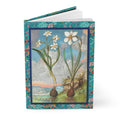
Gherardo Cibo and the Botanical Landscape: Plants in Their Place
Every botanical illustrator of the Renaissance painted plants against a blank background. This was the convention, and it made sense: the purpose of botanical illustration was scientific documentation, and a blank background eliminated distraction, focused attention on the specimen, and made the image as useful as possible to the physician or apothecary who needed to identify the plant. From the woodcuts of Leonhart Fuchs's De Historia Stirpium (1542) to the engravings of Rembert Dodoens and Carolus Clusius, the plant floated in white space, isolated and precise, a specimen rather than a living thing.

Gherardo Cibo did something no one else did. He put the plants back in the landscape.
The Artist and the Botanist
Gherardo Cibo was born in Genoa in 1512, the grandson of Pope Innocent VIII and a member of one of the most distinguished families in Italy. He was, by training and inclination, both an artist and a naturalist — a combination that was not unusual in the Renaissance, when the boundaries between art, science, and philosophy were far more permeable than they would later become. He spent much of his adult life in the Marche region of central Italy, in the territory of the Roman States, where he developed an intimate knowledge of the local flora that would become the foundation of his most important work.
His connection to the world of Renaissance botany came through Pietro Andrea Mattioli (1501–1577), the Sienese physician whose Commentarii in sex libros Pedacii Dioscoridis — a commentary on the ancient Greek physician Dioscorides' De Materia Medica — was the most widely read botanical work of the sixteenth century. Mattioli's Commentarii, first published in 1544 and revised and expanded through multiple editions over the following decades, identified and described hundreds of plants with their medicinal uses, and it required illustration. Cibo became one of the artists who provided it, creating watercolour and gouache miniatures of the plants described by Mattioli with a technique and a vision that were entirely his own.
The Paintings of Flora of the Roman States
The works that survive from Cibo's hand — collected in manuscripts now held in the British Library, the Biblioteca Universitaria di Bologna, and other institutions — are among the most beautiful botanical illustrations of the sixteenth century. They are also, in one crucial respect, unlike anything else produced in the tradition: each plant is set against a living landscape background.
The backgrounds are not generic or decorative. They are specific: the rolling hills of the Marche, the distant towns of the Roman States, the rivers and lakes of central Italy, the birds that Cibo observed in the same countryside where he found his plants. A narcissus grows in the foreground while behind it a town sits beside a body of water and birds wheel in the sky. A hepatica is rooted in the earth while a small human figure moves through the landscape behind it. The plants are not specimens. They are inhabitants — creatures of a particular place, documented in their actual environment with the same devotion that Cibo brought to the plants themselves.
This was a radical departure from the conventions of botanical illustration, and it was entirely Cibo's own invention. No other botanical illustrator of the period did anything like it. The blank background was so thoroughly established as the norm that Cibo's landscapes read, even today, as a kind of surprise — a reminder that plants grow somewhere, that they are part of a world, that the landscape and the specimen are not separate things but aspects of the same living reality.
Narcissus: The Flower of the Roman States
The narcissus illustrations in Cibo's manuscripts are among his finest works. He painted two species with particular care: Narcissus tazetta, the bunch-flowered narcissus, which produces several smaller white flowers on a single stalk and was widely cultivated in Renaissance Italy for its fragrance; and Narcissus poeticus, the poet's narcissus, with its single large white flower and delicate yellow corona edged in red, which had been celebrated in classical literature since Ovid and Homer.
In Mattioli's pharmacobotanical tradition, the narcissus was valued for its bulb, which was used as an emetic and as a treatment for wounds and dislocations. Dioscorides had described it in the first century AD, and Mattioli's commentary updated and expanded the ancient account with observations drawn from contemporary practice. Cibo's illustrations served this scientific purpose with complete fidelity — roots, bulbs, stems, leaves, and flowers all depicted with meticulous precision — while simultaneously achieving something that pure scientific illustration rarely manages: beauty.
Hepatica: The Doctrine of Signatures
Hepatica nobilis — the three-lobed liverwort, also known as Anemone hepatica — was one of the most studied plants of the Renaissance, and its presence in Cibo's manuscripts reflects the central importance of the doctrine of signatures in sixteenth-century pharmacobotany. The doctrine held that God had marked each plant with a sign indicating its medicinal use: the liver-shaped leaves of the hepatica indicated its value in treating liver ailments, jaundice, and bronchitis. This belief, which seems naive to modern eyes, was in the Renaissance a serious theoretical framework that guided both botanical observation and medical practice.
Cibo's hepatica is rendered in the same luminous watercolour and gouache technique as his narcissus — the characteristic blue-purple flowers and three-lobed leaves depicted with the precision demanded by Mattioli's tradition, the small landscape with a figure animating the background in the way that was uniquely his. The result is an image that is simultaneously a scientific document, a work of art, and a record of a specific place — the Roman States countryside that Cibo knew and loved and painted with such intimate knowledge.
A Vision Ahead of Its Time
Cibo's botanical landscapes were not influential in his own time — the blank-background convention was too firmly established, and his manuscripts circulated in too limited a sphere for his innovation to be widely known. It was not until the nineteenth century, with the rise of ecological thinking and the growing interest in plants as inhabitants of specific environments rather than isolated specimens, that the kind of vision Cibo had articulated in the 1560s began to seem not eccentric but prophetic.
Today, his manuscripts are recognised as among the most extraordinary works in the history of botanical illustration — not only for their beauty, which is considerable, but for the idea they embody: that a plant cannot be fully understood in isolation, that it belongs to a landscape, and that the landscape belongs to it. This is an ecological insight expressed in watercolour and gouache nearly five centuries before ecology became a science.

Our Narcissus & Hepatica Journal reproduces two of Cibo's most beautiful works — the narcissus miniature of c.1564 on the front cover and the hepatica on the back — from the Paintings of Flora of the Roman States, in the luminous watercolour and gouache technique of the artist who put plants back in the world where they belong.
References
Arber, A. (1938). Herbals: Their Origin and Evolution. Cambridge University Press.
Blunt, W. & Stearn, W. T. (1994). The Art of Botanical Illustration. Antique Collectors' Club.
Ogilvie, B. W. (2006). The Science of Describing: Natural History in Renaissance Europe. University of Chicago Press.
Reeds, K. M. (1991). Botany in Medieval and Renaissance Universities. Garland.
Toderi, G. & Vannel, F. (2000). Gherardo Cibo: Dilettante di botanica e pittore di piante. Olschki.