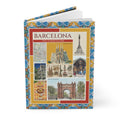
The City That Gaudí Built: Barcelona, Modernisme, and the Architecture of the Organic
Share
On the morning of 7 June 1926, a tram struck an elderly man crossing the Gran Via in Barcelona. He was poorly dressed, his pockets contained only a rosary, a prayer book, and some dried herbs, and the taxi drivers who were called to take him to hospital refused — he looked too poor to pay. He was taken eventually to the Hospital de la Santa Creu, where he died two days later. Only then did the city of Barcelona realise that the man they had left to die in the street was Antoni Gaudí, the greatest architect of the age.
He was seventy-three years old. He had spent the last twelve years of his life living in the crypt of the Sagrada Família, eating almost nothing, sleeping on a cot, devoting every waking hour to the building that would become his life’s work and his tomb.
The Architecture of the Organic
Gaudí’s genius was rooted in a single conviction: that the forms of the natural world — the branching of trees, the curve of a shell, the geometry of a honeycomb — were not merely beautiful but structurally optimal, and that architecture that followed these forms would be both stronger and more beautiful than architecture that imposed artificial geometric order on the world.
This conviction expressed itself in every building he designed. The Sagrada Família’s towers rise like stalactites, their surfaces encrusted with naturalistic ornament. Casa Batlló’s facade ripples like the scales of a dragon, its roof arching like a spine. Park Güell’s viaducts lean like the trunks of stone trees, their columns inclined to follow the line of structural force. The trencadís mosaics that cover so many of his surfaces — broken ceramic and glass shards assembled into brilliant, irregular patterns — are the visual expression of this organic principle: beauty emerging from fragmentation, order from apparent chaos.
Modernisme and the Catalan Renaissance
Gaudí did not work in isolation. He was the greatest figure of Catalan Modernisme — the architectural movement that flourished in Barcelona between roughly 1880 and 1920, and that was inseparable from the broader cultural and political movement known as the Renaixença, the Catalan Renaissance. The Renaixença was a reassertion of Catalan identity, language, and culture against the centralising pressure of the Spanish state, and Modernisme was its architectural expression: a style that drew on Gothic and Moorish precedents, on the organic forms of Art Nouveau, and on the craft traditions of Catalonia to create an architecture that was unmistakably, defiantly Catalan.
Lluís Domènech i Montaner’s Palau de la Música Catalana — with its extraordinary inverted stained-glass skylight, its mosaic-covered columns, and its sculptural programme celebrating Catalan folk music — is the most complete expression of this programme. The building is a manifesto in stone and glass: a declaration that Catalan culture was not provincial but cosmopolitan, not backward but at the forefront of European modernity.
The City That Gaudí Built
Barcelona today is, in a very real sense, the city that Gaudí built. The Sagrada Família — still under construction, still not finished, more than a century after Gaudí began it — draws more visitors than any other monument in Spain. Park Güell, with its serpentine bench and its forest of stone columns, is one of the most photographed places in Europe. Casa Batlló and Casa Milà stop tourists in their tracks on the Passeig de Gràcia.
But the city is more than Gaudí. It is the Arc de Triomf, built for the 1888 Universal Exposition that announced Barcelona’s arrival as a modern European metropolis. It is La Boqueria, one of Europe’s great public markets, where the produce of Catalonia — the tomatoes for Pa amb Tomàquet, the herbs for Escudella i Carn d’Olla, the cream for Crema Catalana — is laid out in the colours of a Modernisme mosaic. It is the Gegants de Barcelona, the towering festival figures who dance through the streets during La Mercè, carrying in their papier-mâché bodies the memory of a city that has always known how to celebrate itself.