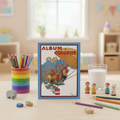
The Girl on the Swing: Gaston Maréchaux and the Album à Colorier of the Art Deco Era
There is a particular kind of childhood object that is almost impossible to find intact: the colouring book. Designed to be used, to be filled in, to be completed by the small hands of children who were given crayons and told to stay within the lines, the colouring book is, by its very nature, a consumable — an object that fulfils its purpose by being transformed, page by page, into something different from what it was when it left the printer. To find a colouring book from the 1920s that has never been coloured in is, as any collector of vintage children's ephemera will tell you, extraordinarily rare. And to find one by Gaston Maréchaux — whose Album à Colorier, published around 1920 by the Parisian publisher G. Marton, is one of the most sought-after objects in the field of Art Déco children's illustration — is rarer still. The cover alone tells you why: a girl on a swing, holding a painter's palette, with pots of yellow, blue, and red paint hanging beside her, rendered in the flat colours and clean black lines of the pochoir technique that was the defining aesthetic of French illustrated publishing in the years between the wars. It is an image of childhood as the Art Déco era imagined it: joyful, elegant, and suffused with the pleasure of making things.

Gaston Maréchaux was born in 1872 and came of age as an illustrator in the generation that made French graphic art the envy of the world. He belonged to the circle of artists associated with L'Assiette au Beurre — the great satirical magazine of the Belle Époque that launched the careers of a generation of French illustrators — and he made the transition, as the best of that generation did, from the political satire of the pre-war years to the elegant commercial style of the 1920s and 1930s. His work for children — the Album à Colorier, the illustrated books Bon Voyage and La Ronde des Lettres, the advertising posters for Goodrich tyres and the patriotic lithographs of the First World War — shows an artist of extraordinary versatility, capable of adapting his simplified aesthetic to any subject and any audience while maintaining the visual clarity and elegance that made his work immediately recognisable.
Gaston Maréchaux: From L'Assiette au Beurre to the Art Deco Nursery
The generation of French illustrators that came of age around 1900 — the generation of Maréchaux, of Benjamin Rabier, of Zyg Brunner and their contemporaries — was shaped by two competing traditions: the political satire of the great illustrated magazines, and the decorative elegance of the Art Nouveau movement that was transforming the visual culture of Paris. L'Assiette au Beurre, founded in 1901, was the crucible in which these traditions met: a magazine that combined the visual ambition of Art Nouveau with the social engagement of political caricature, and that gave a generation of artists the technical skills and the visual vocabulary they would carry into the very different world of the 1920s.
Maréchaux's transition from the satirical world of L'Assiette au Beurre to the children's publishing of the Art Déco era was not unusual — many of the best French illustrators of his generation made the same journey, finding in children's books and educational publishing a market that valued exactly the skills they had developed in the world of political illustration: the ability to tell a story in a single image, to use colour and line with economy and precision, to create characters that were immediately legible and emotionally engaging. What distinguished Maréchaux was the particular warmth and charm he brought to his depictions of childhood — a quality that made his work for children not merely competent but genuinely delightful.
The Album à Colorier: Pochoir, Flat Colour, and the Art of the French Colouring Book
The Album à Colorier was published around 1920 by G. Marton, one of the Parisian publishers who specialised in the illustrated children's books and educational materials that were a significant part of the French publishing industry in the interwar period. The album's format was characteristic of the genre: each illustration appeared in two versions, side by side — a full-colour version on the left, showing the child what the finished image should look like, and a black-and-white outline version on the right, ready to be coloured in. It was a format that combined the pleasure of looking at beautiful images with the pleasure of making them — a pedagogical device that taught children about colour and composition while giving them the satisfaction of creative achievement.
The technique that Maréchaux used for the colour versions — flat areas of pure colour bounded by clean black lines, with no shading or modelling — was the pochoir technique that was the defining aesthetic of French illustrated publishing in the 1920s. Pochoir — the French word for stencil — was a printing technique in which colour was applied through hand-cut stencils, one colour at a time, producing images of extraordinary vibrancy and precision. It was a technique that demanded both artistic skill and technical mastery, and it was used by the finest French publishers of the period. In Maréchaux's hands, applied to the subjects of childhood — children at play, animals, domestic scenes, the small dramas of everyday life — it produced images of a particular kind of beauty: simple, clear, and suffused with the warmth and optimism of the Art Déco vision of the world.
The Cover: A Girl on a Swing with a Painter's Palette
The cover of the Album à Colorier is one of the most charming images in the history of French children's publishing. A girl sits on a swing — her dress a flat, clear colour, her hair neatly arranged, her expression one of absorbed concentration — holding a painter's palette in one hand, with pots of yellow, blue, and red paint hanging from the swing beside her. It is an image that works on multiple levels: as a simple, immediately appealing picture of a child at play; as a visual argument for the pleasures of colour and painting; and as a self-referential image about the album itself — an image of a child with the tools of colour, on the cover of a book designed to give children those same tools.
The choice of yellow, blue, and red — the three primary colours — is not accidental. It is a pedagogical choice, a reminder that the album is not merely entertainment but education: an introduction to the world of colour and its possibilities, presented in the most charming and accessible form that Maréchaux's art could devise. The girl on the swing is not just playing; she is learning. And the child who opens the album and begins to colour in the outlines is doing the same thing — learning, through the pleasure of making, the fundamental lessons of colour, line, and composition that are the foundation of all visual art.
Rarity and the Paradox of the Coloured-In Book
The Album à Colorier presents collectors with a paradox that is unique to the genre of the colouring book: the object that has fulfilled its purpose — that has been coloured in by the child for whom it was intended — is, from a collector's perspective, worth less than the object that has not. An uncoloured copy of the Album à Colorier is extraordinarily rare, precisely because the album was designed to be used: the blank outlines were an invitation, and most children who received the album accepted it. The coloured-in copies that survive are documents of individual childhoods — records of the particular colours that particular children chose, the particular ways they stayed within or strayed beyond the lines — and they have their own kind of historical interest. But the uncoloured copies, with their pristine outlines waiting to be filled, preserve something that the coloured copies cannot: the original intention of the artist, the image as Maréchaux designed it, before the child's hand transformed it into something new.
A Coloring Book for All Ages

Our Album à Colorier Coloring Book brings Maréchaux's illustrations to a new generation of colorists — printed on 26 premium white sheets in the spacious 8.5 x 11 format that gives every illustration room to breathe, and compatible with coloured pencils, crayons, markers, gel pens, pastels, and light watercolour washes. The flat colours and clean black lines of Maréchaux's pochoir-inspired style make his illustrations ideal for colouring: the outlines are clear and precise, the areas of colour are well-defined, and the subjects — children at play, animals, domestic scenes — are as charming and immediately appealing today as they were when he drew them a century ago.
It is a book for children discovering the pleasure of colour for the first time, for adults seeking the meditative calm of mindful colouring, and for anyone who finds in the Art Déco vision of childhood — joyful, elegant, and suffused with the pleasure of making things — something worth returning to.
On the cover, the girl on the swing holds her palette and waits. The pots of yellow, blue, and red hang beside her, ready. The pages inside are blank. What you make of them is up to you.
References and Further Reading
- Cate, Phillip Dennis and Shaw, Mary (eds.). The Spirit of Montmartre: Cabarets, Humor, and the Avant-Garde, 1875-1905. Rutgers University Press, 1996.
- Hillier, Bevis. Art Deco of the 20s and 30s. Studio Vista, 1968.
- Rickards, Maurice. The Encyclopedia of Ephemera. Routledge, 2000.
- Silverman, Debora L. Art Nouveau in Fin-de-Siecle France. University of California Press, 1989.
- Jourdain, Margaret and Janneau, Guillaume. Modern Decorative Arts in France. Batsford, 1925.
- Couperie, Pierre et al. A History of the Comic Strip. Crown, 1968.
- Warnod, Andre. Les Berceaux de la jeune peinture: Montmartre, Montparnasse. Albin Michel, 1925.