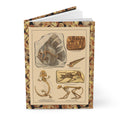
Stone Time: Friedrich Rolle, Schubert's Naturgeschichte, and the Chromolithograph Fossil Plates of 1886
A fossil is time made visible. Formed over millions of years by the slow replacement of organic material with mineral matter, it is a record of a living creature preserved in stone — a document of life as it existed before the world became the world we know. The great paleontologists of the nineteenth century understood this with a clarity that gave their work an almost philosophical dimension: to study fossils was not merely to collect curiosities but to read the history of life on Earth, to reconstruct the sequence of forms through which living creatures had passed on their way to the present. And the scientific illustrators who worked alongside them faced a particular challenge: how to represent, on a flat page, the three-dimensional complexity of a fossil specimen, the subtle textures of its surface, the precise geometry of its form.

Friedrich Rolle met this challenge with exceptional skill. His chromolithograph plates of fossil specimens, produced in 1886 for Schubert’s Naturgeschichte — one of the great German natural history encyclopaedias of the nineteenth century — are among the finest examples of paleontological illustration produced in the Victorian era. The plates show prehistoric shells, ammonites, and marine fossils of extraordinary variety and beauty, each one rendered with the precision of a scientific document and the chromatic richness that only the chromolithograph technique could achieve.
Friedrich Rolle and German Paleontology in the 1880s
Friedrich Rolle (1827–1887) was one of the most significant German paleontologists of the nineteenth century. A student of the great Swiss naturalist Louis Agassiz, he had devoted his career to the study of fossil invertebrates — the shells, corals, and marine organisms that formed the bulk of the fossil record — and had made important contributions to the understanding of evolutionary change in the geological record. His work was deeply influenced by Darwin’s On the Origin of Species (1859), which he had been among the first German scientists to engage with seriously, and his paleontological research was consistently framed within an evolutionary perspective.
By the 1880s, Rolle was at the height of his career, and his contribution to Schubert’s Naturgeschichte represented the culmination of decades of work on fossil invertebrates. The plates he produced for the publication were designed to serve both as scientific references and as educational illustrations — images that could be used by professional paleontologists and by students encountering the subject for the first time. They are, in this sense, exemplary works of scientific communication: images that do not sacrifice accuracy for accessibility, or beauty for precision.
Schubert’s Naturgeschichte and the German Natural History Tradition
The publication for which Rolle produced his fossil plates — Schubert’s Naturgeschichte — was one of the great encyclopaedic natural history works of the nineteenth century. Originally conceived by the German naturalist Gotthilf Heinrich von Schubert (1780–1860), the Naturgeschichte had grown, through successive editions and expansions, into a comprehensive survey of the natural world that covered mineralogy, geology, botany, zoology, and paleontology in exhaustive detail. By the 1880s, it had become a standard reference work in German-speaking scientific and educational circles, and its illustrated plates were among the most widely reproduced images in German natural history publishing.
The tradition of natural history encyclopaedism that Schubert’s work represented had deep roots in German intellectual culture. From the great natural history cabinets of the seventeenth century to the encyclopaedic ambitions of Alexander von Humboldt’s Kosmos, German naturalists had consistently sought to produce comprehensive accounts of the natural world that combined scientific rigour with literary and aesthetic quality. Schubert’s Naturgeschichte was part of this tradition — an attempt to make the full complexity of the natural world accessible to an educated general readership, through a combination of authoritative text and high-quality illustration.
The Chromolithograph and the Art of Fossil Illustration
The technique used to produce Rolle’s fossil plates — chromolithography — was the dominant colour printing technology of the second half of the nineteenth century. Developed in the 1830s and 1840s from the earlier technique of lithography, chromolithography used multiple stones or plates — one for each colour — to build up a full-colour image through successive printings. At its best, the technique could produce images of extraordinary chromatic richness and tonal subtlety, capable of reproducing the full range of colours found in natural specimens with a fidelity that earlier printing techniques could not approach.
For fossil illustration, chromolithography offered particular advantages. Fossils are objects of considerable visual complexity: their surfaces show the textures of the original organism, modified by the processes of fossilisation; their colours range from the warm ochres and browns of limestone matrix to the iridescent blues and greens of pyritised specimens; their forms combine the organic irregularity of living creatures with the geometric precision of crystalline replacement. To represent this complexity convincingly required a printing technique capable of subtle colour gradation and fine detail — requirements that chromolithography, at its best, could meet.
Rolle’s plates demonstrate the technique at its finest. The ammonites — the coiled cephalopod shells that are among the most beautiful and most commonly illustrated of all fossils — are shown with the characteristic ribbing and suture patterns that distinguish different species, rendered in colours that range from warm golden-brown to deep russet and grey. The bivalve shells are shown in both external and internal views, allowing the reader to understand their three-dimensional structure. The coral specimens are rendered with the delicate branching forms and surface textures that make them among the most visually striking of all fossil types.
Reading the Fossil Record: Ammonites, Shells, and Marine Life
The fossil specimens shown in Rolle’s plates represent a cross-section of the marine life of the Mesozoic era — the period of geological time, extending from approximately 252 to 66 million years ago, during which the ammonites and many of the other organisms shown in the plates flourished and eventually became extinct. The Mesozoic seas were dominated by invertebrate life of extraordinary variety: ammonites in hundreds of species, bivalves and gastropods of every form, corals and crinoids, belemnites and nautiloids — a world of marine diversity that the fossil record has preserved in remarkable detail.
The ammonites — which appear prominently in Rolle’s plates — are among the most important index fossils in geology: their rapid evolution and wide geographic distribution make them invaluable for dating and correlating rock strata across different regions. But they are also, quite simply, among the most beautiful objects in the fossil record. The mathematical precision of their spiral form — a logarithmic spiral that grows at a constant rate, producing a shell of perfect geometric regularity — combined with the organic complexity of their surface ornamentation, makes them objects of aesthetic fascination as well as scientific interest.
Rolle understood this dual nature of the fossil specimen — its simultaneous status as scientific evidence and aesthetic object — and his plates reflect this understanding. The specimens are arranged and rendered in ways that emphasise both their scientific information content and their visual beauty: the ammonites are shown at angles that reveal their characteristic suture patterns; the bivalves are arranged to show the range of forms within a single genus; the corals are rendered with the delicate detail that makes them immediately recognisable as living organisms preserved in stone.
Darwin, Evolution, and the Meaning of the Fossil Record
The fossil plates that Rolle produced in 1886 were not merely illustrations of interesting objects. They were, in the context of the post-Darwinian scientific culture of the 1880s, documents of evolutionary history — evidence for the sequence of forms through which life on Earth had passed on its way to the present. Darwin’s On the Origin of Species had been published in 1859, and by the 1880s the evolutionary framework it had proposed had been largely accepted by the scientific community, though debates about the mechanisms of evolution continued.
For paleontologists like Rolle, the fossil record was the primary evidence for evolutionary change: it was in the sequence of fossil forms, layer by layer through the geological column, that the history of life could be read. The ammonites and shells shown in his plates were not merely beautiful objects but witnesses to the history of life — organisms that had lived and died and been preserved in stone, waiting to be found and interpreted by the scientists of the nineteenth century.
This sense of the fossil as historical document — as evidence of a deep time that dwarfed human history — gave Victorian paleontology a particular intellectual excitement. To hold a fossil ammonite in your hand was to hold a creature that had lived 150 million years ago, in a sea that no longer existed, in a world that was almost unimaginably different from the present. Rolle’s plates capture something of this excitement: they are images that invite the viewer to think about time on a geological scale, to imagine the Mesozoic seas in which these creatures lived, to feel the weight of deep time that every fossil carries.
A Journal for Those Who Think in Deep Time

Our Friedrich Rolle Fossil Specimens Journal carries these 1886 chromolithograph plates across its full wraparound cover — the ammonites and shells and marine fossils rendered in their original chromatic richness, the specimens shown with the precision that Rolle’s plates demanded. It is a journal for those who find beauty in paleontological illustration, who understand that a fossil plate is also a portrait of deep time, who appreciate the Victorian tradition of natural history encyclopaedism that produced these images.
Inside, 150 perforated lined pages await your geology notes, fossil observations, field sketches, or whatever form your engagement with the history of life takes. The casewrap sewn binding opens completely flat — ideal for field use. The matte laminated cover preserves every detail of Rolle’s chromolithographs in a finish that rewards close examination.
Friedrich Rolle spent his career reading the history of life in stone. Perhaps the pages inside will help you record a little history of your own.
References & Further Reading
- Bowler, Peter J. Life’s Splendid Drama: Evolutionary Biology and the Reconstruction of Life’s Ancestry, 1860–1940. University of Chicago Press, 1996.
- Darwin, Charles. On the Origin of Species. John Murray, London, 1859. [The foundational text of evolutionary biology, which shaped Rolle’s paleontological work.]
- Gould, Stephen Jay. Wonderful Life: The Burgess Shale and the Nature of History. Norton, 1989. [On the meaning of the fossil record and the contingency of evolutionary history.]
- Rudwick, Martin J.S. The Meaning of Fossils: Episodes in the History of Palaeontology. Macdonald, 1972. [The standard history of paleontology as a discipline.]
- Rudwick, Martin J.S. Bursting the Limits of Time: The Reconstruction of Geohistory in the Age of Revolution. University of Chicago Press, 2005.
- Schubert, Gotthilf Heinrich von. Naturgeschichte. Multiple editions, 1820s–1880s. [Primary source; the encyclopaedic work for which Rolle produced his fossil plates.]
- Ward, Peter Douglas. In Search of Nautilus. Simon & Schuster, 1988. [On the living relatives of the ammonites and the science of cephalopod paleontology.]