Frederick McCoy's Prodromus of the Zoology of Victoria: The Giant Cuttlefish Documented
In the spring of 1885, the first fascicles of a new scientific work began to appear from the presses of the Government Printer in Melbourne: Prodromus of the Zoology of Victoria, or Figures and Descriptions of the Living Species of All Classes of the Victorian Indigenous Animals — a title that announced, with the confident ambition of Victorian science, the intention to document every living creature in the colony of Victoria, from the mammals and birds of the bush to the molluscs and echinoderms of the temperate southern seas. Its author was Frederick McCoy (1817–1899), Irish-born palaeontologist, founding director of the National Museum of Victoria, and professor of natural science at the University of Melbourne — a man who had spent four decades building one of the finest natural history collections in the southern hemisphere, and who now proposed to publish it for the world.

Frederick McCoy and the Natural History of Victoria
Frederick McCoy was born in Dublin in 1817 and trained as a palaeontologist under Adam Sedgwick at Cambridge, where he produced his landmark Synopsis of the Characters of the Carboniferous Limestone Fossils of Ireland (1844) and his Contributions to British Palaeontology (1854) — works that established him as one of the leading fossil specialists of his generation. In 1854, he was appointed to the newly created chair of natural science at the University of Melbourne, a position he would hold for the rest of his life, and as the founding director of what would become Museum Victoria — a role that gave him the resources and the institutional platform to pursue the most ambitious natural history project in Australian colonial history.
The Prodromus was the culmination of that ambition. Published in fascicles between 1885 and 1890, it covered the full range of Victorian fauna — vertebrates and invertebrates, marine and terrestrial — in a series of chromolithographic plates of extraordinary scientific precision and visual richness. The plates were executed by John James Wild (1824–1900), a Swiss-born scientific illustrator who had served as artist on the HMS Challenger expedition of 1872–1876 — the voyage that founded the science of oceanography — and whose experience documenting the deep-sea fauna of the world’s oceans made him uniquely qualified to render the marine life of southern Australia with the fidelity that McCoy’s scientific standards demanded.
The Mollusca Plates: Sepia apama
The malacology section of the Prodromus includes two plates of exceptional visual and scientific interest: Mollusca IV and Mollusca V, devoted to Sepia apama, the giant Australian cuttlefish, one of the largest and most biologically extraordinary cephalopods in the temperate waters of the southern hemisphere.
Sepia apama is not a fish. It is a cephalopod mollusc — a relative of the octopus and the squid — whose intelligence, camouflage ability, and complex social behaviour have made it one of the most studied marine invertebrates of the modern era. The giant Australian cuttlefish can reach sixty centimetres in length and weigh up to ten kilograms. It possesses eight arms and two feeding tentacles, a calcified internal shell — the cuttlebone — and a mantle covered in chromatophores: pigment-containing cells that allow it to change colour and pattern with a speed and precision that no other animal can match. It is, in the estimation of many marine biologists, the most visually sophisticated creature in the ocean.
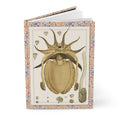
Mollusca IV — the plate that appears on the front cover of the journal — documents Sepia apama in its full external form: the eight arms and two feeding tentacles rendered with the meticulous precision of Wild’s chromolithographic technique, the distinctive fin fringe that runs the length of the mantle captured in its full anatomical detail, the chromatophore-rich skin documented with a fidelity that no photograph of the period could have achieved. The plate is both a scientific document and a work of art — a portrait of one of Australia’s most extraordinary marine creatures at the moment when Victorian science was first bringing it to the attention of the world.
Mollusca V — the back cover — extends the documentation into anatomical detail: internal structures, chromatophore distribution, and the biological systems that make Sepia apama one of the most sophisticated invertebrates in the temperate Australian seas. Together, the two plates wrap the journal in a complete scientific portrait of the giant cuttlefish — from external form to internal architecture — in the tradition of the great Victorian natural history atlases.
John James Wild and the Art of Scientific Illustration
John James Wild was one of the finest scientific illustrators of the Victorian era. Born in Switzerland in 1824, he trained as an artist before establishing himself as a specialist in natural history illustration — a field that, in the age before scientific photography, required the combination of artistic skill, scientific knowledge, and technical mastery that Wild possessed in exceptional measure.
His appointment as artist on the HMS Challenger expedition of 1872–1876 — the first voyage dedicated to the systematic study of the deep ocean — gave him the opportunity to document the fauna of the world’s seas at a moment when they were being revealed to science for the first time. The Challenger expedition discovered thousands of new species and founded the science of oceanography; Wild’s illustrations were the visual record of that discovery. His subsequent work for McCoy’s Prodromus brought the same standards of precision and artistry to the fauna of southern Australia — and the Mollusca plates of Sepia apama are among the finest examples of his mature work.
The chromolithographic technique that Wild employed for the Prodromus plates was the most advanced colour printing technology of the 1880s: a process that required the preparation of a separate lithographic stone for each colour, the precise registration of each impression, and the skill to build up the full chromatic range of the original illustration through successive printings. The result — in the hands of a master like Wild — was a colour reproduction of extraordinary fidelity, capable of capturing the subtle gradations of tone and the complex surface textures of a living cuttlefish with a precision that would not be surpassed until the age of colour photography.
The Legacy of the Prodromus
The Prodromus of the Zoology of Victoria was never completed. McCoy died in 1899, and the work — which had been intended to cover the full range of Victorian fauna — was left unfinished at his death, with many groups undocumented. What was published, however, remains one of the most important scientific works in Australian natural history: a monument to the ambition and the visual richness of Victorian colonial science, and a record of the fauna of southern Australia at a moment before the environmental changes of the twentieth century had begun to alter it.
The giant Australian cuttlefish, Sepia apama, remains one of the most extraordinary creatures in the temperate southern seas. Its annual aggregation at Point Lowly in Spencer Gulf, South Australia — where thousands of individuals gather to breed in the shallow waters of the gulf — is one of the great wildlife spectacles of the southern hemisphere, and one that McCoy and Wild could not have imagined when they documented the species in the 1880s. Their plates, however, remain the finest scientific portraits of the species from the Victorian era — documents of a moment when the natural sciences and the visual arts were still, in the hands of the great illustrators, the same conversation.
If McCoy’s vision of the natural world inspires you, our Cuttlefish Journal — Frederick McCoy 1885–1890 Mollusca IV & V brings his plates to the cover of a hardcover journal.
References
- McCoy, F. Prodromus of the Zoology of Victoria. Melbourne: Government Printer, 1885–1890.
- Darragh, T. A. & Mahoney, J. H. “The Geological Survey of Victoria under Alfred Selwyn, 1858–1868.” Historical Records of Australian Science 5(3), 1982.
- Stranks, T. R. “Frederick McCoy and the Natural History Collections of Museum Victoria.” Museum Victoria Science Reports 1, 1997.
- Norman, M. Cephalopods: A World Guide. ConchBooks, 2000.
- Herring, P. The Biology of the Deep Ocean. Oxford University Press, 2002.