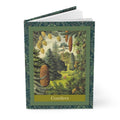
C.F. Tunnicliffe & the Forestry Commission: When British Wildlife Art Met the Forest
There is a particular kind of quiet that settles over a British forest in autumn — the light filtered through amber and gold, the creak of oak and beech, the soft carpet of needles underfoot. It is a quiet that Charles Frederick Tunnicliffe understood better than almost any artist of his generation. And when the Forestry Commission asked him to illustrate their landmark identification guides in the 1960s and 1970s, he brought that understanding to the page with the precision of a scientist and the warmth of someone who had spent a lifetime watching the natural world.

The result was two of the most beloved covers in British nature publishing: Know Your Conifers (Booklet No. 15, c. 1970–71) and Know Your Broadleaves (Booklet No. 20, 1968) — both written by Herbert L. Edlin, both illustrated by Tunnicliffe, and both destined to become the defining visual reference for a generation of British foresters, naturalists, and countryside walkers.
The Artist: C.F. Tunnicliffe (1901–1979)
Charles Frederick Tunnicliffe was born in Macclesfield, Cheshire, in 1901, the son of a farmer. He grew up surrounded by the animals and landscapes of the English countryside, and that intimacy with the natural world never left him. After studying at the Royal College of Art, he established himself as one of Britain's foremost wildlife illustrators — a reputation built on decades of meticulous observation, field sketching, and an extraordinary ability to render the texture of feather, bark, and leaf with equal conviction.
He is perhaps best known today for his work with Ladybird Books, whose nature series introduced millions of British children to the birds, trees, and wildflowers of their countryside. He also worked extensively with the Royal Society for the Protection of Birds, producing illustrations that combined scientific accuracy with a painter's sensitivity to light and atmosphere. By the time the Forestry Commission approached him, Tunnicliffe was at the height of his powers — and the forest was a subject he knew intimately.
The Guides: Herbert L. Edlin and the Forestry Commission Series
Herbert Leeson Edlin (1913–1976) was a forester, botanist, and prolific author who spent much of his career with the Forestry Commission, the government body established in 1919 to manage and expand Britain's woodland. His identification guides — practical, authoritative, and beautifully produced — became the standard reference for anyone who wanted to understand the trees of the British Isles.
Know Your Broadleaves, first published in 1968 as Booklet No. 20, was among the most successful of the series. Tunnicliffe's cover — an autumn scene of broadleaved trees in their seasonal transformation, golden and amber foliage against a soft sky — captured the essence of the British deciduous forest with a painterly atmosphere that no photograph could have matched. It remains one of the most recognised images in British nature publishing.
Know Your Conifers, Booklet No. 15 (c. 1970–71), took a different approach: Tunnicliffe's cover presents the defining features of common conifer species — their distinctive silhouettes, needle arrangements, and characteristic cones — with the clarity of a field guide and the beauty of a nature painting. Species such as the Douglas Fir are depicted with the scientific precision that made the Forestry Commission series the standard reference for a generation.
Two Covers, One Forest
What makes these two guides so compelling together is the completeness they offer. The British forest is not one thing — it is the dark geometry of a conifer plantation and the dappled light of an ancient oak wood; the sharp scent of pine resin and the earthy sweetness of autumn leaves; the year-round green of spruce and fir and the seasonal drama of beech and ash. Tunnicliffe understood this duality, and his two covers — one precise and botanical, one atmospheric and painterly — capture it perfectly.
Together, they form a complete portrait of the British forest across its two great tree families. And together, they appear on the Forest Journal from LeBonJournal — the front cover celebrating the conifers of Booklet No. 15, the back cover honouring the autumn broadleaves of Booklet No. 20.
A Legacy in Print
Tunnicliffe died in 1979, leaving behind a body of work that continues to define how the British see their natural world. His illustrations for Ladybird Books are now collector's items; his paintings of the birds of Anglesey, where he lived for the last decades of his life, are held in museum collections. But there is something particularly enduring about his work for the Forestry Commission — guides that were designed to be used in the field, carried into the forest, consulted under a canopy of branches.
That is the spirit the Forest Journal carries. Not a museum piece, but a working companion — something to take into the woods, to write in, to think with. A journal that reminds you, every time you open it, that knowing the names of trees is the first step to truly seeing the forest.