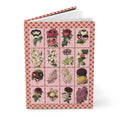
The Florist and Garden Miscellany 1849: James Andrews and the Art of Victorian Floriculture
In the spring of 1849, a London publisher issued the first number of The Florist and Garden Miscellany — a monthly horticultural journal that would become, over the following decades, one of the most visually ambitious publications of the Victorian age. Its mission was straightforward: to document the finest garden specimens of the era, to celebrate the achievements of British and European plant breeders, and to do so through illustrations of a quality that no previous horticultural publication had attempted. The man responsible for those illustrations was James Andrews, a botanical artist whose hand-coloured stone lithographs set a standard for chromatic richness and botanical precision that his contemporaries could only admire.

The Victorian Passion for Floriculture
To understand The Florist and Garden Miscellany, one must first understand the extraordinary place that flowers occupied in Victorian culture. The nineteenth century was the great age of floriculture — of competitive flower shows, of specialist nurseries, of plant hunters returning from the furthest corners of the empire with specimens that had never been seen in European gardens. The Bourbon rose, the hybrid perpetual, the camellia, the dahlia, the chrysanthemum: these were not merely garden plants but objects of intense horticultural ambition, bred and exhibited with the same competitive spirit that the Victorians brought to everything they touched.
The floricultural press was the medium through which this passion expressed itself in print. Publications like The Florist, The Gardeners' Chronicle, and The Garden provided their readers with cultivation advice, show reports, and — crucially — illustrations of the varieties that were winning prizes and setting new standards of beauty. It was into this world that The Florist and Garden Miscellany arrived in 1849, with a commitment to illustration that distinguished it from its rivals from the outset.
James Andrews and the Art of the Lithograph
James Andrews (1801–1876) was one of the most accomplished botanical illustrators of the Victorian period, a specialist in the hand-coloured stone lithograph who had developed, over decades of practice, a technique of extraordinary delicacy and chromatic fidelity. Where earlier botanical illustrators had worked primarily in engraving — a medium that required the intervention of a skilled engraver between the artist's original and the printed plate — lithography allowed Andrews to draw directly onto the stone, preserving the immediacy and expressiveness of his original work.
The hand-colouring that followed the printing was itself an art form. Each copy of The Florist and Garden Miscellany was coloured individually by a team of skilled colourists working from Andrews' original watercolours, applying layer upon layer of transparent washes to build up the luminous depth that distinguishes the finest Victorian botanical lithographs from mere reproductions. The result was a publication in which every plate was, in a meaningful sense, unique — a hand-made object that combined the reproducibility of print with the individuality of the painter's hand.
The Specimens: A Portrait of Victorian Floriculture
The range of specimens documented in The Florist and Garden Miscellany is itself a portrait of Victorian horticultural ambition. The roses — Bourbon roses like 'Baron J.B. Gonella', hybrid perpetuals in deep crimson and blush pink, tea roses of the most delicate colouring — reflect the extraordinary achievements of nineteenth-century rose breeders, who had transformed a genus of perhaps a hundred wild species into a cultivated flora of thousands of named varieties. The camellias, including the 'Duchess of Sutherland', document the passion for these glossy-leaved evergreens that swept through Victorian gardens in the middle decades of the century.
But the publication's ambitions extended far beyond the familiar flowers of the English garden. The Lycaste skinneri orchid — a Central American species of extraordinary beauty, with its large white and rose-pink flowers — represents the Victorian passion for orchid cultivation that would reach its peak in the 1870s and 1880s. The Embothrium coccineum, the Chilean Firebush, and the Swainsona formosa, Sturt's Desert Pea from Australia, document the global reach of Victorian botanical exploration, the network of plant hunters, colonial botanists, and commercial nurseries that brought the flora of the world to the gardens of Britain.
The Alpine Auricula — that most English of florists' flowers, with its powdered leaves and jewel-like blooms — appears alongside exotic dahlias, striped petunias, and the Bougainvillea speciosa, a reminder that Victorian floriculture was simultaneously deeply rooted in English tradition and insatiably curious about the wider world.
A Document of a Lost World
Many of the varieties documented in The Florist and Garden Miscellany no longer exist. The 'Chellaston Beauty' tulip, the 'Baron J.B. Gonella' Bourbon rose, the 'Duchess of Sutherland' camellia: these names survive in the pages of Victorian horticultural journals, but the plants themselves — the specific cultivars bred with such care and exhibited with such pride — have in many cases been lost to the passage of time, to the disruptions of two world wars, to the changing fashions of the garden. Andrews' lithographs are, for many of these varieties, the only visual record that survives.
This is what gives The Florist and Garden Miscellany its particular historical value — and its particular poignancy. It is not merely a beautiful publication but a document of a world that has largely disappeared: the world of the Victorian florist, with his specialist shows and his named varieties and his passionate commitment to the cultivation of beauty in a rapidly industrialising society.
The Garden Journal — Florist Garden Miscellany 1849 James Andrews brings both covers of this extraordinary publication to a hardcover journal designed for those who share the Victorian passion for the garden. Explore the journal →