The Gathering of Flowers: Florilegia, the Art of the Flower Book, and the Legacy of De Bry’s 1641 Florilegium Novum
The word florilegium comes from the Latin flos (flower) and legere (to gather). A gathering of flowers — but not flowers pressed between pages or dried in a herbarium. The flowers of the florilegium were gathered by the engraver’s needle and preserved in ink, colored by hand with pigments ground from minerals and plants, and bound between covers to be held, studied, and admired by collectors who understood that a flower’s beauty was worth preserving as carefully as any philosophical text or historical document.

The florilegium was one of the great inventions of the 17th century — a book form that emerged at the intersection of the scientific revolution, the explosion of horticultural enthusiasm that followed the arrival of exotic bulbs from the Ottoman Empire, and the extraordinary technical achievements of the Frankfurt and Antwerp printing houses. Johann Theodor de Bry’s 1641 Florilegium Novum is one of its finest examples.
The Origins of the Florilegium
The florilegium as a distinct book form emerged in the late 16th century, as the botanical garden — itself a new institution — began to generate a demand for visual records of the plants it cultivated. The great botanical gardens of Padua, Leiden, and Oxford were assembling collections of plants from across the known world, and the scholars and collectors who visited them wanted images they could take home: accurate, beautiful, portable records of the flowers they had seen.
The earliest florilegia were closely tied to the herbarium tradition — the systematic documentation of plants for medical and pharmaceutical purposes. But as the 17th century progressed, the florilegium increasingly separated itself from purely utilitarian concerns. The flowers it depicted were chosen for their beauty as much as their scientific interest, and the books themselves became objects of aesthetic pleasure as well as botanical reference.
The arrival of tulips, hyacinths, and other exotic bulbs from the Ottoman Empire in the late 16th century transformed European horticulture and gave the florilegium its most celebrated subjects. The tulip mania of the 1630s — the speculative bubble in which single tulip bulbs changed hands for the price of a house — was both a symptom and a cause of the extraordinary cultural investment in flowers that the florilegium both reflected and fed.
Johann Theodor de Bry and the Frankfurt Tradition
Johann Theodor de Bry (1561–1623) was the son of Theodor de Bry, the Flemish engraver and publisher who had established one of the most important printing houses in Frankfurt in the late 16th century. The de Bry family — Theodor, his sons Johann Theodor and Johann Israel, and their successors — produced some of the most significant illustrated books of the late Renaissance and early Baroque periods, including the monumental America series documenting European exploration of the New World.
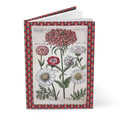
The Florilegium Novum was a different kind of project — more intimate, more purely aesthetic, more directly connected to the horticultural enthusiasms of the early 17th century. First published in 1611 and expanded in subsequent editions including the 1641 edition whose plates appear on this journal, it documented the flowers of the European garden with the same technical mastery that the de Bry family brought to all their work.
The plates of the Florilegium Novum were engraved with extraordinary precision — the fine lines of the burin capturing the texture of petals, the structure of stamens, the curve of leaves with a fidelity that botanical illustration had rarely achieved before. The hand-coloring that was applied to the finest copies added another layer of beauty: the warm reds of the Lychnis, the soft whites of the daisies, the checkered purple and white of the fritillary rendered in pigments that have survived nearly four centuries with remarkable freshness.
The Flowers of the 1641 Plates
The plates that appear on this journal document some of the most beloved flowers of the 17th-century European garden.
Lychnis — the wild catchfly — was a native European wildflower that had been cultivated in gardens since the medieval period. Its vivid red flowers made it a favorite of gardeners and artists alike, and it appears frequently in the florilegia of the period as a symbol of the beauty that could be found in the native flora as well as the exotic imports from the East.
The chrysanthemum documented by De Bry is the Cretan chrysanthemum (Chrysanthemum coronarium), a Mediterranean species that had been introduced to Northern European gardens in the 16th century. Its daisy-like flowers — white petals surrounding a yellow center — gave it the common name “oxeye daisy” in English, and it was prized both for its ornamental value and its medicinal properties.
The fritillary (Fritillaria meleagris) is perhaps the most distinctive flower in the 1641 plates. Its checkered pattern — purple and white squares arranged with an almost geometric precision — made it one of the most admired flowers of the 17th century, and its common name “snake’s head fritillary” reflects the sinuous elegance of its drooping bell-shaped blooms. The pansy (Viola tricolor), known in the 17th century as the “Trinity flower” for its three-colored petals, was equally beloved — a symbol of remembrance and contemplation that appears throughout the art and literature of the period.
The Florilegium Today
The great florilegia of the 17th century — De Bry’s Florilegium Novum, Basilius Besler’s Hortus Eystettensis, Pierre Vallet’s Le Jardin du Roy — survive today in the collections of the world’s great libraries and botanical institutions. Their plates have been reproduced countless times, but the originals retain a quality that reproduction cannot fully capture: the texture of the paper, the slight variations in the hand-applied color, the sense of a specific human hand guiding the burin across the copper plate.
What the florilegium preserves is not merely botanical information but a way of looking at flowers — with the combined attention of the scientist and the artist, the collector and the craftsman. It is a way of looking that the 17th century invented and that we have never entirely abandoned.

Our J.T. De Bry Daisies & Chrysanthemums Journal carries two plates from the 1641 Florilegium Novum — Lychnis, chrysanthemums, and daisies on the front; fritillaria and pansy on the back — the golden age of the flower book preserved in a journal you can carry every day.
References
- Lack, H. Walter. Garden Eden: Masterpieces of Botanical Illustration. Taschen, 2008.
- Pavord, Anna. The Tulip. Bloomsbury, 1999.
- Blunt, Wilfrid & William T. Stearn. The Art of Botanical Illustration. Antique Collectors’ Club, 1994.
- De Bry, Johann Theodor. Florilegium Novum. Frankfurt, 1611–1641.