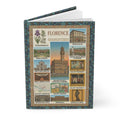
Florence Through a Vintage Lens: The Travel Poster Art of the Renaissance City
Florence has always inspired artists. From Botticelli painting the Birth of Venus in a Medici workshop to Brunelleschi solving the impossible geometry of the Duomo's dome, the city has a way of drawing out the best in those who encounter it. And the vintage travel poster tradition — that golden age of illustrated tourism that flourished from the 1920s through the 1960s — was no exception. When artists turned their attention to Florence, they found a subject almost too rich to contain: a city where every piazza, every church, every bridge tells a story that changed the course of Western civilisation.

The Florence Journal from LeBonJournal celebrates that tradition through two vintage-style illustrated poster covers — one a cultural collage of the city's artistic and intellectual treasures, the other a landmark tour of Florence's most iconic sites. Together they form a portrait of a city that has been inspiring travellers, scholars, and dreamers for six centuries.
The Front Cover: Florence's Cultural Collage
The front cover is a celebration of Florence as a city of ideas — a place where art, science, architecture, and politics converged in a way that had never happened before and has rarely been matched since. At its heart is the Uffizi Gallery, home to Botticelli's Birth of Venus and Primavera, two of the most recognisable paintings in the history of Western art. Nearby stands the Palazzo Vecchio, the medieval fortress-palace that served as the seat of Florentine power for centuries, and the Santa Croce Basilica, where Michelangelo, Galileo, and Machiavelli are buried — a pantheon of Renaissance genius beneath a single Gothic roof.
The collage also honours the Laurentian Library, commissioned by Pope Clement VII (a Medici) and designed by Michelangelo himself, whose collection of rare manuscripts made Florence one of the great centres of humanist learning. The Museo Galileo, the Boboli Gardens behind Pitti Palace, Piazzale Michelangelo with its panoramic views over the city, and Donatello's bronze David at the Bargello complete the picture — a Florence that is not just beautiful, but intellectually alive.
The Back Cover: Florence Adventure
The back cover takes a different approach: a landmark tour of the city's most iconic sites, rendered in the bold, celebratory style of mid-century travel posters. The magnificent Duomo — Santa Maria del Fiore, with Brunelleschi's revolutionary dome that changed the history of architecture — dominates the composition. Around it gather the Ponte Vecchio, the medieval bridge lined with jewellers' shops that has spanned the Arno since 1345; Michelangelo's David at the Accademia, the defining image of Renaissance humanism; and the Medici family's great palaces — Palazzo Medici Riccardi and Palazzo Pitti — along with the Medici Chapels, whose marble work by Michelangelo remains among the most extraordinary decorative achievements of the Renaissance.
San Miniato al Monte, the Romanesque church perched above the city with its panoramic views, and the Ospedale degli Innocenti — Brunelleschi's masterpiece of early Renaissance architecture and one of the first purpose-built orphanages in Europe — complete the tour. Tuscan flora, local transportation, and travel memorabilia fill the spaces between, giving the cover the layered richness of a city that rewards every return visit.
The Medici Legacy
No account of Florence is complete without the Medici — the banking family who became the city's de facto rulers and, in doing so, became the greatest patrons of art and learning in European history. It was Cosimo de' Medici who commissioned Donatello's David, the first freestanding nude sculpture since antiquity. It was Lorenzo the Magnificent who supported the young Michelangelo, recognising his genius before the world did. It was the Medici who funded the Platonic Academy, who collected the manuscripts that filled the Laurentian Library, who built the palaces and chapels and gardens that still define the Florentine skyline.
The vintage poster tradition captures this legacy with a lightness of touch that academic history sometimes lacks — a celebration rather than a catalogue, an invitation rather than a lecture. That is the spirit the Florence Journal carries.
A City Worth Writing In
There is a long tradition of writers keeping journals in Florence. Henry James wrote about it. E.M. Forster set a novel there. Mary McCarthy devoted a book to it. Something about the city — its density of beauty, its layered history, its particular quality of light — makes people want to record what they see and feel and think.
The Florence Journal is designed for exactly that impulse. 150 lined pages, a binding that lays flat, paper that takes fountain pen and pencil with equal grace. A cover that reminds you, every time you pick it up, that you are carrying something of the city with you — its art, its history, its enduring invitation to look more carefully at the world.