The Art of Walking: Flânerie, the Travel Journal, and the Slow Rhythm of Paris
There is a word in French that has no precise equivalent in English, and that fact alone tells you something important about Paris. The word is flânerie — the practice of the flâneur, the urban stroller who walks without destination, observes without purpose, and finds in the city an inexhaustible source of interest, beauty, and reflection. The flâneur is not a tourist. The tourist has an itinerary, a list of monuments to visit, a limited time in which to see everything. The flâneur has none of these things. The flâneur has only time, attention, and a willingness to be surprised.
Paris invented the flâneur, or at least gave the figure its name and its mythology. The city's particular combination of grand boulevards and intimate side streets, of formal gardens and hidden courtyards, of famous monuments and forgotten corners, makes it uniquely suited to the practice of purposeless walking. You can spend an afternoon in Paris moving from the Jardin du Luxembourg to the flower markets of the Madeleine to the terraces of Montmartre without any plan at all, and at the end of the afternoon you will have seen more, and thought more, than any itinerary could have produced.
Baudelaire and the Painter of Modern Life
The flâneur as a cultural figure was defined by Charles Baudelaire in his 1863 essay Le Peintre de la vie moderne — The Painter of Modern Life. Baudelaire's flâneur is an artist and an observer, a man who makes his home in the crowd and finds in the spectacle of city life the raw material of art. He is, Baudelaire writes, “away from home and yet feels everywhere at home; who sees the world, who is at the centre of the world, and yet remains hidden from the world.” The flâneur is simultaneously present and invisible, engaged and detached, a participant in city life who is also always its observer.
Baudelaire's essay was ostensibly about the illustrator Constantin Guys, but its real subject was the experience of modernity itself — the experience of living in a city that was changing faster than any city had ever changed before, under the radical transformation of Haussmann's grands travaux. The Paris that Baudelaire walked was a city in the process of becoming the Paris we know today: the wide boulevards replacing the medieval streets, the new parks and gardens opening, the arcades and department stores creating new forms of urban sociability. The flâneur was the figure who could navigate this transformation with equanimity, finding beauty and meaning in the new city without losing the memory of the old.
Walter Benjamin and the Arcades
The great twentieth-century theorist of flânerie was Walter Benjamin, whose unfinished masterwork Das Passagen-Werk — The Arcades Project — was a vast meditation on the covered shopping arcades of nineteenth-century Paris and the culture they had produced. Benjamin spent the last decade of his life in the Bibliothèque nationale, reading about Paris, walking through Paris, and assembling the thousands of quotations, observations, and reflections that make up the Arcades Project. It is, among other things, the greatest work of flânerie ever produced: a book that is itself a kind of walk through the city, moving from one observation to another without a fixed destination, finding connections and meanings in the most unexpected places.
For Benjamin, the arcades — those glass-roofed passages that connected the streets of central Paris and housed shops, cafés, and entertainments — were the emblematic spaces of nineteenth-century modernity. They were spaces of display and desire, of commodity and dream, where the new consumer culture of industrial capitalism presented itself in its most seductive form. But they were also spaces of flânerie: sheltered from the rain, lit by gaslight, lined with the curiosities of the modern world, they were the perfect environment for the urban stroller who wanted to observe without being observed, to move through the city without committing to any particular destination.
The Travel Journal and the Art of Attention
The flâneur and the travel journal have always been natural companions. The practice of flânerie — of walking without destination, of observing without purpose — produces exactly the kind of material that a journal is designed to hold: impressions, observations, fragments, the small details of city life that would otherwise be lost. The flâneur who carries a journal is not a tourist recording the monuments they have visited; they are a writer collecting the raw material of a city, the texture of its streets and its people and its light at different times of day.
The great tradition of Parisian travel writing — from Stendhal's Rome, Naples et Florence to Henry James's A Little Tour in France to Hemingway's A Moveable Feast — is a tradition of attentive walking and careful writing. These writers did not visit Paris; they inhabited it, at least temporarily, and their journals and notebooks were the instruments of that inhabitation. The journal was not a record of what they had seen but a tool for seeing more clearly — a way of slowing down the experience of the city, of forcing themselves to find the words for what they had observed, and in finding the words, of understanding what they had seen.
The Slow Rhythm of Paris
Paris rewards slowness. The city's great monuments — the Eiffel Tower, Notre-Dame, Sacré-Cœur, the Arc de Triomphe — are best seen not as destinations but as landmarks encountered in the course of a walk, appearing suddenly at the end of a street or rising above the rooftops of a neighbourhood. The Jardin du Luxembourg is not a sight to be ticked off a list but a place to sit for an hour, watching the children sail their boats on the fountain and the old men play pétanque in the shade of the chestnut trees. The flower markets of the Madeleine are not a tourist attraction but a sensory experience — the smell of roses and lilies and fresh-cut stems, the colours of the seasonal flowers, the particular quality of Parisian light on a spring morning.
This is the Paris that the flâneur knows, and that the travel journal can capture: not the Paris of the guidebook but the Paris of the slow afternoon, the unexpected encounter, the detail noticed and recorded before it disappears. It is a Paris that has always existed alongside the famous one, and that is, in many ways, more real — more intimate, more personal, more enduringly beautiful.

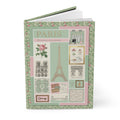
Our Paris Journal is designed for exactly this kind of writing — a companion for the flâneur who wants to carry Paris with them, in the form of Redouté roses and vintage postcards, Sacré-Cœur and the Tuileries Gardens, layered together in a shabby chic collage that celebrates the city as it has always been: intimate, romantic, and endlessly beautiful.
References
Baudelaire, C. (1863). Le Peintre de la vie moderne. Le Figaro.
Benjamin, W. (1999). The Arcades Project. Trans. Howard Eiland & Kevin McLaughlin. Harvard University Press.
Hemingway, E. (1964). A Moveable Feast. Scribner.
Tester, K. (ed.) (1994). The Flâneur. Routledge.
White, E. (2001). The Flaneur: A Stroll through the Paradoxes of Paris. Bloomsbury.